Absence, presence, and power of Women in chess
By Sergio Ernesto Negri

«Because the past still controls how we think, how we behave,
through stories that people invented centuries ago or tens of thousands of
years ago. We don’t have to get rid of them all, but we have to understand
that they are just stories invented for people, not the laws of nature or
absolute truth. So some stories are good and it’s good to keep them but many
of the stories people made up in the past ─and still It shapes our behavior─
are harmful«
Yuval Noah Harari, Israeli historian, and writer. (Site interview
Argentine Friends of the Hebrew University of Jerusalem
(https://huji.org.ar/), October 20, 2022).
Opening words
The participation of women in chess, from the perspective of today, has as a hindrance in previous times, even well into the twentieth century in which, because of the predominance of males in this field, they were seen, at best the cases, with some indifference. It is that their presence in international tournaments of the shaft and chess circles themselves was little less than marginal.
But, it hadn’t always been this way. In fact, there is no underlying reason for letting that be so. Moreover, in the Middle Ages, in which the game made its appearance being a prototypical activity in the European courts, women practiced it with fruition as a hobby, constituting chess, also, an appropriate space pious for socialization and interrelation between people of both sexes.
In the Modern Age, we will see, instead, the phenomenon of its growing marginalization, which will only begin to be reversed from the end of the nineteenth century, very shyly first, with more substance since the twentieth and today, as relevant.
However, the horizon of equity is far from being reached. On the other hand, with the strengthening of a look that places the accent on genres, with new variants of sexuality, perhaps we are entering a scenario of greater complexity, where the problem of women in their link with chess ceases to be a matter per se or at least the only one to which special attention should be paid, given the dilution of traditional binary schemes within the framework of the fluidity of Genders.
In any case, in this work, we will try to make some history on this question, although, for reasons of extension, we will only provide some keys for a more comprehensive analysis. Following the words of Yuval Noah Harari in the epigraph, although some history is done here, we admit that we will enter the field of invention. And, following his advice, we will try not to harm. On the contrary, we believe that, by choosing this topic, we enter fully into the plane of recognition of the female role in chess, given that there is no ─so we think─ any impediment for women to be part of the chess universe in identical conditions that happened in terms of males.
Female presence in chess legends
Chess was born by evolution from previous versions of various games that emerged in the East, which surely happened at some point on the Silk Road in an indeterminate time. The exact moment of its origin is inevitably darkened in the fog of time, so legends about his invention. And, in some of them, there is a female presence.
Indeed, turning to the figure of the Mater Dolorosa, it imagined an Indian queen very sorry for the death of one of her sons in a confrontation with his brother. She was offered chess to represent the battle thinking that, of that, she would discover that there was no fratricide and find due consolation. (1)
In the account of the origin of Burmese chess, the English historian Harold James Ruthven Murray (1868-1955) indicates that it would have been invented by an ancient queen to entertain her husband, the king, to keep him at his best and push him away wisely from the dangers of real wars. Again, the woman is very present. In that story, as a sufferer; now, as protective.
The Scottish linguist Duncan Forbes (1798-1868) mentions two powerful Eastern queens that may have been paradigms for the later appearance of the respective piece: Semiramis, who according to the myth was sovereign of Assyria (in times as contradictory and distant as the twenty-first and ninth centuries BC) and Zenobia of Palmyra (third century BC).
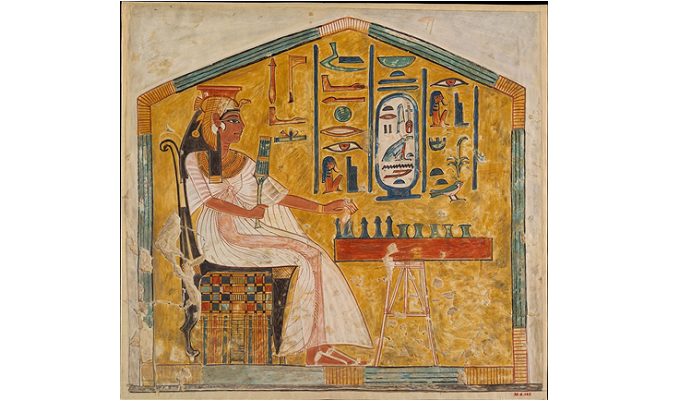
When you try to delve into the past trying to discover other links of Chess with female figures, usually appeals to a suggestive image as a protagonist to the Egyptian queen Nefertari (thirteenth century BC), «Great royal wife» of Pharaoh Ramses II, in which she is seen practicing a board game that includes figures with figurine shapes. This is the antecedent senet to some extent of all the later board games, which possessed a great metaphysical sense to be associated with the eschatological transit.

Figure 1.
Nefertari playing senet.
Tomb of Nefertari in the Valley of the Queens, Luxor, Egypt, south wall.
(Source: http://amigosdelantiguoegipto.com/)
Another fictional account indicates that Empress Irene of Byzantium or Athens (752- 803) gave a set to Charlemagne (c. 742-814), which included a piece of the Queen with extended mobility. The Frankish emperor, frightened by this, did not accept to marry her and unite the Empires of the West and the East.
In another fact, in this true case, which had the empress as the protagonist, notes in a letter addressed to Caliph Harun al-Raschid Ibn Mahdi (765-809) by Nikephoros I (765- 811), Irene’s successor on the throne, who tells her: «The empress, whose place I have occupied, regarded you as a tower and herself as a simple pawn, so he submitted to pay you a double tribute than she should have to have taken out of you.»
In the classic story about the beautiful princess Dilaram, attributed to the Arab chess player al-Lajlaj (900-970), there is talk of the favorite of a vizier who witnesses a game of shatranj (an ancient version of chess), in which her husband had decided, as it was usual in those times, bet it in case of defeat. Realizing the danger her beloved was in the game, she recommends him as a sign of help: «Sacrifice your two towers, and not me«, a game sequence with which the compulsive gambler is imposed who, in this way, preserved the dignity of triumph and his favorite. (2)

Figure 2.
Recreation of the legend of Dilaram, work of the Russian artist Ludmila Gavrilova.
(Source: https://artgavrilova.ru/)
Ascribe to this legendary taxonomy on the wise female counsel the case of Queen Isabella I of Castile, «the Catholic», (1451-1504) who indicates to King Ferdinand V of Castile and II of Aragon (1452-1516) how to elegantly defeat Admiral Fonseca in a game. The sovereign earned, then, the favor of the monarch, who ends up accepting another piece of advice, one that set his country on a sailing course to the west, to supposedly reach the Indies. Thus, thanks to chess and the Queen, America will be discovered. (3)
Women like goddesses, devils, and in Marian worship
The Greek philosopher Pythagoras (571-495 BC) is said to have stated: «There is a good principle that has created order, light, and man, and an evil principle that has created chaos, darkness, and woman.» With the Greek influence in Western culture, these kinds of concepts, which associated sin, the diabolical, and the forbidden with the female figure would exert a further important influence.
Therefore, it should not be surprising that, when formulated in modern times (4) a legend that had as its center the great chess player Paolo Boi (1528-1598), who is presented on the flank of a church in Calabria one morning in the year 1570 facing the devil himself, this was recreated with feminine clothes. (5)

Figure 3.
Paolo Boi vs. the devil (women’s dress).
Drawing by V. Barthe, 1936, Les Cahiers de l’echiquier français.
(Source: https://fr.wikipedia.org/)
On the end of the Middle Ages appears Le jeu des ésches de la dame moralisé, of uncertain author, work in whichshows a lady playing chess against the devil. His soul is bet over and over again, play after play. The devil, for his part, is responsible for tempting her at every opportunity, looking for him to fall into sin. Virtue vs. vice: humanity’s eternal dilemma.
If the woman could be the devil, she could also acquire the category of a goddess, a condition in which it will fortunately endure. To the English philologist William Jones (1746-1794), we owe a remarkable poem entitled Caissa, written in Latin, inspired by the Scacchia ludus, verses by the Italian Marco Girolamo Vida (1485-1566), where a nymph of that name is presented (in the original language, Kaissa (6)) which is courted by the Greek god of war, Ares. As the lady in principle rejects it, the heartthrob seeks the help of the god of sport, Hermes, who creates chess for the purpose that it be given to the pretended to win her favors. She is to be anointed as a chess goddess. (7)

Figure 4.
Caissa, in painting, is attributed to Domenico Maria Fratta (1696–1763).
(Source: https://commons.wikimedia.org/)
Within the line of the Mater Dolorosa to which we already referred, it could add the medieval predicament of the spread of Marian worship and how it was linked to chess. The French monk Gautier de Coincy (1177-1236) presented his poem Miracles de Notre Dame («Miracles of Our Lady«) in which the struggle of Good and Evil in chess key and, in that context, who strikes the checkmate is a piece of the queen represented by the Virgin Mary, the Queen of Heaven
In the same tune is inscribed the poem De vetula («The old lady«), which was at a time attributed to Ovid (poet contemporary to Christ), but which is owed to the French philosopher and troubadour Richard de Fournival (1201-1260) in which, when explaining the movement of the chess pieces to the queen, to whom in principle very chastely it is called Virgo, it is presented by moving obliquely and it is the associated with the planet Venus. It is branded as pleasant, loving, nothing virgin by the way, and a little proud. (8)
Chess, in these pristine visions, evidences the theological conception of redemption, Mary herself, who can bring about salvation to humans. A woman, saint o goddess, so linked to chess. And very far from the Diabolical image of who played it so well to the point of having been able to beat the legendary Boi.
A WOMAN WITH A WIDE PRESENCE AND GROWING POWER IN A CHECKERED MIDDLE AGE
A Middle Ages of checkered and feminine tone Versus de Scachis («Chess Verses«) is a Latin poem from the late tenth century where for the first time the piece of the queen (Regina) is mentioned, in perfect harmony with the appearance of female figures with power in the European courts.
Arises in the heart of the German Roman Empire being the wives of emperors Otto I and II, Adelaide of Italy (931-999), and the Byzantine Theophanus Skleraina (c. 955-991), not only the protectors of the monastery of Einsiedeln, where they were produced and up to date of today the respective manuscripts are preserved but, as the historian Marilyn Yalom assures, probably, the muses that inspired the appearance of a piece with a woman’s face.
Piece that came to replace in any case that of the vizier, the counselor of the Eastern sovereigns, (9) which gave rise to a more understandable phenomenon in Europe where, in addition to the powerful king, in the courts, there were queens often also powerful, either by regency, by the absence of the consorts, or by their weight. And the Chess had to know how to reflect this scheme of power.
It is very likely that the remarkable Eleanor of Aquitaine (1122-1204), queen successively of France and England and protector of culture, played chess; and also that, long before, Queen Toda Aznárez of Pamplona (885-970), led the game to its region from neighboring territories dominated by the Arabs.
Chess became, then, one of the favorite pastimes in the courts, where women practiced it without any kind of discrimination and with enthusiasm. They played with each other, in family situations or, even, as an excuse for an exchange with men that would bear fruit or make possible love situations. The long games (chess was very slow in those early days) perfectly allowed a climate of greater intimacy.
The minstrels will sing to love, to the couple, to the woman, and to chess. The portraits are forceful in terms of people of both sexes disputing the game in the courts, as in the precious book (10) of Alfonso X of Castile, «the Wise» (1221-1284), or in the German Codex Manesse of the 14th century. (11)
The stories of chivalry included situations in which the lover rescued his beloved imprisoned in a fortress gaining the trust of the keeper playing chess and, when both were detected, defending themselves with the pieces and the board in the form of projectiles and shields (12). The Byzantine Anna Komnenos (1083-1153) and the poet Mary of France (1145-1198), will be the first women writers in mentioning chess in literary works, historical in the first case, and fiction in the second.
Already in the form of a parable, a lady is seen being lost after a game disputed by a knight against fortune, for the drama of the situation and grief of the lover, in the so and all beautiful The Book of the Duchess that is owed to the father of English literature, Geoffrey Chaucer (c. 1343-1400), in a clear synecdoche of the woman with the queen’s piece. (13)
Giovanni Boccaccio (1313-1375) will show in his Decameron young men and women playing chess in their retreat outside Florence, escaping the plague and having fun, in an erotic context in which the game is part of the amusements. Also, the character of the narrator Scheherezade of The Thousand and One Nights of the Eastern world will mention in several of his Chess stories.
In probably the greatest literary success of the time, if the Bible is excluded, Jacopo da Cessole’s Ludus Scacchorum («Game of Chess«) (14) (1250-1322), where the sermons of the friar that operated as a parable of social behaviors are recorded, the use of chess as a scheme is appreciated conceptual that represented society. There are abundant precisions techniques in the game. To the queen’s piece, a specific chapter is dedicatedas proof of its overwhelming inclusion. (15)

Figure 5.
Image of the Queen and King, Ludus Scacchorum, by Jacopo da Cessole.
In: The Book of Chess by Jacob de Cessolis (2008), New York: Italica Press.
(Source: https://ajedrezlatitudsur.wordpress.com/)
But the queen’s piece was also increasingly contemplated in other geographies. In France, as we have already seen, linking it to Marian worship. And in England too, in texts such as De Rerum Naturis («Of the Nature of Things«) by Alexander Neckam (1157-1217), (16) a philosophical treatise of moral tone15, where no ethical dilemma about the possibility of bigamy or polygamy (17) will no longer be raised16 (for the crowning of pawns), or transsexualization (the converted male pawn in the female queen). Dilemma, which was solved by giving another name to the crowned pawn: ferzia, closely related phonetically to the oriental farzin and firzan with those who were called in Eastern culture to the vizier. (18)
To Spain, perhaps due to the influence of the Muslim culture whose power fell in the Peninsula only in the fifteenth century, as in its chess the female piece was still without exist, we see that the evolution of vizier in queen occurred prior to the acceptance of the still male “alferza” (chief of the royal standards) and that, when the queen appeared in coinciding with the expulsion of the invader, in a cultural process very correlated from the temporal with the figure of Isabella the Catholic, it will be quickly endowed with the expanded movement, as in the anonymous Valencian poem that is usually dating in 1475 (although it could be later) Scachs d’amor, most likely in the lost text in that language by Francesch Vincent (1450-1512) (19) of 1495, with all certainty in the book of Lucena (20) of 1497 published in Salamanca (21) and, in the same tune, with the text of Luca Pacioli (1445-1517) which includes images very possibly due to the genius of Leonardo da Vinci (1452-1519), and with the De Ludo Scachorum who appears in Italy, at a somewhat imprecise time at the end of the fifteenth century.
In all of them, exclusively or even registering items under the scheme previously with the queen and also the bishop, and without the expanded moves that they will now be uniformly recognized; there will be the beginning of the modern stage of chess, of its dynamism, its universalization; in short, the game that today shelters and excites us.
And queens begin to appear in the designs of the game sets, existing very early findings since the beginning of the second millennium, in particular, in Norse tradition, including England dominated by William the Conqueror, but also in expressions that come from Italy, France, and Germany; but no thus in a Spain that still did not recognize it. The greatest expression, which of course is far from being the only one, they are the beautiful pieces of Lewis found in the west of Scotland, on the island of the same name; they correspond to the twelfth century when queens are presented with all clearly and with a suggestive grimace of astonishment on their faces.

Figure 6.
Piece of the queen in the games found on the Isle of Lewis (Scotland, United Kingdom).
British Museum.
(Source: https://www.britishmuseum.org/)
It is no coincidence that renewed dynamism that would acquire a game that was entering a state of stagnation due to its extreme slowness and its lack of adaptation to the world of new ideas that were beginning to occur in search of modernity, it was due to a woman, to the piece of the queen (or the lady, as she will be known), preferably in Latin countries), in its empowered form. The woman, the one who had been absent in the Eastern versions, appeared finally in the West.
It is a piece with a woman’s face that allowed a better reflection of medieval society and that made the association of play with metaphor more feasible literary and artistic. A piece that would be noticed, with its power of seduction, revolution, aggression, and protection, earning a space that will be definitive.
Modern paradox: presence on the board and social absence
Already in the Renaissance, a time in which a greater individualism is bet, the woman will be somewhat more recognized, always focusing on what was happening in the Western world, now integrating America, giving special weight to the prototypical qualities of purity and honesty. However, his performance continued to concentrateon the intimate sphere without having access to wider social spaces and without thefull exercise of the rights fully exercised by men.
In successive times, nation-states would be created and the diffusion of the values of capitalism centered on work and production, within the framework of Pre-industrial and industrial processes in the context of an accumulation model.
The male, in this situation, as a labor force, will have a leading role (as before knights and warriors and, anciently, hunters and gatherers) while the woman will still be in the background.
Some ladies may carve, rather towards the seventeenth century, in the halls of palaces, showing off their cultural knowledge and, sometimes, for their qualification for political or courtly intrigues, which they could become fond of enjoying more leisure time than those. Some, of course, as before, will be able to become prominent queens and be fond of chess, such as Mary Stuart, queen of Scotland (1542-1587), and Elizabeth I of England (1533-1603); giving a special case of relevance at the end of the Modern Age with Catherine II, «the Great», in Russia imperial, coinciding with the popularization in that territory of the acceptance of the Queen’s piece replacing the old vizier.
In 1575, in the vicinity of Madrid, the first international tournament took place in which women would not be appreciated. Nor will they stand out in a game that, from now on, was ceasing to be strictly social to be part of the space of the skills and of the travelers who practiced it to serve them as sustenance, as in the case of the Italian Il Greco in the seventeenth century. Women remained in their homes, so they did not enter the growing competitive circuits, and Chess continued to be only part of their intimacy.
And here we see the center of the paradox of this time. If the Middle Ages were far from marginalizing them, the Modern Age removes them from the stage. And if it was necessary to wait well into the Middle Ages for a piece of a female face to enter the universe of sixty-four squares, and virtually at its completion for this piece to be empowered, the same did not happen in a Modern Age who seemed to forget them.
At most, they will be linked to expressions of culture, for example in painting, with the Renaissance Sofonisba Anguissola (1535-1625), who will portray her sisters playing chess. Or in written stories such as, for example, The Way of Perfection by Saint Teresa of Avila or Jesus (1515-1582), The Tempest by William Shakespeare (c. 1564-1616) (22), or in Women beware women of another great English playwright of thattime, Thomas Middleton (1580-1627), and in some of the so many works by a Lope de Vega (1562-1635) turned into a “Chess Phoenix” that It certainly included women inthose contexts.

Figure 7.
Lucia, Minerva, and Europe Anguissola playing chess, 1555, Sofonisba Anguissola.
National Museum, Poznan, Poland.
(Source: https://www.arthistoryproject.com/)
The woman will shine in her capacity as the queen’s piece within the board. Its expanded mobility, however, will arouse suspicion and revolutionize chess that will be able to be called «alla rabiosa» in Italy or «de la dame enragée» in France, denoting its angry character (perhaps not being properly understood in their desires to be noticed).
With all her worth, unlike the irreplaceable king, the queen can be captured, which was now quite possible; since, given her aggressiveness, she left «home» (with too much?) frequently and in the very usual circumstance that it could be slaughtered of the great English playwright for the player to obtain a higher objective (that of winning the game), so that she could disappear from the game, that she was doomed to continue perhaps missing her or, more crudely, thanking him for the services rendered, those that made possible the continuity of the game.
On the other hand, as a person, outside the board, the woman will be confined to home environments, being excluded from competitive practice and social spaces, in particular, the cafes in which chess will be practiced, areas exclusively manly men that will appear in the main European cities from the end of the XVII century.
The Middle Ages, always reputed for its apparent obscurantism, had been much more beneficent to a woman than, in those other times, unlike what had been the case.
It happened now, he had shared the chess spaces with the men on an absolute level of equality. And this separation from women will have consequences, since it will consolidate a situation of marginalization that will permeate the culture for a long time, too long…
Women find their place in the Contemporary Age
In the context of the French Revolution, Montesquieu (1689-1755) came to consider that women had constituted themselves in «a new State within the State«. His colleague Voltaire (1694-1778) dared to denounce the injustice of their luck. The state of awareness about the role of women may be changing.
However, she was denied the right to vote that was being imposed as a Model in nascent democracies. In France, where women were reaching further than in other states, however, it will still be said «the husband rules, the wife administers and the children obey». At least, they were granted a role somewhat more committed than before.
With the advent of the Contemporary Age, the equality proclaimed in so many orders, even as one of the three revolutionary principles, was not It prevents women from continuing to be relegated at other levels, including chess.
Chess players continue to compete in the international sphere, although always without a female presence. And the cafes, where he shared, philosophized, politics was done and chess was played were entirely masculine cenacles, as in the famous Café de la Régence in Paris and any other in the main cities of European.
At most, it could see Claire Élisabeth Jeanne Gravier de Vergennes, Madame De Rémusat (1780-1821) playing against Napoleon, one of his cultists. However, at the same time, she will appear nude in a painting of the time, which communicates from the symbolic point of view that what was really about was satisfying the wishes of the emperor.

Figure 8.
Painting of 1805, a chess game that pitted Napoleon Bonaparte against a chess
player…naked.
(Source: http://deludoscachorum.blogspot.com/)
On the other side of the Atlantic, we have Ellen E. Strong Gilbert in the USA (1837- 1900) who, with her husband, in the city of Hartford, capital of the state of Connecticut, founded 1860 a chess club called Queen’s Chess Club, so that the lady will receive a nickname that will become a classic: «The queen of the chess.»
Years before, Benjamin Franklin (1706-1790) conducted diplomatic dialogues not exempt from espionage on both sides of the English Channel, where he won the trust of the residences of local politicians, and between departures he obtained information, including that provided by the occasional woman, to whom he could also enamor.
In the cultural field, since not in the sports that began to be insinuated, in particular since the appearance of François-André Danican, «the great Philidor«, considered the best player of the eighteenth century, who marked a scenario that was would deepen in the future times, the woman could be present in the context Chess. Undoubtedly, the greatest finding is that of the English writer Lewis Carroll (1832-1898) who, in Through the Looking Glass and What Alice Found There, would show his favorite girl in the role of piece in a game that takes place on a board gigantic to which he accesses once he dares to cross the boundary of the mirror, where she will enter an alternate reality.
A splendid woman of the nineteenth century, Cristina Trivulzio Belgiojoso (1808-1871), known in France as Christine de Belgiojoso, an important patriotic figure of the Risorgimiento italiano, in addition to writer and journalist, would be honored by the French writer Joseph Méry (1797-1866), who dedicated a poem to her in 1836 called Une revanche de Waterloo ou Une partie d’échecs («A revenge of Waterloo or A game of chess«). Méry has great merit, since, next to the great player Louis-Charles Mahé de la Bourdonnais (1795-1840), founded the first monthly magazine specializing in chess, the mythical Le Palamède, which appeared in Paris in 1836 at the impulse of the players who frequented the no less mythical Café de la Régence.
In the poem in question, the axis of the story is taken as the meeting that de la Bourdonnais himself starred with the Irishman Alexander McDonnell (1798-1835) and, if in the battle the one who lost had been Napoleon, now in this other fight over the board, a Frenchman would claim the honor of his people. What is relevant to the effects that we are analyzing in this work is that a literary work linked to chess was to be dedicated to a remarkable woman of her time.
The Irish poet William Butler Yeats (1865-1939), meanwhile, in Time and the Witch Vivien, published in 1889, runs about the death of a woman that happens after losing in a game of chess against The «Father Time».
However, what has been said for the Modern Age remains and will continue to be valid with little difference of nuances for the Contemporary. With the values that now refer to the claimed (with the Enlightenment) masculinity and the self-emotion attributed to femininity, given that chess is perfecting its practice and acquiring airs of scientism linked to the intellect, and see that increasingly, gambling was no longer just a hobby indoors, but an activity that could be done outside of intimacy, a woman too confined to the home and bound to the dictates of the heart, she would thus continue to model an exile as demanding as exciting, while chess was enriched in space public where he was already perfecting himself in competitive circles.
Its competitive entry in the nineteenth and early twentieth centuries only with the machinery that, by not demanding greater force, prevents the man from prevailing naturally, will the woman go out to work in the factory and, with this, access new spaces of the social world and begin a journey that It will progressively occupy territories that were alien to it.
Now, in any case, the release will be demanding in labor terms, and no longer strictly the female roles determined above; and in this new performance, she will now be more exploited than the male in the exercise of the productive task. She will work the same as men, but he will never earn the same. Are times in which the ideology of Karl Marx (1818-1883) and Friedrich Engels emerges (1820-1895): more than a struggle of the sexes, women now became part of a class struggle. However, and not without cynicism, it began to assert: «The woman works better and cheaper.» Paradoxes of this kind of modernism: work, on one part, allows the woman to free herself from the yoke of home; but, on the other, it confronts it with another situation of greater slavery: that of the workplace, whether in the countryside or at the factory.
In this context and not without resistance, women once again have a place in chess competitions. Two great pioneers will be the English Mary Rudge (1842-1919) and Italian-British Louisa Matilda Fagan (1850-1931). Rudge was the first woman to join the Bristol Chess Club, being admitted in 1872 (23) to obtain the Challenge Cup of Bristol & Clifton Chess Club in 1889 and become the first woman to give a session of simultaneous games. In addition, she will be able to play against men winning a second category tournament held in the city of Clifton in 1896.
Fagan, meanwhile, will be part in England of the creation of the Ladies’ Chess Club of London, which brought together about a hundred players, and which already in 1882 had won a tournament in the Indian city of Bombay (present-day Mumbai), beating the twelve rivals men she had to face, but was disqualified… since she was a woman!
Both played in 1897, in London, a great women’s international tournament in the presence of players from both sides of the Atlantic, in which Rudge (24) prevailed (with fifty-five years) on Fagan.


Figure 9.
Participants of the first international women’s chess tournament held in London, in
1897.
(Source: http://www.chessarch.com/)
There will be other players, born in one century with strong projection in the next, such as: the Irish Frideswide Beechey (25) (1843-1919), who in 1882 was the first woman to win a chess composition award and also the first of its kind in writing a chess column (26); Sweden’s Anna Katarina Beskow (1867-1937); Edith Martha Holloway (1868-1956), English player who, in addition to being British champion in 1919 then, although with little fortune, she was the only woman that he made an appearance at the Paris Tournament of Nations in 1924; her compatriot Edith Mary Ann Tapsell de Michell (1872-1951), with two early tournament wins in 1906 and 1909; fellow British Edith Charlotte Price (1872-1956), five-time national champion with four titles in the 1920s and one somewhat late in 1948 which, being obtained at the age of seventy-six, constitutes a unique case in the world; another Englishwoman, Agnes Lawson Stevenson (1873-1935), who in addition to winning four women’s national championships, was married to the editor of British Chess Magazine, Rufus Henry Streatfeild Stevenson (27) (1878-1943), and the American-English-French artist Grace Alekhine (28) (1876-1956), who won a tournament in Tokyo in 1933 where he met simultaneous world champion Aleksandr Alejin (1892-1946), of whom she ended up being his fourth wife and that in 1944 will be women’s champion of Paris.
One would, however, have to look to the Netherlands to determine where the first specifically women’s chess club was set up, a fact that happened in 1847, although its viability would be scarce: it would last barely a year. On the other hand, the first chess book written by a woman will be one published in 1859, in England, under the title The ABC of Chess, which is due to H. I. Cooke, of the that little is known. (29)
Two years earlier, the German Amalie Paulsen (1831-1869), sister of the great chess player Ludwig Paulsen (1833-1891), had defeated Alexander Beaufort Meek (1814- 1865), one of the leading American chess players, at a meeting unofficial that was verified in contemporaneity to the first national championship of that country made in 1857.
We would have to wait in the U.S. anyway until 1894 to make the Women’s Chess Association of America seventy-five its first president was Eliza Campbell Foot (1851-1914). Little then, in January 1895, the Ladies’ Chess Club of London was formed.
In 1898, in the English capital, the opening of Gambit will take place, a club exclusively for men (as usual and will last about sixty years), was paradoxically ruled by a lady named Edith Price (1872-1956), who will be champion English five times, entity that allowed the ladies could perform there in their role as waitresses.
The woman began to leave their homes. And, in that way, chess was presented again within the universe of her interests and certain possibilities. of rapprochement and development. But, of course, the eminent players were only men and the big tournaments still had them, at most, merely in their quality as spectators or companions of those who showed off in front of the boards.
Vera Menchik and Judith Polgar, symbols of integration in the 20th century. The challenges of the 21st century.
Already in the twentieth century and beyond the cruel wars, totalitarianism, despotisms, and inequities in the distribution of economic, social, and cultural goods, a commitment was made to greater openness and integration in very broad planes, which were made possible by the scientific and technological revolution, in some cases the democracy, and in all to the growing validity of an inevitable modernization.
In this context, women began to play a more active, comprehensive, and sophisticated in society and entered sometimes fields that at other times would have been completely forbidden or restricted in their access. And chess could be considered within that more global phenomenon.
Access to the vote, the demands of feminist movements, and a greater global awareness of the issue of the second sex put the accent on issues of discrimination, helplessness, and misogyny, and the need for more and better integration. Of course, this transformation was feature to the Western world.
They go from emancipation to liberation, and all value difference. It is appreciated, as a great achievement, that in the new times «the life of girls no longer resembles that of their mothers.» The contraceptive pill will allow the woman to reappropriate her body, the debate on abortion will be generated and divorce will put things in many cases instead by not making situations of submission endure.
These profound changes would have their due correlate in our game. First, in the sports field, where outstanding women chess players will appear, particularly, in the first half of the twentieth century with the pioneering example of Vera Menchik (1906- 1944) who will know how to play against men many times on equal terms and who will become the first women’s world champion.
First, it will be regarded with a certain disdain, proof of which a proposal to create the Menchik club composed of those who very eventually, so it believed, they could lose to someone who, precisely, won many men connotated, among them, the Dutch former world champion Max Euwe (1901-1981).

Figure 10.
Vera Menchik playing.
Margate, England, 1935.
(Source: http://britishchessnews.com)
There will be other exponents in those times, in particular, the German Sonja Graf (1908-1965), who will seek freedom by fleeing from Nazism and who at times assumed masculine attitudes and clothes to be noticed and respected. Graf wrote in the 40s two books (30) in Buenos Aires, the first given by a woman in the Spanish language based on chess, crossed by the dramatic experiences of her own life.
All in all, two remarkable facts must be highlighted: both the world championship women’s (since 1927) and the Women’s Olympics (since 1957) will be organized many years after both kinds of tournaments for males; although to be fair, women were not handicapped in them of acting, only that their chess level did not allow them to be part of competitions with that level of demand. It is that the distances that separated them from men remained impassable.
For the noted American chess player and psychoanalyst Reuben Fine (1914-1993), in post-World War II times, women were still located in a plane more than secondary. After the end of this conflict, the Soviets will have to prevail and, somewhat later, among them, particularly the Georgians.
The still current Nona Gaprindashvili (b. 1941) will become the first Grandmaster (absolute and not Female Grandmaster, which is a title that always will have to be considered minor) of history, a tour that will later make many others, including hiscompatriot Maia Chiburdanidze (b. 1961).
However, there will be a Copernican change in the conception of women against chess from the Hungarian player Judit Polgár (b.1976), the youngest of three sisters, all very talented. She will become the first player in the world, regardless of gender, to reach the title of GM at an age earlier, dethroning from that condition nothing less than the mythical «Bobby» Fischer (1943-2008), to then make a brilliant career, but already playing decisively against the men.
She will never be a world champion for women, simply because she doesn’t know it is proposed. She beat every world champion who ever crossed her path, overcoming the barrier of 2,700 ELO points once (no woman equate in it), remained in the top 10, being in the ranking world and, although it came last, was a participant in the absolute world championship played in Potrero de los Funes (Argentina), in 2006; so no one like her reached so high or was so close to the summit to which the males.

Figure 11.
Judit Polgár.
(Source: https://www.juditpolgar.com/)
From her example, many girls and players will have to stand out in diverse geographies. Already for these new times, particularly since the decade of 1970, here and there, women could interact with men, being increasingly less resonant looks of suspicion. Ukraine, Russia, China, Georgia, and India, among other countries, will show female exponents of shafts that will also shine before men. China’s Yifan Hou (b. 1994) and before India’s Humpy Koneru (b. 1987), will be especially prominent already in the third millennium, figuring the first as a regular participant in the world Top 100.
There is a trend in this development. And a question: Can we imagine that, over time, the gap that always existed between men and women in chess, can not only be shortened but one day closed definitively? In addition, there are other challenges, those of gender and sex change, which put in place tension the classic differentiated competitions, a model that subsists in the Olympics and national championships. And how do cultural and even biological factors influence the forever-established achievement gap between men and women? (31)
Moreover, women are very present in cultural expressions linked to chess. The recent and popular miniseries Queen’s Gambit (Frank, A. Scott. 2020. USA: Netflix) placed her as the absolute protagonist in her relationship with the game, which, although it is not consistent with the reality of what happened over time, is valid from the point of view of an aspirational look.
And, to give just one more name of a peak artist (and chess player) of that century, the great Marcel Duchamp (1887-1968), we can recall that he portrayed his two brothers playing chess in 1910 in a famous painting in which their wives seem to be absent from what might be happening on the board; and remember that 1963 exhibition, in which he played live chess with a beauty, who could not distract from the concentration that the game demands.

Figure 12.
Duchamp and his female rival. Photo by Julian Wasser, Duchamp Playing Chess with a
Nude (Eve Babitz), 1963, Duchamp Retrospective, Pasadena Museum of Art, USA
(Source: https://www.artsy.net/artwork/)
Of all the cultural stories that we could mention that united chess with women in the twentieth century, we will finish by mentioning two corresponding to authors Argentine. The writer Abelardo Castillo (1935-2017) titled one of his stories with an express mention of a chess variant in which the main piece is the queen, La cuestión de la dama en en Max Lange («The question of the lady in the Max Lange«), posing in the plot the crime of the wife of a chess player, while the poet Alejandra Pizarnik (1936-1972) offered a somewhat hermetic poem that will be called Chess, (32) such like the famous sonnets of Borges.
At this point, it could be said that in the twenty-first century, although not uniformly in all cultures and circumstances, we are always involved in the analysis with a bias focused on what happens in the Western world; the woman can, at the less much more freely than before studying, voting, working, expressing herself, thinking, deciding her destiny, loving, enjoying her sexuality, giving her opinion and making decisions about her life and environment. Possesses the same rights as men, even though they do not be always equally recognized, and we must not forget that it also exercises equal responsibilities and obligations, because of which this state of affairs presupposes a profound transformation of the socio-cultural order, absolutely unthinkable in previous times (and not distant).
Behaviors, perceptions, and even, at times, language are modified, adopting exaggerated and grotesque features, seeking to contemplate genders with a degree of greater parity. There is talk of «male deconstruction», which can be more feasible for the new generations than for those males educated in previous times. However, it must also be said, at times the speeches are more powerful than concrete actions in terms of real equity, and the problem of the second sex reinforces a binary approach that can also be put in question (although for various reasons in the emergence of the phenomenon of fluency of gender), as well as some vindictive behaviors sometimes become offensive, aggressive and exclusive, although in the opposite direction of what was traditional.
But the truth is that things are changing. We come from a stage in that women knew how to be a central participants in the practice of chess in the medieval European courts, to be left aside from the Modern Age until much then and re-emerge only timidly during the nineteenth century to be reborn with increasing substance in the XX, and with all the force of the claim in the present.
Today woman is and wants to be the protagonist of a game like chess that, in its structure, intrinsically, ignored her for too long, until she appeared and became empowered.
The same phenomenon that, fortunately, is now happening off the boards skimmed.
A woman who is present and powerful and who leaves behind a long time when she suffered the evil of absence.
Bibliography
Beauvoir, Simone de (1977). The Second Sex, collection Facts, and myths. Buenos Aires, Century twenty.
Cessolis, Jacob de (2008). The book of Chess, translated and edited by H. L. Williams. New York, Italica Press.
Chaucer, Geoffrey (2005). The Parliament of Birds and Other Visions of the Dream (includes the Book of Duchess). Madrid, Siruela.
Dextreit, Jacques y Engel, Norbert; Jeu d´echecs et sciences humaines, Payot, París, 1984.
Duby, Georges and Perrot, Michelle (1993). Women’s History, Volume 5, The Twentieth Century. Spain Taurus minor.
Fine, Reuben (1974). Psychology of the chess player. Escaques Collection. Barcelona, Edition Martinez Roca.
Garcia, Leontxo (2013). Ajedrez y ciencia, pasiones mezcladas. Madrid, Review.
Gautier de Coinci (2020). Les Miracles de Nostre Dame. Paris, Jean-Michel Berger.
Grieve, Patricia (2006). ‘Floire and Blancheflor’ and the European Romance. Cambridge, Cambridge University Press.
Komnenos, Anna (1989). La Alexiada, translated by Emilio Díaz Rolando. Seville, University of Seville.
Negri, Sergio Ernesto: series on the appearance of the queen’s piece and other articles, on the site Ajedrez Latitud Sur. Retrieved from: (https://ajedrezlatitudsur.wordpress.com/) [accessed 25 May 2023].
O’Shea, Regina (2010). Queening: Chess and Women in Medieval and Renaissance France. Provo Brigham Young University.
O’Sullivan, Daniel (2012). Chess in the Middle Ages and Early Modern Age (includes work by Mark Taylor). Boston and Berlin, De Gruyter.
Sloan, Sam (1985). The Origin of Chess. Retrieved from: http://www.anusha.com/origin.htm [accessed 25 May 2023].
Wichmann Hans & Siegfried (1964). Chess: The Story of Chesspieces from Antiquity to Modern Times. London, Crown Publishers.
Yalom, Marilyn (2005). Birth of the Chess Queen. London, Harper Perennial
Notes:
1 This legendary episode was mentioned in the Shāhnāma («Book of Kings«) by the Persian poet Ferdowsi (935-1020), being years later evoked by several English historians, from Thomas Hyde (1636-1703) to Harold Murray (1868-1955).
2 Murray mentions another example that has as its protagonist the Mughal emperor Shah Jahan (who ruled India in the 17th century) who is advised by his four wives on how to play a similar game, one of whom is named Dilaram.
3. In Chinese xiangqi, antecedent or at least first cousin of chess millennial, long before you could appeal to the Shuo Yuan («Garden of stories«), a text believed to have been presented to King Liu Xiang (77-6 BC), which includes the reference: «Meng Changjun played xiangqi and danced with Mrs. Zheng.» The game, and that lady, are also mentioned in another ancient record, the Shi Ji, in which Yong Men Zhou, of the Qi kingdom, expresses to Meng, his circumstantial interlocutor: «How can you be sad while playing xiangqi and dancing with Mrs. Zheng?«; and, as wartime was concerned, he adds: «Both the kingdoms of Zhou like Qin’s they expand left and right. Regardless of who wins, the land of Xue will be doomed. And are you still in the mood to play xiangqi, and dance?» Chess, dance, and good female company seem to have been contraindicated, in times when other priorities had to be addressed from power.
4 This story appeared in the magazine Les Cahiers del’echiquier français, November-December 1936.
6 And Kaissa would be the first Russian computer to win a world championship in 1974!
7 Jones’s poetry begins: «Of armies on the chequer’d field array’d, / And guiltless war in pleasing form display’d; / When two bold kings contend with vain alarms, / In ivory this, and that in ebon arms; / Sing, sportive maids, that haunt the sacred hill / Of Pindus…”. The beautiful Caissa is, precisely, one of those «sportive maids».
8 The respective verses read: «The queen whom we call fierge / Takes after Venus, who is no virgin (vierge) / She is likeable and loving (amoureuse) / Debonair and hardly proud (orgueilleuse)«.
9 If one analyzes the games that are direct antecedents to chess, not only the most classical ones such as Indian chaturanga, Persian chatrang and Arabic shatranj, but also Chinese xiangqi and others of oriental origin, and extending that study even to the first medieval versions generated in Europe, they will be able to appear, in addition to the classic figures of the king, horse and elephant (which will become bishop), which alludes to the condition of infantry force (the subsequent pawn), of the chariot or boat (future tower), others such as: the cannon; the general; the governor; the counsellor; the elderly; the madman; the judge, and some others; but, in no case, pieces will refer the woman. It can be interpreted that, being a game in the image of a battle, in which women did not participate, at least directly, their exclusion from the game responded to that logic.
10 «El libro del axedrez dados et tablas«, accurate compilation of the most popular games of its time.
11 This work portrays Emperor Otto IV (1175-1218) playing chess with a woman.
12 For example, in the Perceval or «The Tale of the Grail» by Chrétien de Troyes (1135-1183), but also in German texts and, later, in Boccaccio’s Il Filocolo.
13 “Whan I sawg my fers awaye, / Alles, I kouthe no longer playe” (655/656), according to the original text in the English language of the time. Fers alludes to the queen and the passage clearly shows her lover’s lamentation at her loss. “He began to play chess with me. With his false and hostile moves, he robbed me and carried off my queen. When I saw my queen gone, alas, I could play no longer and said: ‘Goodbye, my dear! And, surely, goodbye to everything forever!‘, this is how the (enlarged) text can be read in modern English.
14 Liber de moribus hominum et de officiis nobilium super ludum scacchorum, is it full name.
15 Within the prescriptive tone of this work, four virtues are specifically recognized for the queen first, she must behave in a mature manner and with impeccable manners (modest and thoughtful, but not bold); second, it must be pure and chaste; third, she has to be reserved, speak carefully, and be able to keep her secrets, and, finally, she had to educate her children in the virtue, good manners and chastity.
16 In the Poem of Winchester, by an anonymous English author, composed in England no further from the year 1150, it can already be seen that the mutation of vizier in queen was taking place, according to the following verses written in Latin: «Rex paratus ad pugnandum, prim tun locum teneat, Ejus atque dextrum latus Regina possideat…», describing the position of the queen next to the king and in «pedester usque summam venerit ad tabulam, / Nomen eius tunc mutetur; appelletur ferzia; / Eius interim regine gratiam obtineat…», attributing the name ferzia to the crowned pawn.
17 Another unwanted situation is presented in Eracle, a text by the Flemish troubadour Gautier d’Arras (deceased in 1185), where a mention is made of the adultery of a queen considering that the king, in the face of that infidelity, has received the corresponding «checkmate».
18 In the same linguistic direction, Catalan alfersa and Italian fercia or fersa are ascribed. Of the latter way, the piece is mentioned in the Bonus Socius and in Civis Bononie, unified texts attributed to Buoncompagno of Siena (c. 1165/1175-1240), which includes numerous chess problems, the majority of whom were of Muslim origin; but without feminine connotation in those allusions.
19 This is Llibre dels jochs partits dels schacs on behalf of 100 («Book of chess games and games in number of 100«), on which it is speculated, not without foundation, that it would be the first text where it is presented in detail the modern way of playing chess.
20 «Lucena hijo del muy sapientissimo doctor y reuerendo prothonotario don Johan remirez de Lucena embaxador y del consejo delos reyes nuestros senores studiando en el preclarissimo studio dela muy noble ciudad de Salamanca«, is how Antonio Gude reminds us, in Spanish, that the author describes himself in the work (in https://antoniogude.com/lucena/).
21 “Repetición de amores y arte de ajedrez, con 150 juegos de partido”, title in Spanish, published in Salamanca, Spain, of which several copies transcended time.
22 “Here Prospero discovers Ferdinand and Miranda playing at chess” is one of the epigraphs of that last work.
23 It is worth comparing with the prestigious Manhattan Chess Club in New York, which will recently incorporate them into from 1938.
24 In a session of simultaneous games, Rudge will manage to defeat the world champion, the Prussian Emanuel Lasker.
25 Better known as Mrs. Thomas Rowland. It is that, in many cases, women at that time was named by the surname of their respective husbands.
26 Also in the 80s of the nineteenth century she would write several books.
27 Who would later marry with Vera Menchik.
28 Her full name was Grace Norton Eisler Peeke Freeman Bromley Alekhine.
29 One of the many editions of this book, more precisely, in the sixth, appeared in London due to Jacques and Son (in which Benjamin Franklin’s work Morals of Chess is added), it is clarified, immediately after the title appears: «By a Lady«, so there is no doubt of its female authorship. In the presentation the author states: «I would like to see in my country men and women from all social clases play chess, as happens in many cities in Germany.»
30 «Así juega una mujer» (1941), Buenos Aires: Editorial Sudamericana and «Yo soy Susann» (1946), Buenos Aires Aires: Editorial Piatti.
31 We will not delve into this essay on this issue, which deserves a very delicate approach, supported by scientific and academic studies, particularly based in the greatest specialization of the cerebral hemispheres that could perhaps differentiate the members of each sex, and the fact of how the development of estrogen and testosterone influences differently during puberty. By now, is sufficed to say that the Chess Chinese school is showing signs that there is no differences in ability of understanding and in the performance of the players, regardless of their gender, when the recruitment of talents ocurrs at an early age.
32 “Todavía la enclítica no destruye / los peones reverentes ante él / millares de montañas / revientan exquisitas / delante del sol rojo / (no sol amarillo) / pensar innato en moldeadas rejas / torta trashumeante de vela sin fogón / quisiera ser masa lingüística para cortarle la barba / ondas en preciosa lumbre / alzar bandera gratuita / kilómetros de nueces / y golpes en relevante torniquete.”, in the original versión in Spanish. En traducción: «“Still the enclitic does not destroy / the pawns bowing reverently before him / thousands of mountains / burst exquisitely / before the red sun / (not yellow sun) / innate thinking in molded bars / nomadic cake of wax without a hearth / I wish to be linguistic dough to shave his beard / waves in precious firelight / to raise a gratuitous flag / kilometers of walnuts / and blows on a crucial tourniquet”