Chess in the 19th century. Milestones of 1886
By Sergio Ernesto Negri

Global context
The conflict between Serbia and Bulgaria ends. Workers in Chicago go on strike, demanding an eight-hour working day, which will leave dozens dead after a massacre by the authorities: for this reason, May 1 is established as International Workers’ Day. The Canadian city of Vancouver is devastated by a major fire, and an earthquake causes hundreds of casualties in Greece. Ludwig II, King of Bavaria, dies in unclear circumstances. The end of slavery in Cuba is determined by a decision of Spain, which occupied the island. The British Empire transforms Jamaica and Nigeria into colonies. France turns Madagascar into a protectorate.

Coca-Cola goes on sale in the USA, first as a medicinal product, then as a soft drink. A method for manufacturing aluminum and fluorine is discovered by Frenchman Henri Moissan (1852-1907), who will win the Nobel Prize in Chemistry in 1906. Serbian-American Nikola Tesla (1856-1943) invents the alternator. Karl Benz (1844-1929) patented the Benz Patent-Motorwagen, considered the first automobile in history designed to be powered by an internal combustion engine. Two inventors, Charles Hall (1863-1914) from USA and Paul Héroult (1863-1914) from France, independently discovered a cheap method for extracting aluminum by electrolysis.

Scottish writer Robert Stevenson (1850-1894) presents the book The Strange Case of Dr. Jekyll and Mr. Hyde. Gertrude Pridgett (1886-1939), the first great blues singer in history, is born in Columbus, USA. The Statue of Liberty is inaugurated in that country. Johannesburg is founded in South Africa and Addis Ababa in Ethiopia. Chilean historian Benjamín Vicuña Mackenna (1831-1886) dies, who highlighted that Argentine liberator José de San Martín (1778-1850) was a chess enthusiast.

Chess in 1886
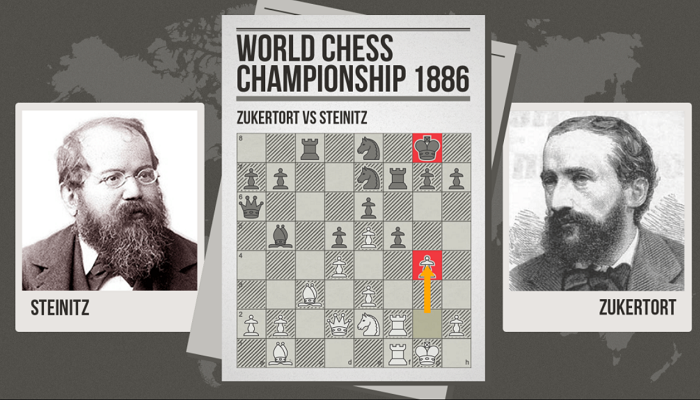
The world championship match is held in the US between Prague-born Willhelm Steinitz (1836-1900), who played under the flag of the Austro-Hungarian Empire, although he had been a resident of the US since 1883, which would become his final destination, and Johannes Zukertort (1842-1888), who was born in a Polish city at a time when that territory was part of the Russian Empire but became a naturalized English citizen in 1878.
The first five games were played in New York, the next four in St. Louis, and the last eleven in New Orleans. The contest would be decided in favor of the first to obtain ten victories (draws did not count), which was achieved by Steinitz, who, in addition to winning that number of times, lost five games and drew only five of the twenty games, in a display of competitiveness.
Thus, although at the time there was still no international body to regulate this type of competition (FIDE would not appear until 1924), it is considered, without dispute, the first official world champion in the history of chess.
Zukertort had just won the 1883 London tournament convincingly, ahead of Steinitz (and all the other leading players of the time); Steinitz, for his part, had been considered the best since 1866, when he defeated the Prussian Adolf Anderssen (1818-1879) 8-6 in a match in London and subsequently confirmed his dominance time and again on the international stage.
The antagonism between them was legendary. Steinitz, who had dominated the London chess scene, was eventually overtaken by Zukertort, who seemed poised to take his place. It is said that during a banquet, when the world’s best chess player was asked to stand, both rose. A testament to their confidence and, also, to their rivalry.
It was in this context that Steinitz challenged Zukertort to a match to decide who was the best, which took place this year. A clock (not yet in common use) was used to control the time of the games, which were played at a rate of thirty moves in two hours and one hour for the subsequent fifteen.
It is curious that, after Steinitz‘s initial success (with black) in the opening game, Zukertort won four consecutive games, so that when both reached St. Louis, the British representative’s advantage seemed unassailable. However, the Prague native made a spectacular comeback and, in the end, won by a wide margin.
The key game was played on February 10th. It was the ninth game and so far the score was tied at four. Steinitz won with the black pieces, showcasing his strategic prowess and, from that moment on, taking complete control of the match. It has been asserted that this is the date on which modern chess was born, definitively burying Romantic chess, the style embodied by Zukertort, who from this moment would be clearly surpassed by his rival’s positional play.
Zukertort, despite being younger than Steinitz, was very upset by the result and died only two years later, so he had no chance of revenge, going down in history as the first world chess runner-up or, perhaps, as «the first world champion who was not.»


Only one major tournament took place this year. It was held in London, where local player Joseph Blackburne (1841-1924) emerged victorious, narrowly ahead of fellow Englishman Henry Bird (1829-1908) and German Emil Schallopp (1843-1919), with American (born in Scotland) George Mackenzie (1837-1891) finishing fourth. There are some competitive matches, although certainly friendly, such as the one in which Bird and the also British Amos Burn (1848-1925) tied at nine in the London square, or the one in which Isidor Gunsberg (1854-1930), another local figure who had been born in Hungary, defeated Bird by 6.5 to 2.5; and a third in which Burn tied at five with Mackenzie.

The EDO Historical Chess Ratings ranking for this year lists the following top 5: Steinitz; the BritishJoseph Blackburne (1841-1924); the Prussian Siegbert Tarrasch (1862-1934); Gunsberg; the Slovak Miksa Weiss (1857-1927), with Zukertort occupying a curious thirteenth place. More reasonable is Chessmetrics, for which the leading quintet is made up of Steinitz; Zukertort; Blackburne; the Irish-American James Mason (1849-1905) and Mackenzie.
Born in Riga, the capital of Latvia (at that time part of the Russian Empire), although he later became Danish, Aron Nimzowitsch (1886-1935) was not only a great player (winner of countless tournaments, including Carlsbad 1929) but also an innovator who cultivated hypermodern ideas in chess like few others and, with his 1925 book Mein System, helped to rethink the logic of the game. And in Switzerland born Erwin Voellmy (1886-1951), who as a player was part of his country’s team that won the bronze medal in the unofficial Olympic competition in Paris in 1924, although more importantly, he was one of the signatories of the founding charter of FIDE in that same context.

Augusto de Muro (1886-1959) was born in Argentina. He would become the second president of FIDE in 1939, the year in which, during the Tournament of Nations held in Buenos Aires, he was appointed to that position, replacing the Dutchman Alexander Rueb (1882-1959), who was exalted as Honorary President, given the Second World War that had broken out in Europe.

Scottish historian Alan McGowan notes that, by that year, there were already three national chess federations: the Netherlands, created in 1873; Germany, since 1877; and Scotland, since 1884. Although it is often claimed that the first was Canada’s, dating from 1872, D. A. Yanofsky (1967) states that, strictly speaking, «…it was not really a governing body.»
Two writers were born whose works featured chess. The American Rex Stout (1886-1975) who, in Gambit, a 1962 book, shows a chess prodigy that is poisoned while drinking hot chocolate during a tournament; and the poet Baldomero Fernández Moreno (1886-1950) in Argentina who, in one of his works, he says:
“A chessboard / restless, you look like waiters, / playing between columns / on linoleum tracks.” In others, always with reference to the game, he asserts: “A white frontispiece and a slate roof / play before my eyes a broken chess game, / the foliage of a square rises and tears apart / and a bell tower raises its bell and its pride”; also: «In front of me, the city opens up to my gaze, / and I see a chessboard of oiled streets, / where cars with large, lifeless headlights drive / to palaces with their eyes open.“ And finally: ”The red trousers of a captain pass by / and after a doubly courteous salute / they play the complicated game of chess / with the black cassock of the chaplain. / They modestly combine the hidden game/(…)»; and

This, and the following year, marks the creation of Fortunata y Jacinta, a work by Spanish writer Benito Pérez Galdós (1843-1920) in which chess is presented, appealing to its aesthetic sense. French psychologist Alfred Binet (1857-1911), who is particularly valued for his contributions to predicting school performance, with his work also serving as the basis for many intelligence tests that would be developed later, was very intrigued by the way chess players thought, addressing the subject in a paper published that year under the title The Psychology of Reasoning: Experimental Research by Hypnotism.
In a clear example of gender discrimination in chess, it is known that only since this year, in the Italian city of Turin, women and daughters of chess players were allowed to join a local club. Of course, in other places, both in Italy and abroad, the restriction may still be in force. There was, however, a precedent: Mary Rudge (1842-1919) was the first woman to join the Bristol Chess Club, being admitted there in 1872.