Chess in the Middle Ages. A light in the darkness
by Sergio Ernesto Negri

CHESS IN THE MIDDLE AGES, A POWERFUL SOURCE OF INSPIRATION
A pastime of kings, nobles, merchants, and globetrotting travelers, celebrated by poets and reflected in the literature and painting of the time, the game of science experienced widespread growth during this period, when it acquired its modern form.

The Middle Ages are considered, from a certain perspective, to be a period of obscurantism. However, this was not the case with chess. In fact, it was during this period that chess spread and acquired its modern form. The vector of transmission followed the path of trade and conquest. The Muslims (who had learned it from the Persians, who had received it from India) took it to Spain, where they established a caliphate in Cordoba, and to Italy. It also entered through Byzantium and, following the course of the Volga River, through Russia and Scandinavia. It then spread throughout the continent. All these events took place during this long period of human history.
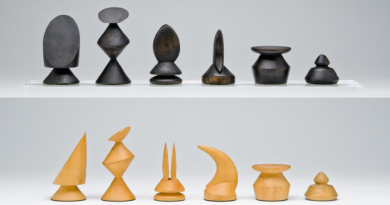
During its journey, it took on its definitive name. The Spanish word ajedrez derives from al shatranj (chess), the expression used by the invaders to refer to it, which came from other phonetic mutations (from chaturanga to chatrang). The abstract pieces (without faces, as prohibited by the Koran) gave way to statuettes with realistic figures. The single-color checkered board mutated into a two-color one. The pieces were reconfigured: from the elephant to the bishop; from the chariot or ship to the rook; from the vizier to the queen. Black replaced red as it was considered more appropriate as an image of evil (darkness) in its agonizing battle against white, which continued to refer to good (light).
Given its prestige, it is considered a game fit for kings. The Persian Cosroes I received it in Ctesifonte, in the vicinity of what would become Baghdad. Several caliphs, despite religious reservations, cultivated it (among them the powerful Harun al-Rashid), employing the most skilled players of each generation (the most notable being al-Adli and al-Suli). In the courts of Europe, kings and nobles made it their main pastime.
Muslims are credited with the first works on the game, the classification of players by category, and the impressive modalities of simultaneous and “blind” play. It was included in influential non-specific stories, such as Ferdowsi’s Book of Kings, Al-Mas’udi’s Book of the Golden Meadows, Khayyam’s Rubaiyat, and The Thousand and One Nights. This is where the story of Dilaram comes from, the favorite of a sultan who, when she is the subject of a bet, manages to avoid her fate by telling her lord how to win the contest.
Hypothetically, it is imagined that Empress Irene of Byzantium sent a game incorporating the queen to Charlemagne, whom she wanted to marry in order to unite the Western Roman Empire with the Eastern Roman Empire; but the Gaul, frightened by the powers assigned to the new piece, rejected the invitation. More tangibly, the piece is mentioned in Europe for the first time (along with the game as a whole) in the Versus de scachis manuscripts, which date from 997.
There are references to it in influential epic poems and songs: The Song of Ruodlieb; Parzival; Tristan; The Song of Roland; Carmina Burana. Pedro Alfonso lists the seven virtues of a knight, which include chess (as well as archery, hunting, and writing poetry). The works of Boncompagno da Siena, Damiano, Vicent, and Lucena are produced for educational purposes.
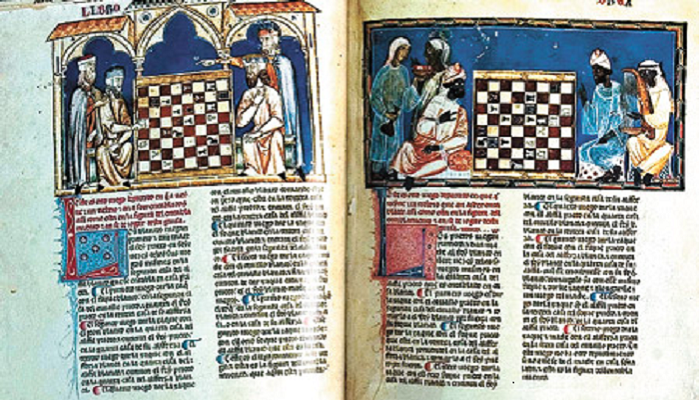
Much of what we know about the game is due to the wealth of literature from that period. With the powerful impact of the printing press, years later we were able to discover emblematic texts from the 13th century (along with several translations): those of the Dominican monk Cessolis and King Alfonso X of Castile. The former, the first to be published in England (before the Bible), compiles his sermons in which chess emerges as a parable of society: the regulated game perfectly represents feudalism. “The Wise Man,” for his part, in his precious Book of Chess, Dice, and Tables, gives it preferential treatment: he considers it “noble and serene” and of ‘sense’ (or “thought”). These works reinforce its metaphorical use and intellectual reputation.
It also facilitates love, given that people of different sexes can meet in front of a board, as recorded by poets and minstrels. Its literary use touches on other themes, including the eternal struggle between good and evil (God against the devil). However, it continues its historical association as a warlike image, so when the French king Louis VI loses a battle; he rebukes an enemy, saying: “Ignorant and insolent knight. Not even in chess can a king be captured”; or it is speculated that the siege of Antioch was decided when the Turkish leader became distracted by a game. Reality and play merge and become confused. Croatia incorporated the chessboard into its coat of arms (and later into its flag) in recognition of a king who achieved freedom for his people by defeating his Venetian counterpart at chess.
The female chess piece bursts onto the scene with the rise of powerful queens, due to the greater social recognition of women and the rise of Marian worship (De Coincy associates the Virgin Mary with the respective piece). It moves timidly on the board at first (just like the exotic vizier it replaces), but then acquires greater mobility. This revolutionized the game, making it more dynamic and aggressive; people spoke of chess “alla rabbiosa” (in a rabid manner). Women were slow to join the battlefield, but when they did, they did not go unnoticed.
The bishop also expands its range of action; castling emerges; the capture of the passed pawn is allowed, a piece that can now be promoted to queen (generating two ethical dilemmas: bigamy and transsexualism). The rules were standardized at the end of the period with the decisive contribution of Valencian chess (reflected in the poem Scachs d’amor, which recounts a match, the first known to have been played under the new format), so that it could now be played without any interpretative problems, favoring future international competition.
As proof of its importance, great writers have taken notice of it. Dante Alighieri, in The Divine Comedy, observing that there were many sparks from a fire, states: “…their number multiplied a thousand times more than that produced by the multiplication of the squares on a chessboard.” Boccaccio, in The Decameron, shows young people playing it, and in Filocolo he takes up the story of the hero who rescues his beloved captive in a castle, gaining access by winning the trust of a guard with whom he plays a few games. A third Italian, Petrarch, does not think much of it: the least he says about chess is that it is futile. The Englishman Chaucer, in addition to including it in his Canterbury Tales, places it at the center of the plot in The Book of the Duchess, where the protagonist laments having lost his wife (his “queen”) in an unequal game that pits him against Fortune.
It is a source of inspiration for numerous painters and portraitists. Some images can be seen in the Palatine Chapel in Palermo. But the best illustrations appear in books (including some attributed to the genius of Leonardo, images that will emerge at the beginning of the next era). Goldsmiths are responsible for making beautiful pieces and boards of high aesthetic and material value, which form part of dowries and are given as gifts and legacies.
Certain obscurantism, so idiosyncratic of the period, continues to affect it. From extreme positions, it is argued that it has something diabolical about it (being so distracting) and because it is associated with gambling (and ungodly money). Pope Alexander II is asked to ban it. But nothing can be done against a game that has become the main pastime and an inseparable part of the culture.
So relevant that it can be argued that while Ferdinand of Aragon was playing it, he was saved from defeat by Isabella the Catholic and, in gratitude, accepted the plan she was advocating, which had been presented to her by a navigator who believed he could reach the Indies by sailing westward. Thus, Columbus was able to “discover” America, ending one era and beginning another.
The ships’ cargo included pieces and boards that would thus arrive in America for the first time, returning in their new design to the East where they had been conceived. The middle Ages, when the game was modernized and spread, laying the foundations for its universalization and flourishing as part of the culture. The middle Ages, when, at least for chess, light had prevailed over darkness.