Chess in the 19th century. Milestones of 1888
By Sergio Ernesto Negri

Global context
Following the death of Wilhelm I (1797-1888), Emperor of Germany and King of Prussia, Frederick III (1831-1888) ascends to the throne for a few days, he will soon die, to be succeeded by Wilhelm II (1859-1941). The British establish a protectorate on the island of Borneo. Germany seizes the island of Nauru in the Pacific Ocean, and the United Kingdom seizes Christmas Island in the Indian Ocean and Papua in Oceania. Chile annexed Easter Island in the Pacific. Brazil abolished slavery (the last Western country to do so). In London, the murders of Jack the Ripper were recorded.
In London, a work by German-British Georg Friedrich Händel (1685-1761)[is recorded on a phonographic cylinder, which is the oldest musical recording in existence: it is Israel in Egypt, performed by a choir of four thousand voices. In London, the first film in history is recorded, a scene in a garden lasting just over two minutes. The Dutch painter Vincent van Gogh (1853-1890) cuts off his ear. The German Friedrich Nietzsche (1844-1900) writes Ecce Homo before being admitted to a mental health institute. The Pasteur Institute opens in Paris. The tire and the submarine are invented. Serbian-American inventor Nikola Tesla (1856-1943) discovers the principle of the magnetic field. The American George Eastman (1854-1932) patented the first Kodak camera. A group of scientists and explorers founded the National Geographic Society in Washington.
The birth of cinema: the first film made in London.
Chess in 1888
Two tournaments in London won by the Hungarian (based in the UK) Isidor Gunsberg (1854-1930), in one of which he was accompanied by the Irish-American James Mason (1849-1905) and the Englishman Henry Bird (1829-1908) completing the podium; Polish (based in the UK too) Johannes Zukertort (1842-1888) came in third; and in the other tournament, local player Joseph Blackburne (1841-1924) came in second, with Bird and Zukertort further behind, in later tournament appearances. Gunsberg achieved a hat trick with his success in Bradford, finishing ahead of Scottish-American George Mackenzie (1837-1891) and Mason. In Nuremberg, the Prussian Siegbert Tarrasch (1862-1934) prevails, with Germans Jacques Mieses (1865-1954) and Hermann von Gottschall (1862-1933) coming in second.
Within the framework of the Universal Exhibition held in Barcelona (which modernized the city as a legacy), a chess tournament was held in which the German Curt von Bardeleben (1861-1924) prevailed, with twelve points out of thirteen, ahead of Blackburne, who was half a unit behind the winner and, further back, his compatriot Amos Burn (1848-1925) and Gunsberg.
Several matches were played, including two in Havana between Prague-born (based in USA) Willhelm Steinitz (1836-1900) and Cuban (born in Spain) Celso Golmayo (1820-1898), with Steinitz winning 9-0 overall. In London, Blackburne beat Mackenzie 2.5-0.5.
The French newspaper «Le Monde Illustré» organized the first international individual correspondence tournament with twenty-five players, fifteen of whom were French. The competition began in May of this year and ran until February 1891. The Austrian Johann Berger (1845-1933) won with forty-five points out of a possible forty-eight, followed by the Russian-Austrian Alexander Halprin (1868-1921) in second place and the local player Jules Arnous de Rivière (1830-1905) in third.

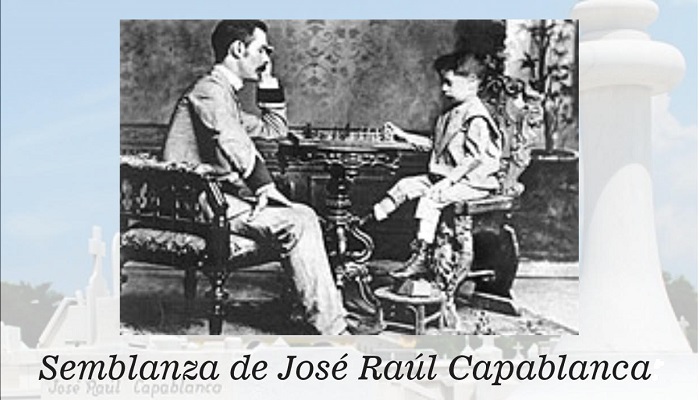
José Raúl Capablanca (1888-1942), the third champion in history, was born in Havana. He seemed unbeatable, although in 1927 he lost his crown to the Russian-French player Alexander Alekhine (1892-1946). The Cuban, known for his pure style, is remembered as one of the greatest chess players in history and, like few others, became a cultural icon.

In addition, two players emerged in Ukraine: Alexei Alekhine (1888-1939), Aleksandr‘s older brother, himself a chess player who competed in several tournaments in the USSR, where he died under somewhat mysterious circumstances, and Boris Verlinski (1888-1950), the first GM of the USSR (a title granted by that country), after becoming national champion in 1929, a decade in which the player had outstanding performances in the competitive local scene, but for FIDE he was only an IM, a title granted in the same year of his death.
The Polish-British player Zukertort dies. He was a great chess player in the second half of the 19th century who, two years before his death, starred in the first world championship match against Steinitz. He collapsed while playing a friendly game at the Simpson’s Divan in London and died the next day at the age of forty-five.
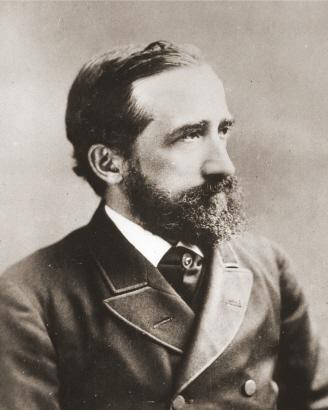
In the annual EDO Historical Chess Ratings ranking, the top positions are held by: Steinitz; Gunsberg; Tarrasch; Russian Mikhail Chigorin (1850-1908), and Blackburne. For Chessmetrics, as of December this year, the order is quite different, being as follows: Steinitz; Mackenzie; Zukertort; Blackburne, and the Czech Berthod Englisch (1851-1897).
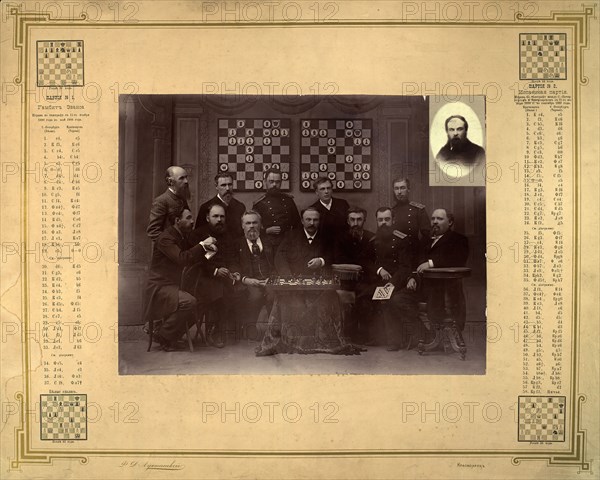
FIDE President Arkady Dvorkovich notes that a telegraph match between the Russian Empire’s cities of St. Petersburg and Krasnoyarsk, more than 4,600 kilometers apart, concluded this September. The match, which began on November 11, 1886, was a technological marvel that bridged the distance between the country’s cultural capital and a Siberian town. The St. Petersburg Chess Club, one of the participating organizations, boasted prominent members at the time, including Chigorin, considered the father of Russian chess. Their counterparts were the local Krasnoyarsk Chess Circle, composed of enthusiastic amateurs. The St. Petersburg Chess Club emerged victorious after the two matches played.
Three writers linked to chess are born in the US: Thomas Stearns Eliot (1888-1965), who later moved to England where he became a naturalized citizen and produced much of his work (for which he would receive the Nobel Prize in Literature), composed The Waste Land in 1922, a poem whose second part is titled A Game of Chess, which includes these beautiful verses:
‘What shall I do now? What shall I do?’ / ‘I shall rush out as I am, and walk the street / ‘With my hair down, so. What shall we do tomorrow? / ‘What shall we ever do?’ /// The hot water at ten. / And if it rains, a closed car at four. / And we shall play a game of chess, / Pressing lidless eyes and waiting for a knock upon the door».

Also, Raymond Chandler (1888-1959), creator of the character Philipe Marlowe, a detective who is introduced by Argentine writer Osvaldo Soriano (1943-1997) in his novel Triste, solitario y final («Sad, Lonely and Final«), at the twilight of his career, being contacted by British Stan Laurel (1890-1965), the comic actor from the famous series Laurel and Hardy, and, as the plot unfolds, chess appears repeatedly, which is entirely plausible given that Chandler mentions it repeatedly in two of his noir novels: The High Window and The Long Goodbye.
The third American born this year is S. S. Van Dine (1888-1939), creator of Philo Vance, the protagonist of several stories, including The Bishop Murders, later made into a film, whose murderer assumes that role, that of bishop, equivalent to the piece in chess, which he leaves at the scene of the first of the crimes.
The poet Enrique Banchs (1888-1968) is born in Argentina. In his 1909 work El cascabel del halcón («The Falcon’s Bell«), he includes references to chess in two poems, one of which reads:
“He leaves the kingdoms, and with him goes his beloved, / the king who only knows how to play chess.”
The writer Fernando Pessoa (1888-1935) is born in Portugal. Under the heteronym Bernardo Soares, he presented a work written between 1913 and 1935 called, precisely, The Book of Disquiet, in which he notes about the game:
«I am still obsessed with creating a false world, and will be until I
die. Today I don’t line up spools of thread and chess pawns (with an
occasional bishop or knight sticking out) in the drawers of my chest,
but I regret that I don’t, and in my imagination I line up the
characters – so alive and dependable! – who occupy my inner life,
and this makes me feel cosy, like sitting by a warm fire in winter
(…)
The strategist is a man who plays with lives like the chess player with
chess pieces. What would become of the strategist if he thought
about how each of his moves brings night to a thousand homes and
grief to three thousand hearts?
(…)
The remaining general lot of humanity –
amorphous, sensitive, imaginative and fragile – is no more than the
backdrop against which these stage actors perform until the puppet
show ends, no more than the flat and lifeless chess board over
which the pieces move until they’re put away by the Great Player,
who, fooling himself with a double personality, plays against his
own person* and is always entertained.
(…)
Vis-à-vis the intransigent march of all
things, the life that we were given without knowing why and that
we’ll lose we don’t know when, the ten thousand chess games that
constitute our life in common and in conflict, the tedium of
uselessly contemplating what we’ll never accomplish ….. – vis-à-vis
all that, what can the wise man do but ask to retire, to be excused
from having to think about life (since living it is already
burdensome enough), to have a little sun and fresh air and at least
the dream that there’s peace on the other side of the hills?».
The writer and ex President of Argentina Domingo Sarmiento (1811-1888) dies. He was a pioneer in his country in mentioning chess in his written work. He did so in his book Viajes («Travels») and Campaña del Ejército Grande («Campaign of the Great Army«) and also in an 1842 chronicle in the Chilean newspaper El Progreso («Progress«) where the game appears in a situation in which the possibility of seduction is intertwined with the high intellectual reputation of the pastime.