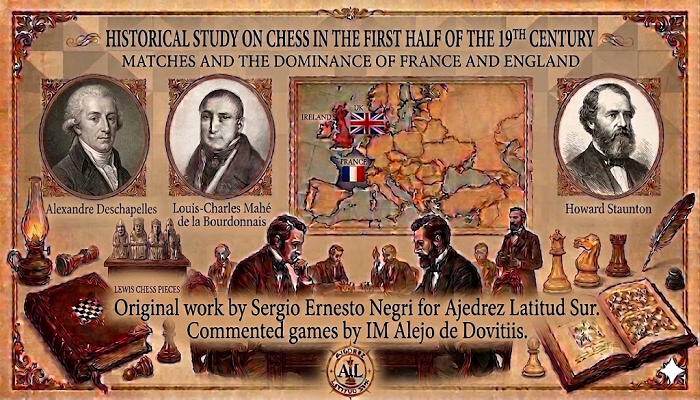
Chess in the First Half of the 19th Century: The Era of Matches and the Dominance of France and England
By Sergio Ernesto Negri
ABSTRACT
From the first half of the 19th century onward, chess established itself as both a social and competitive activity. It was no longer played solely in courtly circles, in monarchies declining in the face of the rise of republics, but was incorporated into public spaces such as cafés and clubs dominated venues closely linked to intellectual and cultural activities. Consequently, chess accompanied the evolution of ideas and new political movements and, in itself, continued to enhance its intellectual reputation.
In France and England, the greatest players of the era emerged—Deschapelles, de la Bourdonnais, and Staunton—in countries where the game was played with the greatest enthusiasm, particularly at the Café de la Régence in Paris, a landmark for the finest chess of the time.
Similar venues for the game spread to numerous other locations, such as London, Berlin, St. Petersburg, New York, Buenos Aires, Istanbul, and Cairo. These were exclusively male domains, so women were virtually excluded from the game, although there are marginal references to their presence in that field.
In the absence of international tournaments, the way to settle disputes over supremacy at the highest level was through match challenges. The most iconic match of the period was the one that pitted de la Bourdonnais against the Irishman McDonnell, with de la Bourdonnais emerging victorious and establishing French dominance—a dominance that would later be reversed with the emergence of Staunton toward the end of the first half of the century.
On the other hand, less formal play continued, in games where the better player could give his opponent starting advantages—in the form of material (a pawn, knight, or even a rook)—and even allow them to make two or more consecutive moves.
Technical books and the first specialized magazines appeared. In Germany, a movement emerged known as the Berlin Pleiades, with von der Lasa, one of its members, who would excel as both a player and a historian, while in St. Petersburg, another major center, Petrov would take the lead, within a milieu where great Russian writers and men of the aristocracy and culture cultivated the game.
Toward the end of the period, the Staunton pieces also emerged, whose design became the standard, replacing the earlier models, which were very beautiful but often not very functional.
In practice, the game became associated with the Romantic cultural movement, although with Staunton, play began to take on a less impulsive character, in keeping with the greater rationality of the Industrial Revolution, which had its main center in England. Furthermore, from a philosophical standpoint, chess is linked to the ideas of dialectical materialism, to the extent that Marx and Engels met at the Café de la Régence itself.
Numerous figures in power, from kings to politicians, as well as personalities from the worlds of culture and science, played the game, with some even developing an extreme passion for it.
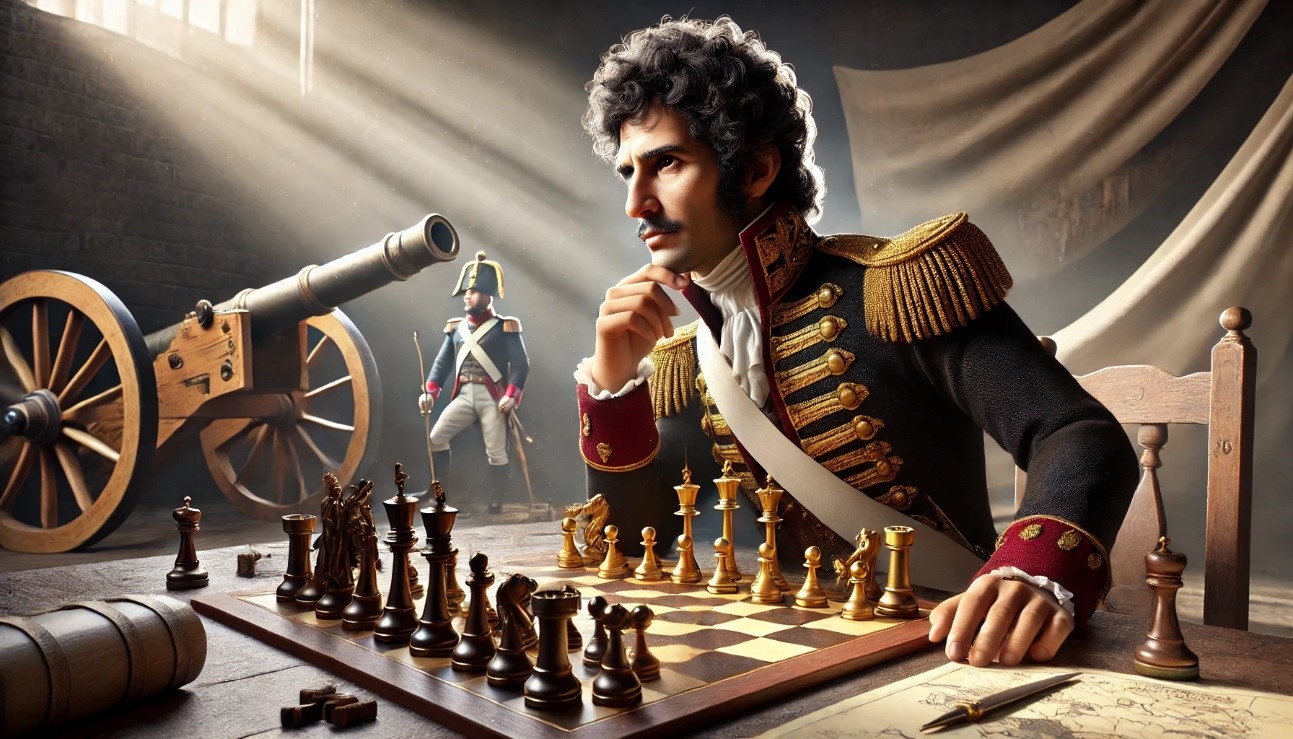
In an America seeking freedom, and therefore embroiled in wars of independence, the game was played by military figures such as San Martín and Bolívar, the greatest liberators of the southern part of the continent, just as in Europe it was a pastime very dear to Napoleon, both during his heyday and in his final exile.
In the U.S., in addition to the first local championship being held—with the participation of European chess players living in the country—there was Poe’s famous debunking of the so-called chess-playing automaton (the Turk), raising legitimate doubts and suggesting what would later be discovered: that a person was operating the device from within. However, the widespread success of its performances contributed to the growing interest in the game.
Far from the dominant influence of Europe, chess gained a growing presence in India, introduced by British colonial officials, while in Arab countries, the Middle East, and Africa, a slow transition took place from the ancient game of shatranj to Western-style chess. China and Japan, on the other hand, were reluctant to accept a game they viewed as exotic.
Culturally, chess was present in literature, painting, engravings, sculptures, and in the design of the game sets themselves. Its intellectual reputation and metaphorical potential made it well-suited for literary expression, as had been the case since earlier times. Additionally, images alluding to chess were used, such as caricatures, to comment on political and social situations.
From an educational standpoint, the experience of the German town of Ströbeck is significant, as chess became integrated into the formal education system during this period.
Additionally, two very important events occurred, one linked to the past and the other to the future.
In the first sense, a highly significant set of medieval chess pieces, known as the Lewis Chessmen, was discovered in Scotland, providing evidence of their presence in the Nordic tradition, including the early introduction of the queen—a European innovation in which a chess piece replaced the Eastern vizier.
On the other hand, in the U.S., the first telegraphic match between two locations took place, making it possible from that point on for chess to be played over long distances.
CHESS IN THE FIRST HALF OF THE 19TH CENTURY:
THE ERA OF MATCHES AND THE DOMINANCE OF FRANCE AND ENGLAND
GLOBAL CONTEXT
According to British historian Eric Hobsbawm (1917–2012), the 19th century had, strictly speaking, begun in 1789 with the French Revolution and the rise of post-monarchical regimes in Europe; and, in characterizing it as a “long century,” he dates its end only to 1914, when World War I began.
Regarding this first half of the 19th century, viewed more chronologically, he considers that it was lived through during the period known as The Age of Revolution, at least on the Old Continent, which extends until 1848, when The Age of Capital begins.
We are, therefore, within the context of the social and political transformations that accompanied the transition from the Ancien Régime to bourgeois Europe, with all its implications.
That continent stood at the height of imperialism, serving as both its center and driving force, with all political currents accepting its civilizing mission, guided by an idea of moral and material progress, exemplified by the achievements of science, the ceaseless increase in production, and the expansion of the railroads, which linked all the major metropolises of the continent and, in America, stretched from coast to coast.
These ideas became an unshakable article of faith, no longer grounded in the potential of reason, but in the objective and irresistible forces of society.
It was an era of violent and rapid transition, leaving behind a colonial and absolutist world and moving toward industrial, bourgeois, and nation-state modernity. The old empires collapsed, particularly the Spanish Empire, which lost its colonies in the Americas.
Nevertheless, the Napoleonic era in France—which spread revolutionary ideas—would ultimately transform its leader into an emperor, until his downfall. In any case, and beyond excessive personal ambitions, the seed of popular sovereignty had already been planted.
Economically, the First Industrial Revolution took hold. England established itself as a power, leveraging the spread of the steam engine, the development of the textile industry, and coal mining. The rural landscape shifted toward the urban and industrial.
Railroads and steamships shortened global distances, boosting trade and migration. The industrial bourgeoisie (owners of capital) consolidated its power, and the proletariat (the urban working class) emerged, whose appalling living conditions gave rise to the first labor movements and utopian socialism.

The rigid order of the monarchies was shattered by three consecutive waves of revolution: 1820, 1830, and 1848 (the latter known as the “Spring of Nations”). These revolutions can be explained by the tension between three currents: liberalism; nationalism (Germany and Italy sought unification, while others sought independence, especially from the Austrian and Ottoman Empires); and the Communist Manifesto, which emerged in 1848, a movement that gave the working class a voice and encouraged revolution.
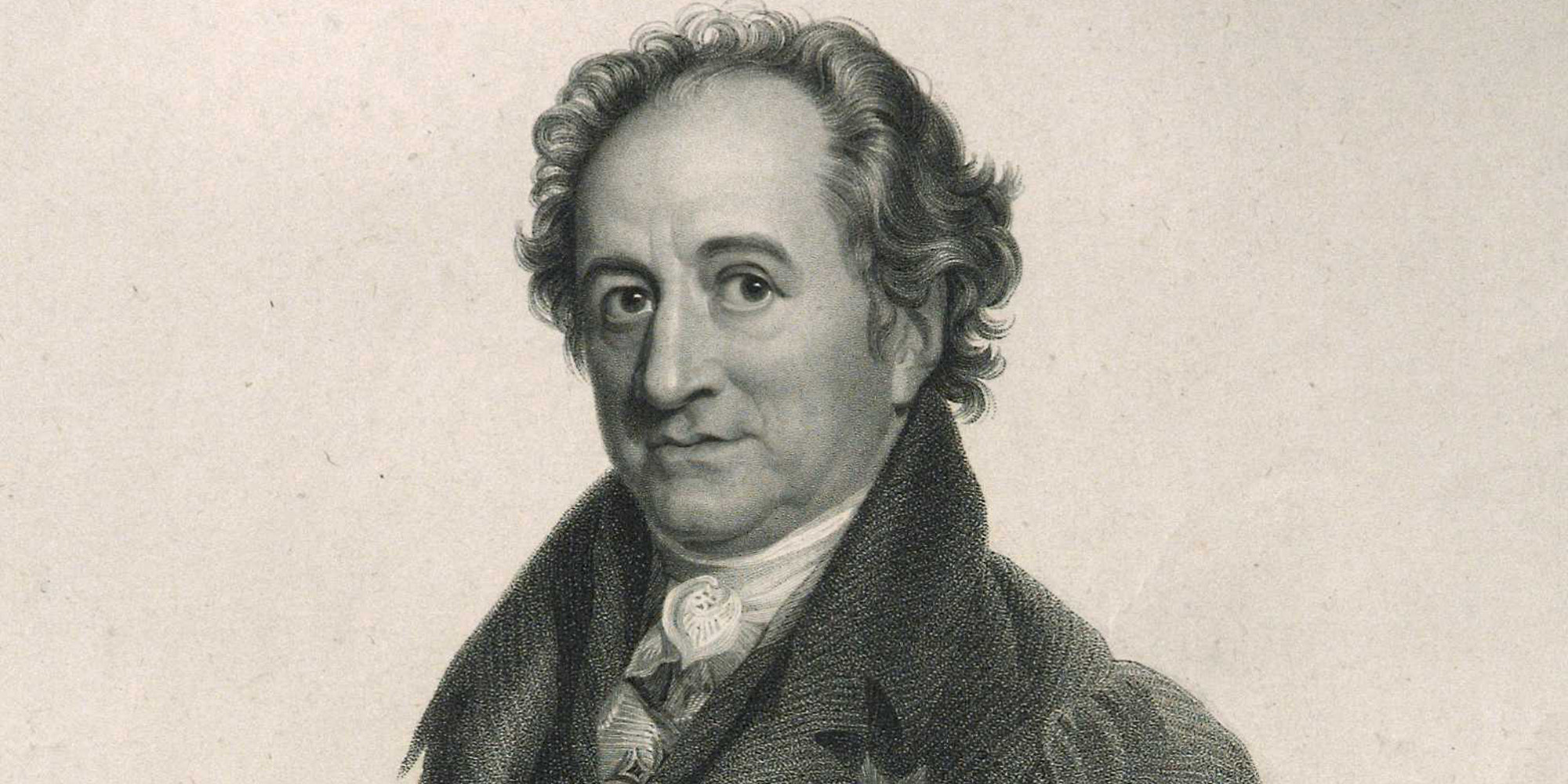
The cold rationality of the 18th-century Enlightenment was abandoned in favor of emotion and technological progress. Romanticism emerged, with figures such as: the German philosopher Johann Wolfgang von Goethe (1749–1832), for whom chess was the “touchstone of the intellect”; the British poet Lord Byron (1788–1824); and the French writer Victor Hugo (1802–1885); the French painter Eugène Delacroix (1798–1863); and the Polish-French musician Frédéric Chopin (1810–1849).
It was a time that celebrated the individual self, disenchantment, absolute freedom, tragic love, and nostalgia for the medieval past or unspoiled nature, in contrast to the smoke billowing from the factories.
In the 1830s, with the development of the daguerreotype, humanity began, for the first time in its history, to mechanically capture reality with the advent of photography.

We are in an era of dual and complementary revolutions: the economic one, centered in Great Britain; and the political one, centered in France, giving birth to the modern, industrial, and republican world.
Under these conditions, it is not surprising that chess—a game that has always adapted to every time and place throughout history—adopted more individually competitive values, embraced romantic ideas as a style of play, and flourished particularly, geographically speaking, in England and France, as well as in other European centers, where commercial currents and cities took center stage.
From a social perspective, chess would gradually shed its exclusively aristocratic aura, being practiced from then on by a burgeoning and increasingly powerful urban bourgeoisie.
CHESS IN THE PERIOD
In the previous century, the Frenchman Philidor (1726–1795) had dominated the scene, with the Café de la Régence in Paris serving as the quintessential venue for the game, viewed as both entertainment and a cultural bond. He was by far the best player of his time, to such an extent that he had to give his opponents a head start to make the games more evenly matched.
Having demonstrated his talents on both sides of the English Channel through his blindfold simultaneous exhibitions, he contributed to the game’s spread. Furthermore, thanks to his 1749 work Analyse du jeu des Échecs («Analysis of the game of Chess«), he played a decisive role in codifying the rules of chess, which, until then, had been played with somewhat vague guidelines.
Due to the implications of the political context, the game lost its prominence in aristocratic courts and palaces, becoming a bourgeois, public, and proto-scientific phenomenon. In this vein, it was the era of Romanticism on the chessboard as well: the game was dominated by fierce attacks, spectacular sacrifices, and the pursuit of beauty, rather than the cold accumulation of positional advantages.
France, and also England, where Philidor had spent the final years of his life, became the center of the global chess world during this period of the 19th century, with a struggle for supremacy that was resolved through matches between their leading figures.
The cafés, which were exclusively male-dominated and served as venues for important cultural and intellectual debates, were the places chosen to play the game. It was a way of democratizing a game that would no longer be the exclusive preserve of the nobility, although, of course, it would remain out of reach for the members of what would come to be known as the proletariat.
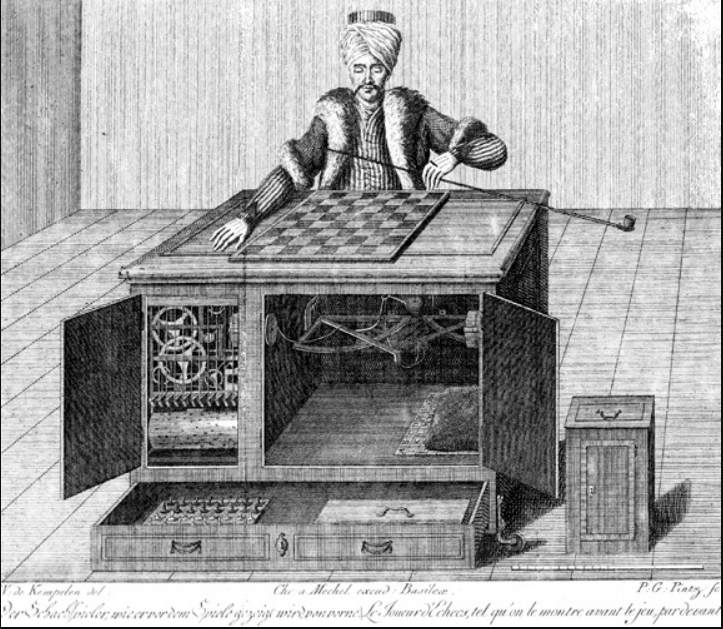
The Café de la Régence remained the epicenter where the best players competed and philosophers, politicians, and men of culture interacted. It was there that the automaton known as “The Turk” was unveiled—a supposedly non-human device that played the game—though, as would later be revealed, this was a ruse, since a person was hidden inside its structure, moving the pieces. In any case, the game could also be viewed as a spectacle.


In other parts of the world, particularly in Vienna and St. Petersburg, the phenomenon of chess in cafés was replicated. And, notably, another such venue would open in London—Simpson’s Divan, founded in the late 1820s—which aimed to compete with the Régence.
In addition, specialized clubs began to emerge in major urban centers, always with an exclusively male membership. This was the case in London with the London Chess Club, founded in 1807; the Westminster Chess Club, which operated from 1831 to 1843; and, as a splinter group of the latter, the St. George’s Chess Club, established in 1843 under Staunton’s leadership. The Berliner Schachgesellschaft appeared in Berlin in 1827, the oldest club in Germany and the main hub of activity for the Berlin Pleiades. On the other side of the Atlantic, a notable example is the New York Chess Club, founded in that U.S. city in 1839.
There are two other very important organizations, which are in fact the oldest of all, and which are still operating today, as noted by the Scottish historian Alan McGowan. On the one hand, we have the Schachgesellschaft Zürich (Zurich Chess Society), which was founded in 1809, and on the other hand, there is the Edinburgh Chess Club, which opened its doors in 1822. Since 1846, in Rome, the Caffè de’ Scacchi (also historically known in Roman records as Caffè dei Cento Giovanni) functioned as the epicenter of the game.

Also, other matches could take place in the form of correspondence chess, in which clubs challenged one another by sending moves via postal mail in prolonged events that, in a way, put local pride on the line. For example, there was the match that pitted chess players from Paris against those from London between 1834 and 1836. Although there is an even earlier one, between Edinburgh and London, which took place between 1824 and 1828, during which the opening that would come to be known as the Scotch Gambit was played.
French dominance emerged first with Alexandre Deschapelles (1780–1847) and later with Louis-Charles Mahé de La Bourdonnais (1795–1840). And then, though he did not come to dominate the field, Pierre de Saint Amant (1800–1872) emerged as another prominent chess-player.
Figures also emerged in the British Empire, such as the Scotsman John Cochrane (1798–1878) and the Irishman Alexander McDonnell, who sought to challenge the supremacy of Deschapelles and La Bourdonnais, and later, the Englishman Henry Buckle (1821–1862).
During this period, beyond formal matches, games were played somewhat informally in social settings; matches could even be played with handicaps (in the opening or even in material, usually a pawn). And when a more rigorous demonstration of supremacy was desired, matches were arranged, given that the tournament format would not begin to take hold until the start of the second half of the century.
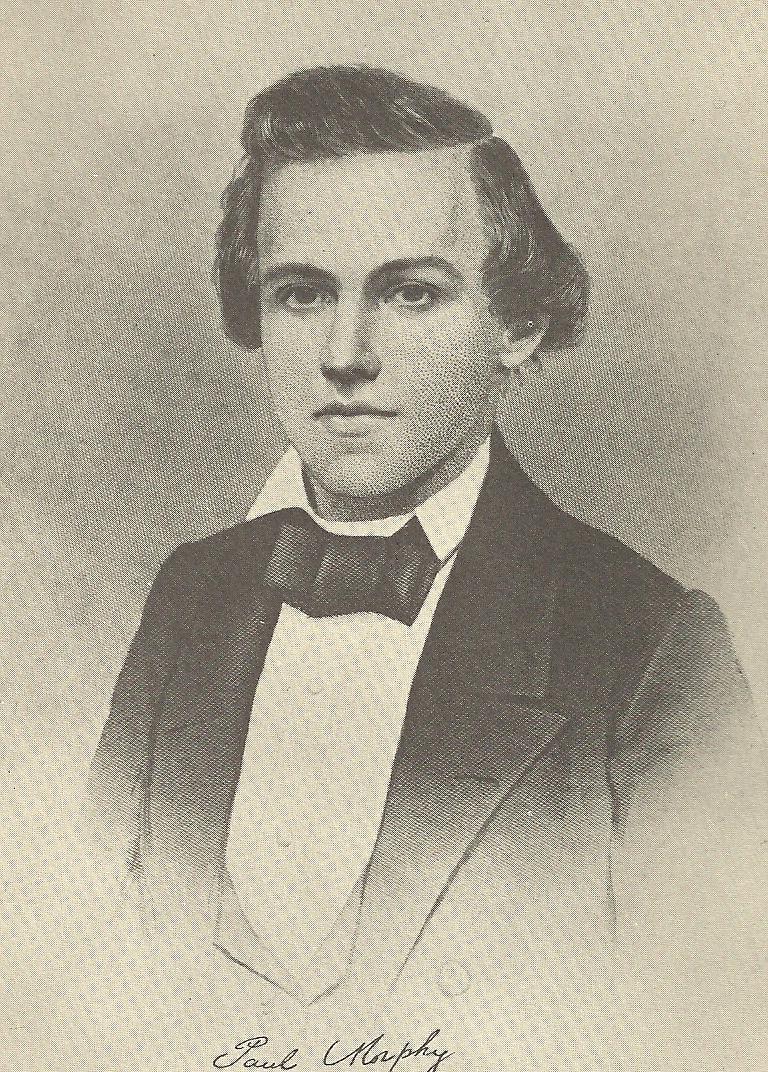
Toward the end of this period, though his influence would extend further, the Englishman Howard Staunton (1810–1874) would emerge as the greatest player of all, snatching from France the supremacy it had held since the time of Philidor. On the other side of the Atlantic, the American Paul Morphy (1837–1884) would emerge; when he toured Europe in the 1850s, he demonstrated that he was a player without equal, given his genius.
Another important center of the period—one that would grow in prominence in the years to come—emerged in Germany, where several prominent figures came to the fore. Since there were seven of them, the movement they formed was named, like stars in the firmament, the Berlin Pleiades. It consisted of Ludwig Bledow (1811–1846), the leader and founder of the group; Paul Rudolph von Bilguer (1815–1840); Wilhelm Hanstein (1811–1850); Carl Mayet (1810–1868); Karl Schorn (1803–1850); and Bernhard Horwitz (1807–1885), whom went on to have distinguished career in England, and, ultimately the most prominent of them all, not only as a player but also as a historian and popularizer, Tassilo von Heydebrand und der Lasa (1818–1899), who was considered for a time to be the best chess player in the world.
A Game by Von der Lasa Analyzed by MI Alejo de Dovitiis
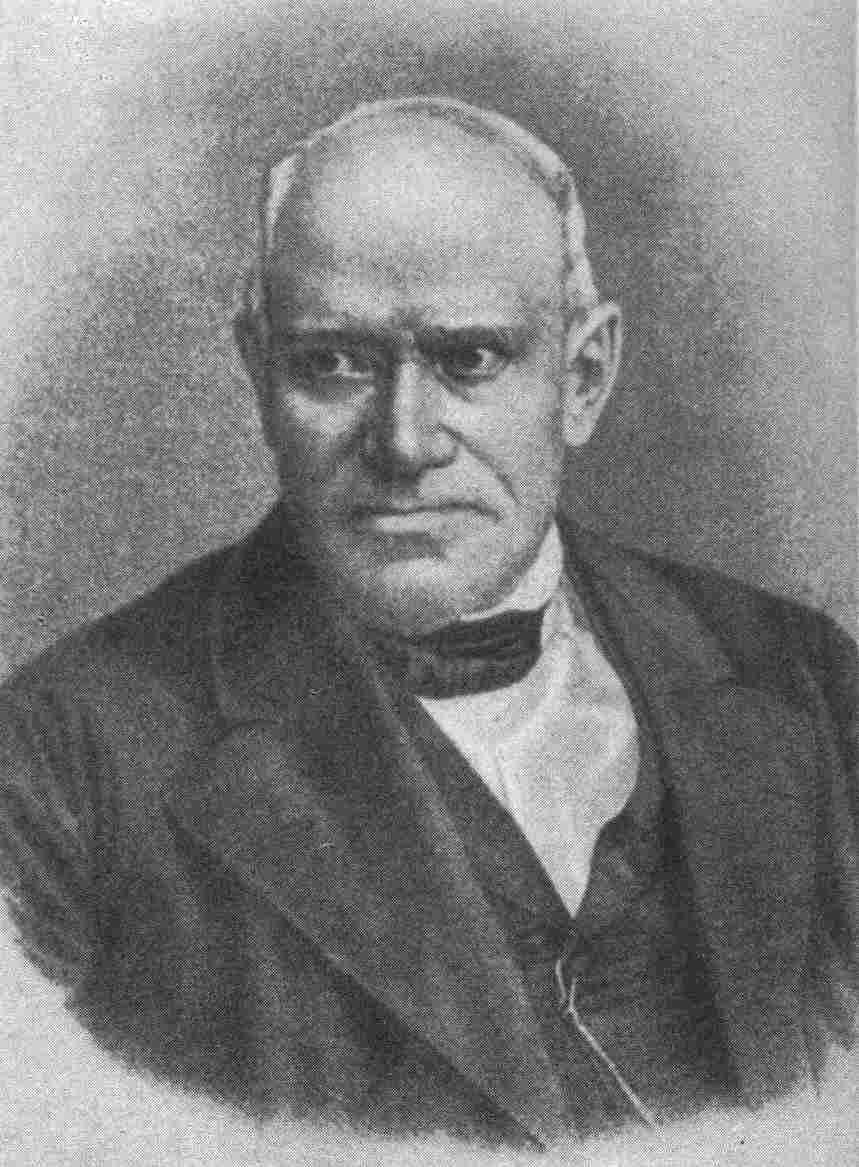
In St. Petersburg, Aleksandr Petrov (1794–1867) and Carl Jaenisch (1813–1872), who was born in Finland (then part of the Russian Empire), stood out in particular, within the context of a game that was all the rage among local aristocrats and men of culture, such as Prince Sergei Urosov (1827–1897) and the writers Leo Tolstoy (1828–1910) and Ivan Turgenev (1818–1883). Although we will see that, by certain measures, Petrov came to be considered the best of his time, strictly speaking that claim is somewhat difficult to sustain, since he did not interact with other figures of the era, except in Warsaw (in a Poland that was then part of the Russian Empire), where he resided for many years and in whose local milieu he also came to prevail.
A Game by Petrov Analyzed by MI Alejo de Dovitiis
In what is now Estonia, a Baltic German was born, Lionel Kieseritzky (1806–1853), who would go on to have a brilliant career in Paris, where Italy’s finest player, Serafino Dubois (1817–1899), also played, primarily at the Café de la Régence, clearly demonstrating that this was the place to go from anywhere in the world to play the best chess of the era.
In contrast, the Hungarian Johann Löwenthal (1810–1876) would end up in England, the other major center of the game; he also played in the U.S., as in 1850, when he faced Morphy, who, despite being only thirteen years old, was already showing signs of his genius and managed to defeat his experienced opponent.
In the case of the Prussian Adolf Anderssen (1818–1879), who, like the American, would become another central figure in the second half of the century, he could be seen playing in this period against another strong chess player born in Breslau, Germany (now the Polish city of Wroclaw), Daniel Harrwitz (1821–1884), in a tied match; Harrwitz would move to London in 1849, where he founded the The British Chess Review.
From a gender perspective, with clubs and cafés frequented almost exclusively by men, women were largely excluded from the practice of chess, with a few notable exceptions, such as the Frenchwoman Claire Élisabeth Jeanne Gravier de Vergennes, Madame De Rémusat (1780–1821), and the American Ellen E. Strong de Gilbert (1837–1900). The first, who was a lady-in-waiting to Josephine (1763–1814), the wife of Napoleon Bonaparte (1769–1821), is known to have played against him in 1804 at the Château de Malmaison. The second, for her part, would go on to found a club in Hartford, though this occurred outside the scope of the period under analysis.
Meanwhile, in the Netherlands, around 1847, a women’s chess club emerged, though it was short-lived. In the final decade of this first half of the century, moreover, the Englishwoman Mary Rudge (1842–1919) and the Italian (later British) Louisa Matilda Fagan (1850–1931) were born, two chess players who would later distinguish themselves.
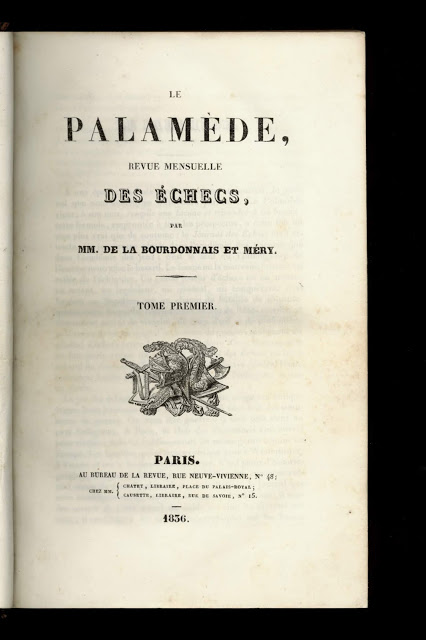
This was a time when the first specialized magazines were published. In 1836, de La Bourdonnais, together with the writer Joseph Méry (1797–1866), launched Le Palamède, the world’s first periodical dedicated to chess, linking the game to poetry and other cultural expressions. Shortly thereafter, in England, in 1841 Staunton launched the more technical Chess Players’ Chronicle, a format that would become the standard.
The game was also covered in mainstream media, such as the weekly The Illustrated London News, starting in 1845, which featured high-quality engravings and Staunton’s ubiquitous pen; and, still during the Victorian era, in Bell’s Life in London, in this case under the editorship of George Walker (1803–1879).
It wasn’t long before books began to appear. First, de La Bourdonnais himself published Nouveau traité du jeu des échecs in Paris in 1835, dedicating it to his teacher Deschapelles, commenting on Deschapelles’s games and his own, and including a section on endgames. It had several reprints, including one in Brussels in 1842, a sign that specialized literature could spread across the continent.

More ambitious in its quest to systematize chess theory was Handbuch des Schachspiels, a work published in Berlin in 1843, which was begun by Bilguer and completed after his death by von der Lasa. It is an exhaustive theoretical treatise, highly regarded for its scope and rigor.

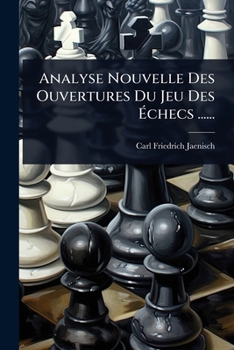
That same year, the second volume of Jaenisch’s Analyse nouvelle des ouvertures du jeu des échecs (New Analysis of Chess Openings) was published in Paris. The previous year, the first volume of this work, written in French, had been presented in St. Petersburg. As its title suggests, it deals with the opening phase of the game, introducing innovations such as the Jaenisch Gambit itself, which occurs in the Ruy Lopez Opening following the sequence of moves: 1.e4 e5 2.Nf3 Nc6 3.Bb5 f5.
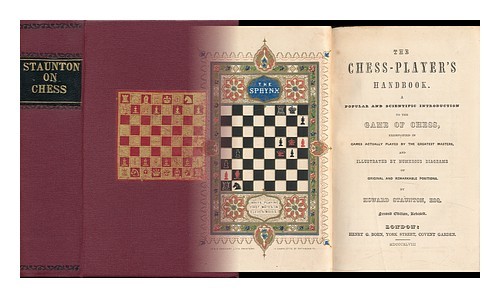
In London, in 1847, Staunton presented The Chess-Player’s Handbook, an indispensable text for the English-speaking world and the world at large, in which openings and endgames are analyzed, games are presented, and the laws of the game are recorded. With this text, a virtual Staunton Regulation was established, clearing the rules of past ambiguities, such as differences in the treatment of castling, en passant, and whether a pawn could be moved two squares at the start or at a later time. It unequivocally establishes the rule of “Piece touched, piece played”; from now on, responsibility in the game is required, in keeping with the pragmatism of the era.
Toward the end of the period, in 1849, the Staunton design was patented, standardizing pieces originally created by his compatriot Nathaniel Cooke (whose exact dates of birth and death are unknown); these pieces would serve as the standard from that time until virtually the present day, with their beautiful and functional design, free of superfluous embellishments, drawing aesthetic inspiration from the Greco-Roman column.

Anticipating the inevitable generational shift, this period saw the emergence of those who would dominate the chess scene in the years to come, notably the aforementioned Anderssen and Morphy, and the Prague-born (Austro-Hungarian Empire) Wilhelm Steinitz (1836–1900), who would become the first world chess champion.
Other notable figures were also born: the Russian Ilya Shumov (1819–1881); the British Henry Bird (1829–1908) and Joseph Blackburne (1841–1924); the Frenchman Jules de Rivière (1830–1905); the Germans Max Lange (1832–1899), Ludwig Paulsen (1833–1891), Berthold Suhle (1837–1904), and Gustav Neumann (1838–1881); the Slovak Ignatz Kolisch (1837–1889); the Scottish-American George Mackenzie (1837–1891); the Pole (first a leading figure in the German Empire and later a British citizen) Johannes Zukertort (1842–1888); and, closing out the period, the Irish-American James Mason (1849–1905), the Polish-French Jean Taubenhaus (1850–1919), and another Russian, Mikhail Chigorin (1850–1908). In Spain, Celso Golmayo (1820–1898) made his mark; he would go on to build a career in Cuba, though outside this period, like many of the others mentioned above—though in his case, and also in those of Mackenzie and Mason, he served as a bridge between two continents.
Beyond Europe, chess was present in other parts of the world. The aforementioned Cochrane, in fact, while in India, played against local players in Calcutta, particularly against the Bengali Moheschunder Bannerjee (dates of birth and death unknown); the persistence of colonial rule led to the game’s gradual acceptance on the subcontinent, where chaturanga had originated and was still being played. From the influence of chaturanga on its later evolved, transformed, and Westernized version emerged what would eventually come to be known as the Indian Defenses. Ghulam Kassim (died in 1844, date of birth unknown), who was born in Madras, published an analysis of the Muzio Gambit in 1829 and, in addition, led a team from his hometown against one from Hyderabad in matches that year and the previous one, contributing decisively to the spread of Western rules.

In the case of China, in the climate leading up to the First Opium War of 1839–1842, foreign influence was unwelcome, and so chess never made its way into a territory where the practice of xiang-qi, that variant of the game which is its predecessor, was so firmly established—a game that has flourished since its emergence, long ago, to the present day. The same occurred in Japan, where the practice of shogi, directly sponsored by the Shogunate, left no room for chess to enter.
In the Middle East and Africa in general, regions with clear Arab influences, the old rules of shatranj (the direct predecessor of our game) continued to prevail; thus, in any case, chess was still played without the extended movement of certain pieces, and with the vizier instead of the queen’s bishop. The cafés of Damascus, Baghdad, Cairo, and Constantinople were ideal places to cultivate the pastime.
One exception was South Africa, due to British and Dutch influence, where, toward the end of the period, it was played in a social setting in Cape Town. In some areas under Ethiopian and Somali influence, however, people played senterej, Ethiopian chess, which is related to shatranj, where both sides move simultaneously at the start of the game until the first capture occurs.
In a nascent America closely tied to Europe—against whose powers the struggle for independence and the establishment of republics eventually took shape during that period—chess naturally had a rapid and widespread impact, driven by immigration. In cafés in New York and Buenos Aires, for example, people began playing it, in addition to social gatherings at clubs or in family homes.
In the northern part of that continent, we see that as early as 1802, James Humphreys’s Chess Made Easy was published in Philadelphia, USA, the continent’s first chess book, which included The Morals of Chess, a text written in 1779 and first published in 1786 by Benjamin Franklin (1706–1790); thus, the game became closely associated with one of the Founding Fathers and a moralizing approach.
Another notable event occurred with the tour of the automaton (“the Turk”) throughout the country between 1826 and 1838, which generated significant public attention and controversy; later, the device, supposedly mechanical, would be debated in America, and it would be discovered that this was not true, it was moved to Cuba, where it continued its exhibitions, initially under the guidance of the German inventor Johann Nepomuk Maelzel (1772–1838) and, after his death, thanks to the efforts of the American physician John Kearsley Mitchell (1798–1858), who oversaw its restoration and the continuation of the exhibitions.

The first master in the United States (though born in England) was Charles Stanley (1813–1901), who, in 1846, shortly after arriving at his destination, founded the first magazine dedicated to the game on the continent: The American Chess Magazine. In 1845, he would face off against another immigrant, the Frenchman Eugène Rousseau (1805–1870), in a match in New Orleans, Morphy’s birthplace, to determine the national champion, which went in favor of the former (+15 -8 =4).
In the southern part of the continent, in Argentina, there are records of numerous patriots and men of culture who played the game; furthermore, with the expansion of the railroad, clubs sprang up along its route for British and French residents who had come to work in the industry and who played chess in their spare time. It was also increasingly enjoyed as part of social gatherings in cafés and in the homes of members of the political and cultural elite in Rio de Janeiro, Lima, Montevideo, and Santiago de Chile.
In the Buenos Aires magazine La Moda, in 1838, edited by Juan Bautista Alberdi (1810–1884), chess was mentioned in its “manners” section—intended to educate citizens in the values of the Enlightenment and European progress—as the ideal pastime, in clear opposition to the “barbaric” games of chance or cockfighting.
In El Mercurio of Valparaíso, during the 1840s and 1850s, the Argentine political exile Domingo Faustino Sarmiento (1811–1888) wrote columns highlighting the valued qualities of chess in local society. And in Argentina, the library of the National Archives contains a bibliographic entry that reads as follows: Juegos de Ajedrez, libremente traducido del francés al español, de los mejores autores, por Gregorio Ibarra, año de 1840, Buenos Ayres (Chess Games, freely translated from French into Spanish by Gregorio Ibarra, 1840, Buenos Aires), a manuscript in twelve folios, written on both sides, discussing technical matters—early evidence of interest in the game in that South American country.
Returning to Europe, a very notable case from this period—and indeed throughout history—is that of the village of Ströbeck, within the Prussian Empire, which holds a world educational record: it is the first place on the planet where chess became a mandatory school subject. This occurred in 1823, when the village council and local educational authorities institutionalized chess classes in the public elementary school. Since then, and to this day, in order to graduate from elementary school, all children must take and pass the chess course, taking a final exam that includes problem-solving and playing tournament games. In addition, the town has preserved a tradition dating back to 1688 of staging live chess matches in the central square, with young people dressed in period costumes reenacting the movements of the pieces on a giant chessboard painted on the ground.
Another significant event occurred in connection with modernity and technological progress when, in November 1844, a long-distance chess match was held between clubs in the American cities of Washington and Baltimore (separated by about forty miles, that is, just over sixty-four kilometers), using the historic first long-distance electromagnetic telegraph line in the United States of America, which, in May of that year, had been unveiled by local inventor Samuel Morse (1791–1872), a devoted chess enthusiast. Thus began the possibility of matches conducted via telegraph.

From a historical perspective, this period is exceptional because, in 1831, the largest archaeological discovery of chess pieces dating from the Middle Ages was made. It consists of a set of seventy-eight figurines, along with fourteen boards and a purse clasp, found on the Isle of Lewis in Scotland. Most were carved from walrus ivory of Nordic origin (likely Norwegian, though some claim they may have come from Iceland) and are believed to have been made in the second half of the 12th century. It is worth noting that the set includes several queen pieces, a chess piece that was only gradually introduced in Europe to replace the Eastern vizier, having been accepted early on by the Vikings. They are regularly exhibited in two museums: the British Museum in London and the National Museum of Scotland in Edinburgh.

THE STRENGTH OF CHESS PLAYERS
There are retrospective assessments of this period which, of course, suffer from consistency issues; nevertheless, they cannot be ignored, at least as an indication of the chess strength of the era’s top players.
In the case of EDO Historical Chess Ratings, which began publishing annual editions in 1821, the top players of each year were as follows:
Chronology of World Chess Supremacy (1821–1850) (EDO Historical Chess Ratings)
Chessmetrics, another classic rating system that publishes monthly updates, lists the following players for the respective months of December in each year of the period, starting in 1843:
| Period | Dominant Master / World Reference |
| 1821 – 1834 | Alexandre Deschapelles |
| 1835 – 1840 | Louis-Charles Mahé de La Bourdonnais |
| 1841 | Alexandre Deschapelles |
| 1842 – 1844 | Alexander Petrov |
| 1845 – 1846 | Howard Staunton |
| 1847 – 1848 | Alexander Petrov |
| 1849 – 1850 | Paul Morphy |
Chronology of World Chess Supremacy (1843–1850) (Chessmetrics)
| Period | Dominant Master / World Reference |
| 1843 – 1848 | Howard Staunton |
| 1849 | Henry Thomas Buckle |
| 1850 | Lionel Kieseritzky |
The Hungarian professor Arpad Elo (1903–1992), who later became a U.S. citizen and created the rating system adopted by FIDE in 1970, also conducted a retrospective analysis, presenting his findings in his 1978 book: The Ratings of Chessplayers -Past & Present-, a 1978 work from which the maximum rating for each player is derived (although Deschapelles, de la Bourdonnais, Cochrane, Bledow, and McDonnell are omitted), according to the following figures:
Historical Chess Ratings / Performance Figures (Prof. Elo)
| Rank | Master | Country | Performance Number |
| 1 | Paul Morphy | United States | 2690 |
| 2 | Adolf Anderssen | Germany | 2600 |
| 2 | Tassilo von der Lasa | Germany | 2600 |
| 4 | Serafino Dubois | Italy | 2550 |
| 5 | Alexander Petrov | Russia | 2530 |
| 6 | Daniel Harrwitz | Germany | 2520 |
| 6 | Howard Staunton | United Kingdom | 2520 |
| 8 | Johann Löwenthal | Hungary | 2510 |
| 9 | Henry Thomas Buckle | United Kingdom | 2480 |
| 9 | Wilhelm Hanstein | Germany | 2480 |
| 9 | Lionel Kieseritzky | Estonia / France | 2480 |
| 12 | Henry Edward Bird | United Kingdom | 2440 |
| 13 | Bernhard Horwitz | Germany | 2420 |
| 14 | Pierre Charles Fournier de Saint-Amant | France | 2400 |
| 15 | Ilya Shumov | Russia | 2390 |
| 16 | Carl Jaenisch | Russia | 2360 |
| 17 | Karl Mayet | Germany | 2330 |
PROFILES OF THE MOST PROMINENT FIGURES
Next, we will discuss in detail the three most prominent figures of the period (Morphy and Anderssen are not included, as their dominance occurred in the second half of the 19th century): Deschapelles, de La Bourdonnais, and Staunton, highlighting the dominance of France first, and then England, in the context of a chess world where Europe reigned supreme.
ALEXANDRE DESCHAPELLES – NAPOLEON’S CHESS PLAYER AND PHILIDOR’S HEIR
Alexandre-Louis-Honoré-Lebreton Deschapelles (1780–1847), born in Ville-d’Avray, in the suburbs of Paris, France, was recognized as the best chess player during the time of Napoleon Bonaparte (1769–1821), dominating the scene at the Café de la Régence following Philidor’s death, for a period of fifteen years, until he was defeated by de La Bourdonnais.
Born into an aristocratic family, he became a revolutionary and joined Napoleon’s ranks as an enthusiastic chess player. In this context, Deschapelles is regarded both as a soldier-chess player (he received the Legion of Honor for his military merits) and as Napoleon’s chess player, due to his dedication to Napoleon’s cause.
In 1798, he learned to play chess, which he observed upon his return to Paris from the battlefields, and which he first practiced at Café Morillon, near the Palais Royal.
While in Germany, it is said that he defeated three of the best local chess players, who played in consultation, at the Berlin Chess Club founded by Frederick II, King of Prussia (1712–1786), following the Battle of Jena in 1806. After another battle, in Eylau in 1807, again in Berlin, he faced several chess players at the local club, giving them a handicap (including a rook), with a result of two wins and one draw. Here, we see several clues left by the French chroniclers: the need to establish its superiority over the Germans and, on the other hand, the intention to use chess for propaganda purposes, which speaks to its cultural and intellectual reputation.
After Napoleon’s second abdication, Deschapelles honed his chess skills at the Café de la Régence, where he defeated the Italian chess player Verdoni (who died in 1804, date of birth unknown), cementing his local dominance. However, first in 1820 and then in 1821, he suffered bitter defeats. In the first year, he faced the British player William Lewis (1787–1870), one of the players who hid inside the “Turk” automaton; Lewis defeated him two to one, but Deschapelles, as was his custom, granted him a one-move and one-pawn advantage. The following year, still in Paris and with those same advantages, he faced the Scotsman John Cochrane (1798–1878) and de La Bourdonnais. The former, who according to the British player Howard Staunton (1810–1874) was the father of his country’s school—where he in fact dominated until the emergence of the Irishman Alexander McDonnell (1798–1835)—was defeated by Deschapelles, but his compatriot and student defeated him decisively, demonstrating that it was unwise to grant such opening advantages to skilled opponents.
Although records of such matches are not necessarily consistent, and are certainly incomplete, there is mention of another match between Deschapelles and Cochrane, this time played “head-to-head,” which is said to have ended in the latter’s favor. Had that been the case, in addition to wounding the local’s pride, it would have been the first time the Frenchman had been defeated under equal conditions, and by a foreigner.
In any case, these were the first significant showdowns between the top players from France and England, the dominant powers of the time. And not just in chess.
Incidentally, Deschapelles, who considered himself far superior, always refused to play on equal terms against his opponents. He was, by the way, very conceited. In England, they mocked him by saying:
“Deschapelles is the greatest whist player in France / Deschapelles is the best billiards player in France / Deschapelles is the best pumpkin grower in France / Deschapelles is the greatest liar in France.”

Deschapelles’s decline as a player seemed definitive when de La Bourdonnais began to defeat him—with no opening advantage—starting in 1824, leading his pride to cause him to abandon the game for many years.
However, as his former student continued his career in London in the 1830s and then died prematurely in 1840, Deschapelles would regain his dominant position on the French scene, first by defeating, in 1836, after a fifteen-year absence from the board, and giving the customary handicap to his compatriot Pierre Charles Fournier de Saint Amant (1800–1872), a then-very-young rival who would soon become the country’s leading figure.
In one of his final matches, now a veteran, Deschapelles faced the German John William Schulten (1821–1875) in 1842, granting him a two-move and one-pawn advantage; despite this, as was his inveterate habit, he managed to win. But now, under those conditions, he was defeated by Saint Amant. Deschapelles’s time, even now that La Bourdonnais was no longer around, had inexorably passed.
Semblanza de Deschapelles, quien desde Francia dominó el panorama mundial en tiempos de Napoleón and Análisis astrológico de Deschapelles, by Sergio Ernesto Negri y Silvia Méndez, respectively (in Spanish)

A Game by Deschapelles Analyzed by MI Alejo de Dovitiis
LOUIS-CHARLES DE LA BOURDONNAIS – THE CHESS PLAYER WHO CEMENTED FRANCE’S SUPREMACY
Louis-Charles Mahé de La Bourdonnais (1795–1840), born on the island of Réunion in the Indian Ocean, was the son of a noble family that governed that French territory. By 1814, he had moved to Paris, where he became a regular visitor at the Café de la Régence, a place where he would learn to showcase his growing chess talent, playing the game with greater seriousness starting in 1818. He earned his living through the game, thanks to the money he won from the betting system so prevalent at the time.
Deschapelles was first his teacher and later his rival. It was a three-year period of instruction that began with his mentor initially offering him a rook advantage, which, as the student progressed, was gradually reduced—first to a knight, then to a pawn and a move—until the young man began to outplay his tutor on equal terms, which happened by 1821.
That year, proving that his talent extended beyond the local level, de La Bourdonnais defeated the strong Scottish player John Cochrane (1798–1878) in Paris by a crushing score of seven to zero. He traveled to London in 1823, where he defeated local player William Lewis (1787–1870) by a score of five to two.
England became the Frenchman’s permanent home, although he would frequently travel back and forth across the English Channel in search of sporting successes that would provide him with financial resources. In fact, it was on the island that he married Eliza Waller Gordon in July 1825.
In 1831, a very critical situation arose because, as a result of real estate speculation in the Breton town of Saint-Malo, he lost his entire fortune, making chess even more essential for his survival. It was in this context that de La Bourdonnais published, in 1833, the aforementioned book Nouveau traité du jeu des échecs.
That pressing period also marked the high point of de La Bourdonnais’s career, as in 1834, in London, he faced the Irishman Alexander McDonnell (1798–1835) in a series of six grueling matches held at the Westminster Chess Club. The contest began in June and lasted until October, with games played every day except Sundays.
Games could be suspended and were very long (some lasted about seven hours), since time controls were not yet in effect. The Irish player is remembered for once taking nearly an hour and a half to make a move; although, on another occasion, the ever-agile de La Bourdonnais also spent an unusually long fifty-five minutes thinking before making a particular move. Under these conditions, the aftermath of such a long and grueling contest would take its toll on both chess players, who were determined to demonstrate their personal superiority and that of their homeland.
It is often stated (the records are somewhat controversial) that eighty-five games were played, with de La Bourdonnais winning forty-six, suffering twenty-six defeats, and drawing thirteen over the course of six matches, in which the Frenchman prevailed in the first, third, fourth, and fifth, lost the second, and, in the final match, when the Irishman was leading five to four, he abandoned the titanic struggle due to visible health problems, which would lead to his death shortly thereafter. The British historian and accomplished chess player George Walker (1803–1879), a witness to the event, raises the count to eighty-eight matches, asserting that three of them were not recorded.
De La Bourdonnais’s dominance would remain clear in every subsequent match. For instance, in 1836 he played in Paris against the Hungarian József Szén (1805–1857), winning—albeit narrowly—by a score of thirteen to twelve (with no draws). But, the winner gave his opponent a pawn and two-move advantage, making the Frenchman’s dominance beyond question. From that same year comes Le Palamède, his venture—the iconic magazine named after Palamedes, the grandson of Poseidon, to whom, according to mythology, the invention of the game was attributed.
The player, in addition to his chess merits, can be considered—due to his playing style—the founder of the modern Romantic school, the one that is the heir to the genre’s precursors from the Italian peninsula, primarily Gioachino Il Greco (1600–1634), a movement that reflects the values of Romanticism of the time.
One of his great skills was playing blindfold games, following in the footsteps of the virtuosity demonstrated in this field by Philidor. De La Bourdonnais had a highly developed sense of calculation, which was very useful to him for this practice.
The second world champion in history, the Prussian Emanuel Lasker (1868–1941), defined de La Bourdonnais’s style of play as follows (in Lasker’s Manual of Chess, E. P. Dutton & Co., New York, 1927):
“…to combat each of the enemy’s developed pieces in the center with a force at least equal to it and to pursue the enemy, after having driven him from the center, with a well-supported outpost in the heart of his position. De La Bourdonnais, it is true, never expressed this plan in words; but he did not write about chess, he played it, and his moves express his intentions.”
De La Bourdonnais, heir to Philidor and Deschapelles, confirmed and expanded France’s dominance, demonstrating his superiority over an England that was emerging as a power. He was someone who played with a speed not without certain inaccuracies, which did not prevent him from being the best of his time. One might say he lived almost in the same way, with a certain recklessness that led to his somewhat early death.
In the end, for his contribution to chess, for having reached the pinnacle, he became one of the unforgettable figures in the history of chess and a leading figure of French dominance in the first half of the 19th century.
Semblanza de Mahé de La Bourdonnais, ajedrecista que confirmó el predominio francés a inicios del siglo XIX, by Sergio Ernesto Negri (in Spanish)

A Game by de La Bourdonnais Analyzed by MI Alejo de Dovitiis
HOWARD STAUNTON – THE CHESS PLAYER WHO TOOK ENGLAND TO THE TOP
The Englishman Howard Staunton (1810–1874) had somewhat obscure origins, as it is not known for certain when he was born; he is believed to have been an illegitimate child, and there is even doubt about his real name. Yet, from those humble beginnings, he managed to build a brilliant life, leaving behind, in the end, a sublime legacy that extended far beyond the realm of chess.
His 1843 victory over the Frenchman Pierre de Saint Amant marked a turning point, as his personal dominance shifted the center of the chess world from France to England. In other fields, he made impressive intellectual contributions, particularly in the second half of the century as a scholar of the complete works of William Shakespeare (1564–1616).

By 1836, he was living in London, where he frequented The Divan Club, one of his favorite haunts. Two years later, he played a series of matches at the Old Westminster Chess Club, losing to the Welsh captain William Davies Evans (1790–1872) and the German Aaron Alexandre (c. 1765/8–1850). But those were just his beginnings.
In 1840, as he made his way in the chess world, he was appointed Secretary of the Westminster Chess Club and wrote a chess column for the New Court Gazette. Furthermore, from 1841 to 1854, he edited the magazine Chess Player’s Chronicle, and, reflecting his great work as a popularizer, beginning in February 1845 he took on a columnistship at the Illustrated London News, serving in that role for twenty-nine years, until the end of his days.
As mentioned earlier, he authored the Chess-Player’s Handbook, published in 1847, and in 1849, two other works: Chess-Player’s Companion and The Chess-Player’s Textbook—voluminous works that included games and advice on the game.
At the chessboard, the aforementioned matches against Saint-Amant would prove decisive in demonstrating his full potential. They faced off in both London and Paris.

In the first match, played somewhat informally at the St. George’s Chess Club between April 28 and May 7, 1843, the Frenchman prevailed with three wins (two consecutive victories in the fifth and sixth games of the match, reversing the previous outcome), two losses, and a draw, seemingly confirming the long-standing tradition of French dominance.
However, the Englishman clearly recovered in the next encounter, reversing the bilateral trend. This time, played between November 14 and December 20 of the same year at the Café de la Régence in Paris, he achieved a decisive victory, with eleven wins, six losses, and four draws. At one point, Staunton held a seven-win advantage.
This was the first time each player had assistants: in the Englishman’s case, these were Thomas Wilson Barnes (1825-1874), the aforementioned Evans, and Thomas Herbert Worrall (1807-1878). In October 1844, Staunton returned to Paris for the rematch of the previous game, but it was suspended when he contracted pneumonia.
From those encounters emerged an opening that would become immortalized: the English Opening (1. c4). In a way, these encounters marked the beginning of a decline in Romanticism, although it would later be revived by Anderssen. Previously, what mattered was impact and beauty, not precision: it was a new era, that of the Industrial Revolution, which demanded a style of play based on the most precise and exact calculations, and one in which a cautious attitude prevailed, averse to dazzling sacrifices. The Industrial Revolution developed most extensively in England, and its values, applied to chess, found their principal exponent in a man from the island, Staunton.
Continuing his successes, he will confirm his European preeminence by defeating in 1846, in two matches, the Germans (residents on the island) Horwitz and Harrwitz, by 15½ to 8½ and 12½ to 9½, respectively, noting that, in both cases, in many of the games Staunton gave an advantage of a pawn.

Staunton’s career, towards the end of the first half of the 19th century, was at its peak. Anticipating that his full potential was far from being realized, he organized, within the context of the pioneering Great Exhibition in London, what would become the first international tournament in history. However, as we will discuss in a future article, things did not go as planned.
A player who, although later overshadowed by Anderssen and Morphy, would subsequently be not only valued but, in a way, vindicated. The Russian Garry Kasparov (born in 1963) considered him «the first modern player, along with Steinitz» and the American Bobby Fischer (1943-2008) included him among the greatest players of all time.
For now, let’s focus on Staunton during his period of chess glory in the first half of the 19th century. It was a time of modernity that demanded efficiency in factories and, also, in the new games of chess, which could move away from the romantic model and, as far as the pieces and rules were concerned, had to be conveniently standardized—something the player himself, as we have seen, took care of.
On his tomb, located in Kensal Green, an area in northwest London, stands a large knight from his beloved game, the one that allowed him to ride out a somewhat dark past, enabling him to build a full and luminous life, one that will transcend, both for what he accomplished in the chess world and beyond, in the enduring memory of his life and work.

Semblanza de Howard Staunton. Inglaterra toma la posta en el predominio mundial, by Sergio Ernesto Negri (in Spanish)

Two Games by Staunton Analyzed by MI Alejo de Dovitiis
SOCIETY, POLITICS, AND CHESS
In earlier times, chess was primarily played in European courts, a power structure that entered a period of crisis with the French Revolution and the rise of the Republics, which were already consolidating in this century. In any case, powerful figures in both political systems were avid chess players, as evidence of its importance as a pastime and its high intellectual reputation.
It was no longer practiced only in courtly circles, but also in places frequented by prominent members of society, particularly in cafes and clubs. Also, undoubtedly due to its reputation as a battle simulator, the game was cultivated by military personnel during their campaigns of conquest or, as happened in the Americas, in the struggles of countries for their independence.
A central figure associated with the game is the Corsican Napoleon Bonaparte (1769–1821), who initially played it at the Café de la Régence and much later accompanied it during his exile on the island of Saint Helena (1815–1821), where he played games against the French general Henri Gatien Bertrand (1773–1844). Furthermore, though somewhat legendary, it has been said that he received the plans for his escape from confinement during a game, but never actually discovered them. From better times, his 1809 encounter with the automaton «The Turk» secretly operated by the German-Austrian Johann Baptist Allgaier (1763–1823), at Schönbrunn Palace, is well known. Also, in France, among many others, it was played by King Louis Philippe I of France (1773–1850), who ruled the country between 1830 and 1848.

In England, Queen Victoria (1819-1901) and her husband, Prince Albert of Saxe-Coburg and Gotha (1819-1861), played chess at the palace. Other enthusiasts included Lord John Manners (1818-1906) and George Eden (1784-1849), the Earl of Auckland, who contributed financially to the development of activities within the St. George’s Chess Club of London, and who promoted the tournament held in the capital in 1851. It has been said, incorrectly, that the queen met Morphy on one occasion, but the image circulating supposedly confirming this fact does not actually depict either of them.
In Germany, it was played by Charles II, Duke of Brunswick (1804–1873), and by von der Lasa, who was also part of the aristocracy as a Baron. In Prussia, chess was deeply linked to the Hohenzollern royal family and the high military and diplomatic aristocracy. The most notable case is that of King Frederick William IV (1795–1861), who not only considered it a favorite pastime but also promoted its practice, being a patron of the Berlin Chess Society (Berliner Schachgesellschaft). All of this within the prevailing climate of the time, established by his father, Frederick William III (1797–1840), another enthusiast of the game. Records survive of chess games played by his wife, Queen Louise of Prussia (1776–1810), at Charlottenburg Palace. Similarly, Prince Radziwiłł (Antoni Henryk, 1775–1833), a member of one of the most powerful Polish-Lithuanian aristocratic families, hosted chess evenings at his palace during the 1810s and 1820s, inviting the best players of the time, including the early masters of the Pleiades group.
In the Russian Empire, chess was a proverbial pastime, even playing a role in the education of the elite. Tsar Nicholas I (1796–1855) played it in the private rooms of the Winter Palace in St. Petersburg, frequently competing against his trusted generals. His passion was such that he commissioned luxurious porcelain and amber chess sets for the imperial family and encouraged his children (including the future Tsar Alexander II) to master the game from childhood.
In St. Petersburg, which aspired to emulate Paris, chess, as in the capital of France, was to be highly significant and even served as a convenient pretext for diplomatic exchanges between the two nations. It was also practiced, and with enthusiasm, by figures of the nobility, such as Count Ivan Vorontsov-Dashkov (1810–1873), one of the main founders and benefactors of the local chess club and, especially, by Prince Sergey Urusov (1827–1897), who came to be considered one of the strongest players in Russia, second only to Petrov.

In North America, John Quincy Adams (1767-1848), the sixth president of the United States, who governed from 1825 to 1829, maintained a deep and well-documented relationship with chess. In that context, he was at the center of an episode that the press dubbed «The Chessboard Scandal.» When compiling the inventory of expenses for furnishing the presidential residence in his inaugural year, an item of thirty-four dollars was included for the purchase of a table with an inlaid chessboard and a set of ivory pieces. He was therefore accused of spending taxpayer money on «articles of gambling, betting, and aristocratic luxuries.» To settle the controversy, Adams paid for the game out of his own pocket, clarifying that it was his private property. Another president, one from the future, Abraham Lincoln (1809-1865), in this first half of the century had chess as one of his favorite pastimes.
In Canada, immigrants from across the Atlantic stood out: the English poet Charles Heavysege (1816–1876) and the Irishman Bernard Devlin (1824–1880), a highly influential politician and military officer, both active in the Montreal Chess Club, founded in 1844.
In Argentina, the game was a form of entertainment for patriots and military personnel, often used in preparations for battles during the War of Independence. The Liberator José de San Martín (1778–1850), particularly during his time in Mendoza preparing for his military expedition across the Andes between 1814 and 1823, was a renowned chess player, his rivals including the Chilean generals Bernardo O’Higgins (1778–1842), who would become Supreme Director of Chile, and Antonio Arcos y Arjona (1762–1851).

A game also played by, among many others, Argentine political figures such as Manuel Belgrano (1770-1820); Juan José Castelli (1764-1812); Bernardo de Monteagudo (1789-1825); Juan Manuel de Rosas (1793-1877); Juan Galo de Lavalle (1797-1841); Bernardino Rivadavia (1780-1845), the country’s first president, and another future President, Bartolomé Mitre (1821-1906), who considered it a favorite pastime during the Great Siege of Montevideo, which took place between 1843 and 1851.
Even the founding revolutionary act of 1810 has been explained in connection with chess: the writer Andrés Rivera (1928-2016), in his novel La Revolución es un sueño eterno («The Revolution Is an Eternal Dream»), described how, when Castelli and Monteagudo demanded the resignation of the Spanish Viceroy Baltasar Hidalgo de Cisneros (1756-1829), he was playing chess (although the true story is that he was distracted by a card game).

From a social point of view, it is known that, in the Club de Residentes Extranjeros («Foreign Residents Club»), founded in Buenos Aires by the English colony on May 24, 1841, where British people lived alongside French merchants, among the activities they practiced was chess, which was also done by locals in the city in places like the Café de los Catalanes, founded in 1799.
Another leader of the American independence struggles, Simón Bolívar (1783-1830), born in what would become Venezuela, was very fond of chess, and it is believed that he may have played it during the Peruvian campaign. Furthermore, when he promoted the 1825 Public Instruction Law for Gran Colombia, which established the education of the people as the government’s primary duty, chess was highly valued, considered an honest and useful game in the context of youth development.
LITERATURE AND CHESS
Aleksandr Pushkin (1799-1837), the Russian Romantic poet (who died very young in a duel, perhaps following the dictates of that movement), invokes chess in his great work Yevgueni Oneguin («Eugene Onegin»), which includes these verses:
«To Olga frequently he would / Some nice instructive novel read / Whose author nature understood / Better than Chateaubriand did / Yet sometimes pages two or three / (Nonsense and pure absurdity, / For maiden’s hearing deemed unfit),/ He somewhat blushing would omit: / Far from the rest the pair would creep / And (elbows on the table) they / A game of chess would often play, / Buried in meditation deep, / Till absently Vladimir took / With his own pawn alas! his rook!«
The German writer and musician E.T.A. Hoffmann (1776-1822) was very interested in the chess-playing automaton, and his adherence to Romanticism did not prevent him from questioning the true nature of the artifact, which he described in his 1814 short story, Die Automate («Automata») as follows:
«AUTOMATA The Talking Turk was attracting universal attention, and setting the town in commotion. The hall where this automaton was exhibited was thronged by a continual stream of visitors, of all sorts and conditions, from morning till night, all eager to listen to the oracular utterances which were whispered to them by the motionless lips of this wonderful quasi-human figure. The manner of the construction and arrangement of this automaton distinguished it very much from ordinary mechanical figures. It was, in fact, a very remarkable automaton. In the center of a room of moderate size, containing only a few indispensable articles of furniture, sat this figure, about the size of a human being, handsomely formed, dressed in a rich and tasteful Turkish costume, on a low seat shaped like a tripod. The exhibitor would move this seat if desired, to show that there was no means of communication between it and the ground».
On the other side of the Atlantic, the case of the American writer Edgar Allan Poe (1809-1849) is very relevant. He is the author of Maelzel’s Chess Player, an essay published in 1836 in the Southern Literary Messenger, a literary magazine published in Richmond, Virginia. In it, he dissects with depth and authority the aforementioned experiment of the supposed chess-playing automaton, which toured the country and had a significant impact. He speculates, with very precise details, that the explanation of its device must have been related to a human action that moved the pieces and not, as was claimed, that everything responded to automaton criteria.
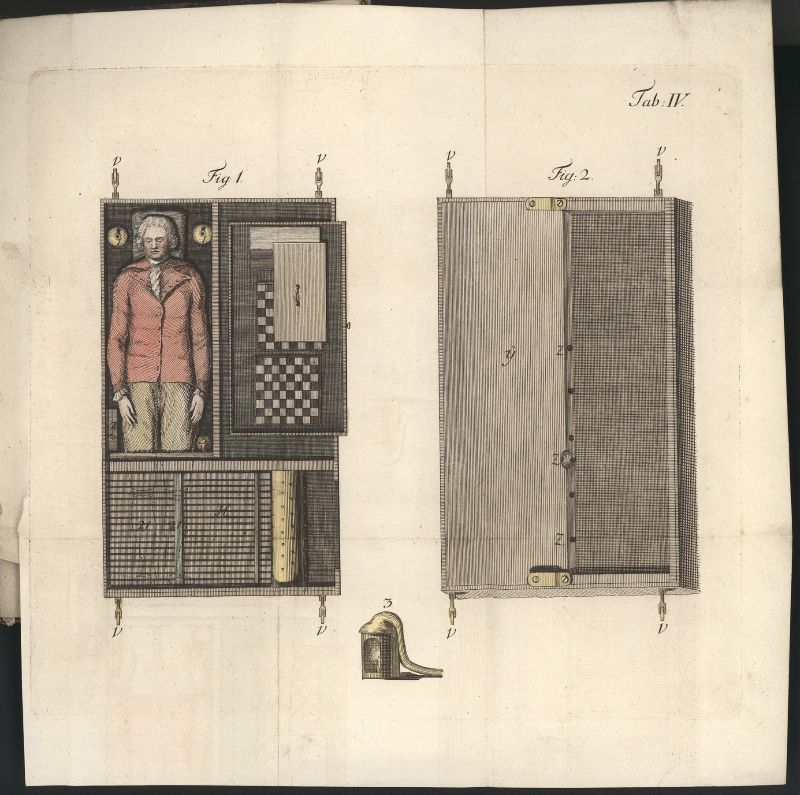
Poe, perhaps due to this suspected deception, though he never fully proved it, didn’t hold chess in high intellectual regard. He considered it frivolous and less relevant than other games, such as checkers or whist. In this context, in 1841, when he presented his story The Murders in the Rue Morgue he stated:
«A chess-player, for example, does the one without effort at the other. It follows that the game of chess, in its effects upon mental character, is greatly misunderstood. I am not now writing a treatise, but simply prefacing a somewhat peculiar narrative by observations very much at random; I will, therefore, take occasion to assert that the higher powers of the reflective intellect are more decidedly and more usefully tasked by the unostentatious game of draughts than by all the elaborate frivolity of chess. In this latter, where the pieces have different and bizarre motions, with various and variable values, what is only complex is mistaken (a not unusual error) for what is profound».
Another American writer, Washington Irving (1783–1859), in his book Tales of the Alhambra (1832), includes the fantastical tale «Legend of the Arab Astrologer,» in which it is mentioned that, at the top of a tower, tables were placed upon which small armies of cavalry and infantry, carved from wood, were arranged, just as «on a chessboard.»
The French poet Joseph Méry (1797–1866), who, along with de La Bourdonnais, was one of the founders of the magazine Le Palamède, published the book Le Joueur d’échecs («The Chess Player») in 1840, which includes this quote:
«Le monde est la patrie du joueur d’échecs ; c’est une profession ou un amusement cosmopolite. L’échiquier est un alphabet universel à la portée de toutes les nations. Le bonze joue aux échecs dans la pagode de Jagrenat ; l’esclave, porteur de palanquins, médite un mat contre un roi de caillou, sur un échiquier tracé dans la sable de la presqu’île du Gange ; l’évêque d’Islande charme le semestre nocturne de son hiver polaire avec les combinaisons du gambit du roi, et le début du capitaine Évans ; sous toutes les zones, les soixante-quatre cases du noble jeu consolent les ennuis du genre humain…»
(«The world is the homeland of the chess player; it is a cosmopolitan profession or pastime. The chessboard is a universal alphabet accessible to all nations. The monk plays chess in the pagoda of Jagrenat; the slave, carrying palanquins, meditates on checkmate against a stone king, on a board drawn in the sand of the Ganges Peninsula; the bishop of Iceland enchants the nocturnal semester of his polar winter with combinations of the King’s Gambit and the Captain Evans Opening; in every zone, the sixty-four squares of the noble game console the tribulations of humankind…»)

Two poems by the same author are known to be related to the game. On the one hand, there is Une revanche de Waterloo ou Une partie d’échecs («A Rematch for Waterloo» or «A Chess Game»), from 1836, which recounts a game played in 1834 between de la Bourdonnais and MacDonnell. On the other hand, there is Une Soirée d’ermites («An Evening of Hermits»), which describes two simultaneous blindfold chess games played in 1838 by the same French player against two writers, his compatriots Antoine Jay (1770-1854) and Etienne de Jouy (1764-1846). Furthermore, poems by Méry, under the title Les Échecs («Chess») enrich a collection of chess rules published in 1840 under the title L’Arbitre des jeux («The Referee of Games»).
The first begins by saying:
«Vous qui croyez encor qu’une paix éternelle / Tient deux peuples rivaux à l’ombre de son aile, / Politiques profonds, mais ne voyez-vous pas / Qu’une guerre de feu s’embrase sous vos pas?»
(«You who still believe that eternal peace / keeps two rival peoples in the shadow of its wing, / astute politicians, don’t you see / that a fierce war is brewing under your feet?»)
For its part, the second of them begins like this:
«Un jour, je vous ai dit, en termes d’épopée, / Ce combat, où le sang ne teignit pas l’épée, / Où le calme champ clos avait pour champions / Deux cavaliers, deux fous, deux tours, et huit pions, / État-major d’ivoire, entourant sur l’arène / Un faible roi, gardé par sa poissante queen…»
(«One day, I told you, in epic terms, / This battle, where blood did not stain the sword, / Where the calm enclosed field had for champions / Two knights, two bishops, two rooks, and eight pawns, / Ivory staff, surrounding on the arena / A weak king, guarded by his powerful queen…»)
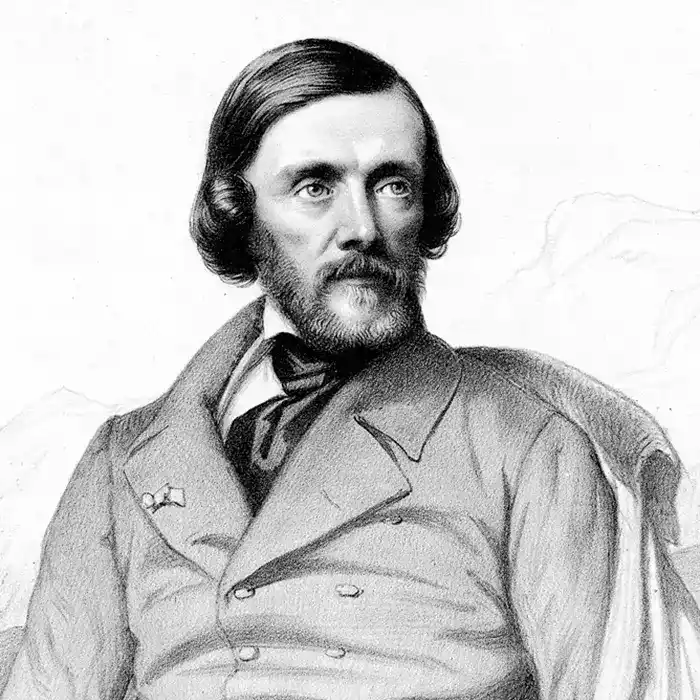
Another Frenchman, the Marquis de Sade (Donatien Alphonse François de Sade) (1740-1814), who amused himself with chess during his confinement in the Bastille, in his book Aline and Valcour or The Philosophical Novel, published in 1795, mentions chess almost incidentally, a sign of his fondness for the pastime, which he did in letter XXXIV, which Déterville sends to Valcour, dated in Vertfeuille on November 15, in which it is said:
«Le soir que madame de Blamont t’écrivit, nous étions, elle, Aline, Eugénie et moi, à raisonner sur ta folie; M. de Beaulé jouait aux échecs avec madame de Senneval, il était environ huit heures du soir, le ciel très-obscur se remettait à peine d’un ouragan épouvantable, lorsque tout-à-coup nous entendîmes un homme à cheval, faire retenir la cour de son fouet».
(«The evening that Madame de Blamont wrote to you, she, Aline, Eugénie and I were reasoning about your madness; Monsieur de Beaulé was playing chess with Madame de Senneval, it was about eight o’clock in the evening, the very dark sky was barely recovering from a terrible hurricane, when suddenly we heard a man on horseback hold back the court with his whip.»)
French poet Alfred de Musset (1810-1857), it is known that, in addition to playing regularly at the Café de la Régence, he even composed chess problems, notably one, published in 1849 in La Régence: Revue spéciale des échecs («La Régence: Special Chess Review»), which is a beautiful example of mate in three moves. One of his rivals on the board, and a friend, was Jules Arnous de Rivière (1830-1905), a renowned French chess player.

Musset, en su novela de 1837 Emmeline, incluye esta mención al juego:
«Elle trouva, en rentrant, son mari dans le salon, jouant aux échecs avec un de ses amis. Elle s’assit à quelque distance, et, presque malgré elle, regarda le comte. Elle suivait les mouvements de cette noble figure, qu’elle avait vue si belle à dix-huit ans, lorsqu’il s’était jeté au-devant de son cheval. Monsieur de Marsan perdait, et ses sourcils froncés ne lui prêtaient pas une expression gracieuse, II sourit tout à coup; la fortune tournait de son côté, et ses yeux brillèrent».
(«When she returned home, she found her husband in the living room, playing chess with a friend. She sat down some distance away and, almost in spite of herself, watched the Count. She followed the movements of that noble figure, whom she had seen so handsome at eighteen, when he had rushed to meet his horse. Monsieur de Marsan was losing, and his furrowed brows did not lend him a graceful expression. He suddenly smiled; fortune was turning in his favor, and his eyes shone.»)
In 1844, Alexandre Dumas, in The Three Musketeers, asserts:
«It was not uncommon for Richelieu and Louis XIII to dispute over their evening game of chess upon the merits of their servants».
The poet Lord Byron (George Gordon Byron, 1788–1824), the epitome of English Romanticism, is often credited with the expression «Life’s too short for chess,» but in truth, it is a chronologically later quote, belonging to the playwright Henry James Byron (1835–1884), and it was included in Our Boys, which premiered in 1875 at the Vaudeville Theatre in London.
From that same period, we find the mathematician and writer Lewis Carroll (1832–1898). Although his Through the Looking-Glass, and What Alice Found There«, a work in which chess plays a major role, came later, having been published in 1871, we know that in 1850, the year that marks the end of the period covered in this work, at the age of eighteen, he frequently recorded chess games played with his brothers during university holidays in his personal diaries.
The Scottish writer Walter Scott (1771-1832) was very close to chess, which he learned on the advice of his doctor while recovering from polio. He mentions it repeatedly in his work.

In 1812 he wrote Minstrelsy of the Scottish Border, a collection of regional ballads, one of which describes a courtly situation in which chess was present:
«It’s four-and-twenty ladies fair / Were playing at the ba’ ; Janet, the wightest of them anes, / Was faintest o ´them a´ / Four-and-twenty ladies fair / Were playing at the chess ; / And out there came the fair Janet / As green as any grass».
In his 1815 novel, Guy Mannering, Scott includes a reference to chess players practicing near a chimney, while in The Antiquary (1816), he mentions the business deal made by Snuffy Davie, who bought The Game of Chess, 1474, the first book printed in England, at a stall in Holland for about two groschen, two pence in our currency, and then sold it for twenty pounds, and furthermore, he makes this comparison: “like an indifferent chess player, he became with each failed move more vulnerable to his opponent’s counterattacks.”
But an even more interesting reference appears in another work from that same year, The Black Dwarf, where Scott alludes to the game, in terms of revenge, saying the following:
«When his father was killed?» said Lucy. «But that was very long ago; and I hope we have outlived the time of bloody feud, when a quarrel was carried down between two families from father to son, like a Spanish game at chess, and a murder or two committed in every generation, just to keep the matter from going to sleep. We do with our quarrels nowadays as with our clothes; cut them out for ourselves, and wear them out in our own day, and should no more think of resenting our fathers’ feuds, than of wearing their slashed doublets and trunk-hose.»
In Kenilworth (1821), he mentions a gold jewel in the shape of a chess piece.
It is evident that for Scott, another writer associated with the Romanticism so fashionable at the time, chess was a very prominent element. His approach to the game in Tristrem, an 1824 novel, is particularly interesting. In it, we see the captain of a Norwegian ship challenge anyone to a game of chess for twenty shillings. The protagonist of the story defeats him, which motivates the loser to go to sea with his victor, simply to avoid paying the bet. Later, the Queen of Ireland falls in love with the protagonist, given his skills in music, chess, and backgammon, within the framework of a story that alludes to others in which chess was relevant, such as the poem by Huon of Bordeaux (a 13th or 14th-century epic) and other related chivalric romances.
In Woodstock, from 1826, a person described as respectable is mentioned, who used to play chess and backgammon with the father of a character, with whom he read Shakespeare, or who acted as secretary for prayers when a reclusive clergyman dared to officiate Mass.
In The Life of Napoleon Bonaparte, from 1828, as one might expect from the Corsican, several episodes are mentioned in which chess plays a central role: it explains that he played it, although he wasn’t very skilled at the game, which required his rivals to be awkwardly positioned facing the emperor. It also highlights that, in the context of the Battle of Eckmühl in 1809, which pitted a Franco-German coalition against the Austrians led by Archduke Charles, things unfolded as follows:
«On the 22th. April, after this fortunate commencement of the campaign, Buonaparte directed his whole force, scientifically arranged into different divisions, and moving by different routes, on the principal army of the Archduke Charles, which, during these misfortunes, he had concentrated at Eckmühl. The battle is said to have been one of the most splendid which the art of war could display. An hundred thousand men and upwards were dispossessed of all their positions by the combined attack of their scientific enemy, the divisions appearing on the field, each in its due place and order, as regularly as the movements of the various pieces in a game of chess».
Following the parallels, there is also talk of the Battle of the Coa River of 1810, in the context of a new French invasion of Portugal, at which time Napoleon made a sort of prudent retreat that could be analyzed in this way:
«He saw, indeed, their retrograde movements, from the banks of the Coa towards Lisbon, conducted with all the deliberate and guarded caution of a game at chess«.
It also mentions the conclusion of «an armistice between Austrians and Russians, under whose terms they agreed to maneuver as in a game of chess«.
In an 1834 book, Essays on Chivalry, Romance, and the Drama, alluding to sayings by the English writer Geoffrey Chaucer (1343-1400) about squires, he states:
«The squire was also expected to perfect himself in the accomplishments of the period, and not only to be a master of the ceremonial of the feast, but to be capable of enlivening it by his powers of conversation. He was expected to understand chess, draughts, and other domestic games. Poetry and music, if he had any turn for these beautiful arts, and whatever other accomplishments could improve the mind or the person, were accounted to grace his station. And accordingly, Chaucer’s squire, besides that he was ´singing or fluting all the day´»
When writing his Memoirs, published in 1837, he went from considering chess a refuge at a certain early stage of his life («My only refuge was reading and playing at chess«) to later viewing it with bitterness, as he came to consider it «a sad waste of brains.»
In his childhood, it had been recommended to him as a respite from his continuous, albeit irregular, studies; and he enthusiastically embraced the game that his classmates had enjoyed so much. But Scott did not continue studying chess after that initial period of his life because, in his opinion, it was a shame to waste time, by mastering a simple game, however ingenious, time that could be devoted to learning, for example, a new language.
Furthermore, it is known that the author, and some of his friends, acquired in London several of the famous and ancient chess pieces discovered on the Isle of Lewis, which would eventually be exhibited in the Edinburgh Museum. This happened in 1831, the same year the pieces were discovered, a time when the writer was also vice-president of the Society of Antiquaries of Scotland.
In 1845, in Valparaíso, Chile, where he was in exile, Veinte días en Génova («Twenty Days in Genoa»), a book by the Argentine Juan Bautista Alberdi (1810-1884) in which the author’s impressions after his trip through Europe two years earlier are transmitted. Referring to the military officer and renowned chess enthusiast Bartolomé Mitre (1821-1906), in a clearly critical tone, he describes him thus:
“They say Mitre plays chess well, but we say he plays billiards better; and we base this on the fact that last time he wrote a letter to Somellera in which he called the men of his party ‘dancers’; and now he has written another to Gutiérrez, giving his political friends a real thrashing, or in other words, giving them a good thrashing (Mitre style). Both letters have been published with great success: is this or is this not playing for a draw perfectly well?…”
Another Argentine exile in Chile, Domingo Faustino Sarmiento (1811-1888), using the epistolary genre, published a fictional piece in 1842 in the Santiago newspaper El Progreso, entitled Carta a dos amigas («Letter from Two Friends») In it, he mentions a social gathering where «…a couple was playing chess…«, an activity so highly valued that one of them asks: «Do you know that this exercise has become a fashionable pastime, one of those essential skills that complement our education?» Besides noting that its practice was trendy, he adds: «…it’s necessary to understand something about chess so as not to be seen as a ‘foreigner’…«. Indeed, chess could naturally serve romantic purposes, and one way to exert a certain power over men was «…by moving the pieces on a board…». In any case, being unskilled at the game was frowned upon by these women, one of whom recounts:
“…to give you a clearer idea of the necessity of practicing chess, I will only add that there was a novice in our gathering, whom I was seeing for the first time, who, invited to a game, couldn’t even move a pawn and escaped the predicament so miserably that it’s impossible I could ever want him in my life, even if I were assured he was the best of his kind. Nor could a man be a good lover who is unfamiliar with such a tasteful pastime as this?”
Viajes («Travels»), one of Sarmiento’s works, is autobiographical in tone, recounting his experiences in other countries. It includes a letter he sent to the jurist Carlos Tejedor (1817-1903), dated May 9, 1846, and written in the French city of Rouen. In it, he describes the city as follows: “…amidst the noblest collection of Gothic monuments that any city in Europe boasts,” adding, “I have explored the city and its surroundings, climbed the towers of Saint-Ouen and the Cathedral, touching with my hands this carved, openwork, vaporized stone like Chinese chess pieces, to convince myself that so many marvels are human creations.” Here, chess was viewed for its iconographic power, and no longer, as in the previous instance, for its social and intellectual prestige.
Sarmiento, who, like Alberdi, was a pioneer in literary references to chess in South America, in his account of the 1848 siege of Montevideo in Volume II of his Campaña del Ejército Grande («Campaign in the Great Army»), a text published four years later, states in the chapter «Campaign of Uruguay» that «…that siege was a checkmate with no way out…». In another passage, when alluding to an episode that occurred on the 26th at Laguna de las Toscas or Laguna del Gato, he feels compelled to clarify the following:
«More valiant are the 103 black Uruguayans who have held our black battalions in check in Montevideo for nine years…».
PHILOSOPHY, SCIENCE, AND CHESS
In exploring the impact of chess on literary expressions, we have already seen how the game was linked to the Romantic movement, to the point that the way it was played at the time infused the period’s values.
The first half of the 19th century was a period of profound reconfiguration of Western thought. It was the era in which philosophy grappled with absolute idealism and the birth of materialism and positivism, while science began to professionalize and structure itself under strict methodological rigor.
In this context, chess was not a trivial game; it was considered a laboratory of thought, a scale model of the scientific method, or a mathematical and ontological reflection (the nature of being) of the order of the universe. Therefore, it was not only linked to Romanticism but also, as an expression of its powerful capacity for adaptation, chess would later become intertwined with the emergence of dialectical materialism and with the prevailing values of the Industrial Revolution.
In this regard, it should be noted that during the 1830s and 1840s, the German philosopher Karl Marx (1818-1883) and his circle of intellectuals in Berlin and Paris (the so-called «Young Hegelians«) were avid chess players. In fact, it is likely that his concept of dialectics would have been perfectly reflected in the duality of this agonistic practice, in which two colors clash. Moreover, the game takes place within the framework of conflict, another idea very dear to this school of thought. Later, in the second half of the century, during his exile in London, Marx continued to play the game.

And it was in the Café de la Régence in Paris itself that, in 1844, a meeting took place that would have future intellectual consequences. It was there that Marx and the Prussian Friedrich Engels (1820-1895) met. A chess match, therefore, closely linked to the world of ideas.
Another German philosopher, Arthur Schopenhauer (1788-1860), adhering to a kind of pessimistic idealism, in his magnum opus, Die Welt als Wille und Vorstellung («The World as Will and Representation«), which had a revised and expanded edition in 1844, mentions play when distinguishing the internal significance of an action from its external significance, which he asserts are frequently separate.
While the external significance of an action in relation to its consequences is for and in the real world, that is, according to the principle of reason, the internal significance lies in the depth of understanding of the idea of humanity that the action unlocks by bringing to light rarely highlighted aspects of that idea through clearly and decisively expressed individualities whose peculiarities are displayed in appropriately established circumstances. And so, this example arises:
«Thus, for example, it is all the same, as far as inward significance is concerned, whether ministers discuss the fate of countries and nations over a map, or boors wrangle in a beer-house over cards and dice, just as it is all the same whether we play chess with golden or wooden pieces» (in the Third Book: «The world as idea«)
The author has other quote about the game, namely:
«He now looks back smiling and at rest on the delusions of this world, which once were able to move and agonise his spirit also, but which now stand before him as utterly indifferent to him, as the chess-men when the game is ended, or as, in the morning, the cast-off masquerading dress which worried and disquieted us in a night in Carnival. Life and its forms now pass before him as a fleeting illusion, as a light morning dream before half-waking eyes, the real world already shining through it so that it can no longer deceive; and like this morning dream, they finally vanish altogether without any violent transition» (in the Fourth Book: «The world as will«)
In the field of science, the German mathematician Carl Friedrich Gauss (1777-1855) became closely linked to chess, as he studied, in the 1830s and 1840s, the problems of «The Eight Queens» (how to place them on the board so that they do not threaten each other) and «The Knight’s Walk» (the sequence of moves the knight makes visiting all sixty-four squares of the board without repeating a position), approaching them not as recreational puzzles, but as complex problems of topology and number theory.
Thus, whether it followed an intrigue that could have come from long ago (the Rudrata problem, the one about the knight, came, for example, from the Indian tradition of chaturanga from at least the 9th century), or whether it was presented contemporaneously (the one about the queens was formulated by the German chess player Max Bezzel (1824-1871) in the specialized newspaper Schachzeitung in 1848), a virtuous imbrication was reinforced that had already had other examples in the past: that of mathematics with chess.
ART AND CHESS
During the first half of the 19th century, the visual arts underwent a profound transition from Neoclassicism to Romanticism and early Realism. As in literature, painters ceased to portray chess exclusively as a courtly or mythological pastime of kings and gods, instead transforming it into a window into human psychology, domestic tensions, and the daily life of the rising bourgeoisie.
The Romantic movement, fascinated by drama, mystery, and distant worlds, found in chess a perfect iconographic motif, especially through the Orientalism that captivated Europe in the 1830s and 1840s.
In this context, the French painter Eugène Delacroix presented, in 1847/1848, Arabs Playing Chess. This oil painting portrays two figures absorbed in an outdoor game. Chess here is not a symbol of scientific calculation, but rather an element of fatalistic introspection, melancholy, and exotic stillness, captured with vibrant brushstrokes and profound chiaroscuro.

Another French artist, Jean-Louis-Ernest Meissonier (1815-1891), an academic painter celebrated for his meticulously detailed and almost photographic works, began producing a series dedicated to chess players, Les Joueurs d’échecs («The chess-players») in the 1840s. Influenced by the 17th-century Dutch masters, he specialized in capturing the psychological tension, particularly of the players who frequented the Café de la Régence.

From the French artist Leopold Boilly (1761-1845), we have a lithograph, not precisely dated, called Le Jeu Des Échecs («The chess-players») which shows players and an absorbed public surrounding a chessboard.
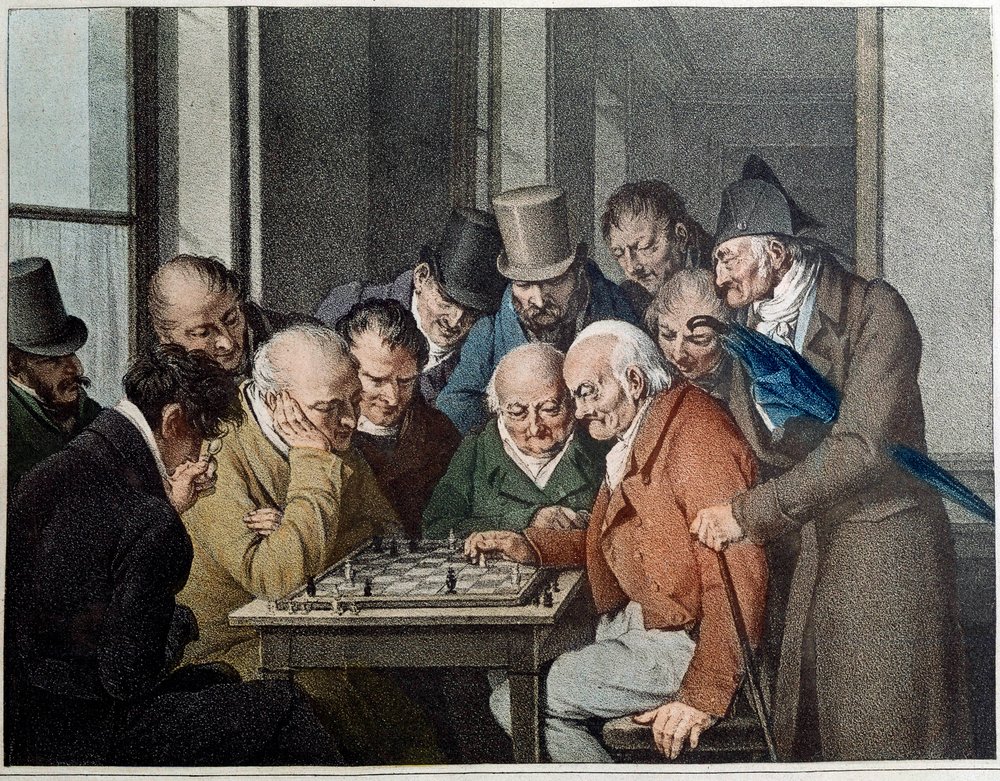
From Germany, we have Moritz Retzsch (1779–1857) who, in 1831, created a pictorial work (an etching that later inspired oil replicas) that became an absolute milestone for both the history of art and for chess culture: Die Schachspieler («The Chess Players»), also popularly known in the English-speaking world as Satan playing at chess with Man, where the myth of Faust is invoked.

Johann Erdmann Hummel (1778-1837), another German painter, presents, in 1830, Die Schachpartie im Palais Radziwill in Berlin («The chess game in the Palais Radziwill in Berlin»), portraying a royal meeting of the Schachgesellschaft (Chess Society) of Berlin in the palace of Prince Antoni Radziwiłł (1775-1833).
The chess pieces and board themselves could, as had been so common since the Middle Ages, be considered works of art. Among these, the Biedermeier and Selenus styles stand out, for which the work of Central European turners and carvers was employed, creating pieces of extreme delicacy in ivory and precious woods. Both styles enjoyed considerable popularity until they were superseded by pieces designed in the Staunton style.
The Biedermeier style flourished in Central Europe during this period (mainly in Germany, Austria, and the Scandinavian countries), reflecting the ideas of simplicity, functionality, geometric elegance, and an absence of excessive ornamentation. The pieces are characterized by their turned, clean, and abstract forms. The king and queen are usually crowned with simple concentric galleries or geometric finials. The horses are stylized. For their construction, finely polished local woods (such as pear, apple, walnut, or maple) were used, although for the wealthier classes, they were made of bone or ivory. The tables were small, round or square, supported by a single thick, sturdy central leg to optimize the space in the drawing room. The chessboard was not a separate piece, but rather artistically inlaid (marquetry) into the wood of the table’s top surface, alternating light and dark woods (such as ash and ebony) to create the sixty-four squares. Often, these tables included small, secret drawers in the sides for storing the pieces.
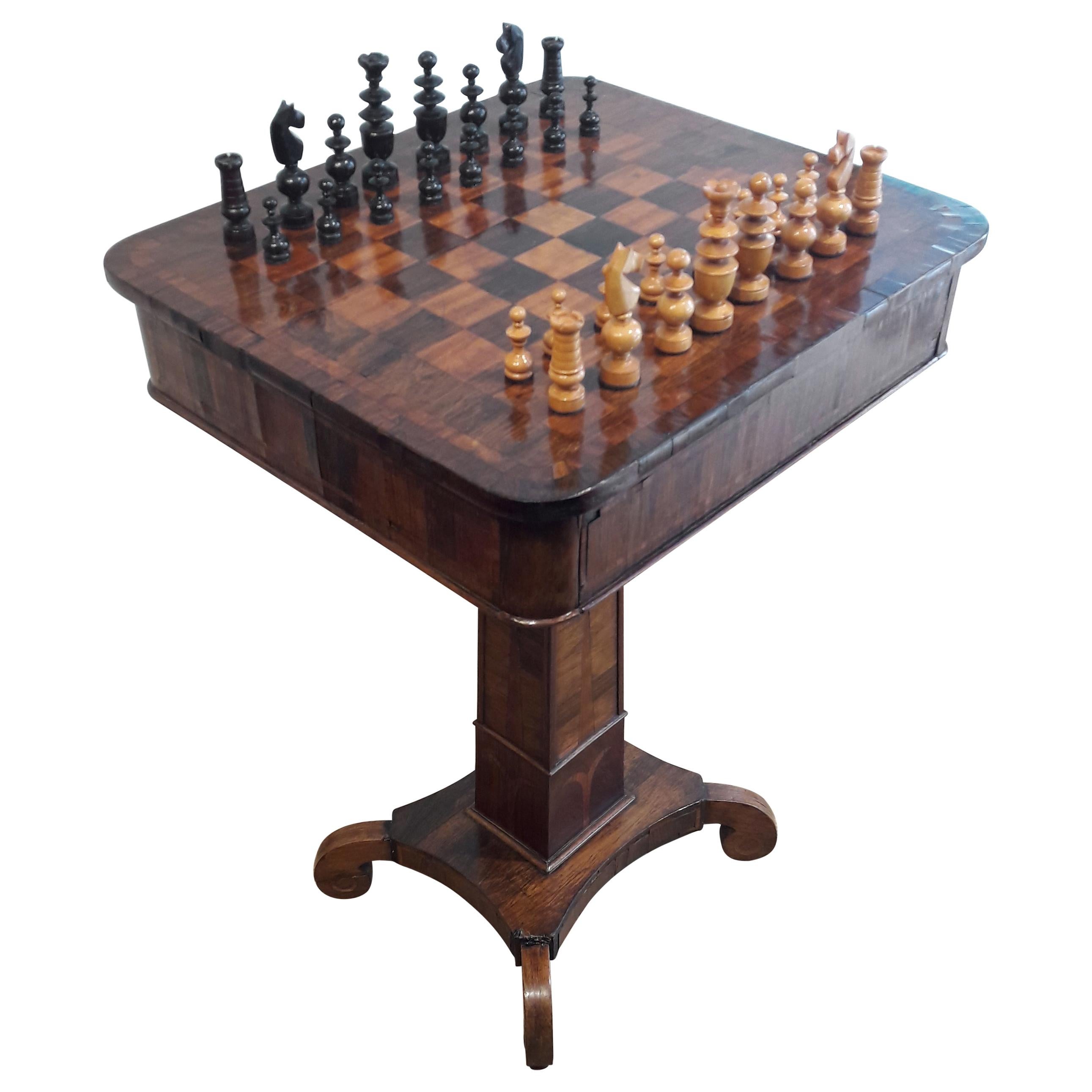
The Selenus style was characterized by stylized figures with delicate openwork concentric galleries or «crowns.» They were veritable sculptures of geometric lace. This style dominated central and northern Europe (Germany, Austria, Scandinavia) from the 17th to the mid-19th century, immediately recognizable by its gravity-defying silhouette compared to modern sets. It is characterized by its slenderness and height (which created a certain fragility that made them more suitable for display than for playing). The fact that the king, queen, and bishops were not distinguished by clear anthropomorphic figures, but rather by the number of platforms or circular crests carved at their apexes (the king usually had three tiers of pierced crowns, the queen two, and the bishop only one), is noteworthy. Pawns typically replicated the slender form of the larger pieces but on a smaller scale, topped with a small, smooth sphere. Knights were usually carved in profile, very flat, but with detailed manes, emerging from a tall pedestal, and rooks were designed as very tall columns or beacons, sometimes crowned with battlements or small flags. Ivory and bone were the preferred materials for luxury sets, while for everyday and commercial sets, fine woods such as ebony, rosewood, boxwood, or fruitwood were used, turned and then stained black and red (or natural black and white).
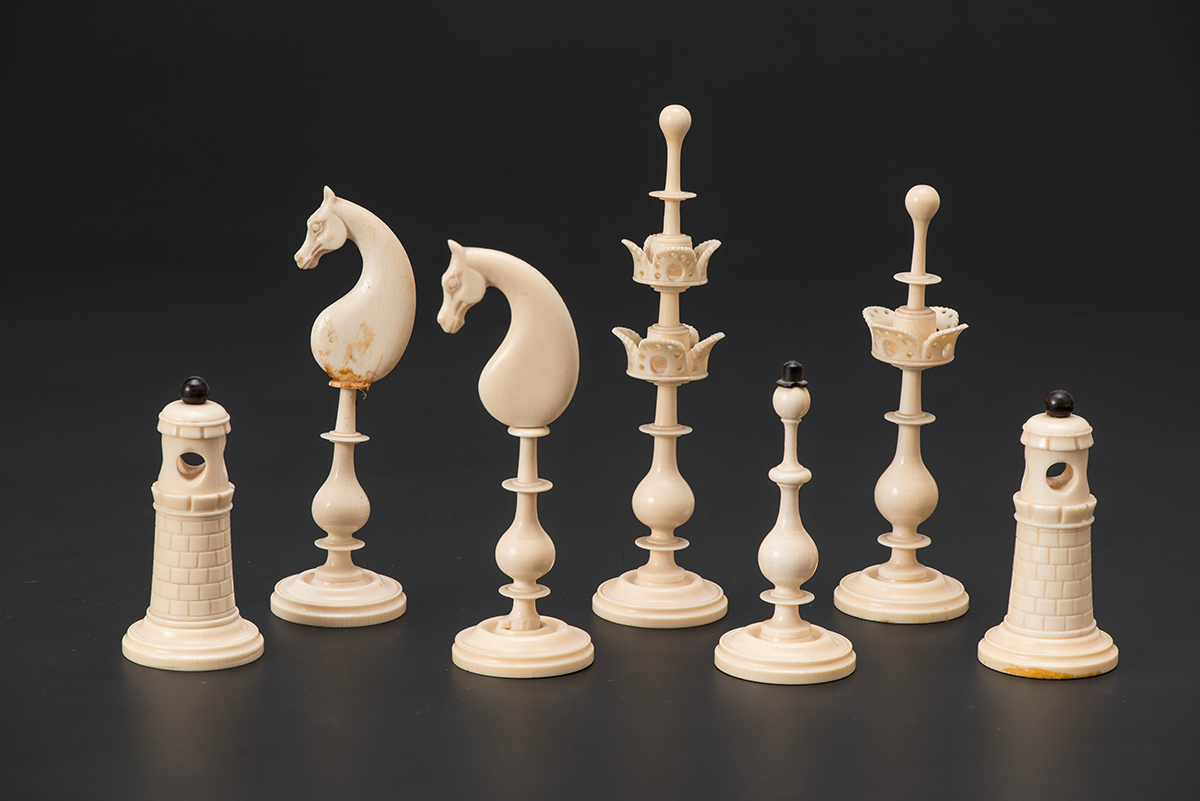
Also from this period are the Meissen porcelain sculptures (from Saxony, Germany), known as the «Indians versus Europeans» (c. 1815-1820), a famous set of figures that reflected the Romantic fascination with exoticism, particularly the presence of the British Empire in India. Each piece is a freestanding sculpture of hard-paste porcelain, measuring only six to nine centimeters. The level of sculptural detail is astonishing: facial features, the jewelry of the Rani (Eastern queen), and the folds of turbans were meticulously carved, defying the material’s tendency to warp in the kiln. The towers are not architectural structures but zoomorphic representations: elephants carrying siege towers for the Eastern side and hunting/guard dogs (or felines, depending on the variant) for the European side, signifying exoticism versus domesticity. The board is an integrated glazed porcelain tray, with a richly ornamented geometric pattern in gold outlining the squares.
Furthermore, both the French satirical publication Le Charivari, founded in 1832 by Charles Philipon (1800-1862), and its British counterpart Punch or The London Charivari (founded in 1841), frequently used chess, either as a geopolitical metaphor to portray international tensions and diplomacy (where rulers move pieces on the world chessboard), or as social criticism, caricaturing the obsession of chess enthusiasts, the atmosphere of 19th-century cafés (such as the Café de la Régence), and the dynamics of bourgeois life.
In the case of the French publication, the most celebrated illustrator was the Frenchman Honoré Daumier (1808-1879), who depicted chess in lithographs, particularly in the series Les Bons Bourgeois («The Good Bourgeois»), showing two bourgeois men engrossed in a night game, a theme he would later return to in a famous painting of the 1860s.
In Punch, meanwhile, John Tenniel (1820-1914) worked, who, in the second half of the century, would illustrate Lewis Carroll’s (1832-1898) books featuring his beloved Alice, and John Leech (1817-1864), with caricatures that primarily depicted the foreign policy of the British Empire. Likewise, illustration was used in this publication as a form of social satire, reflecting a certain «chess mania» in Victorian society.
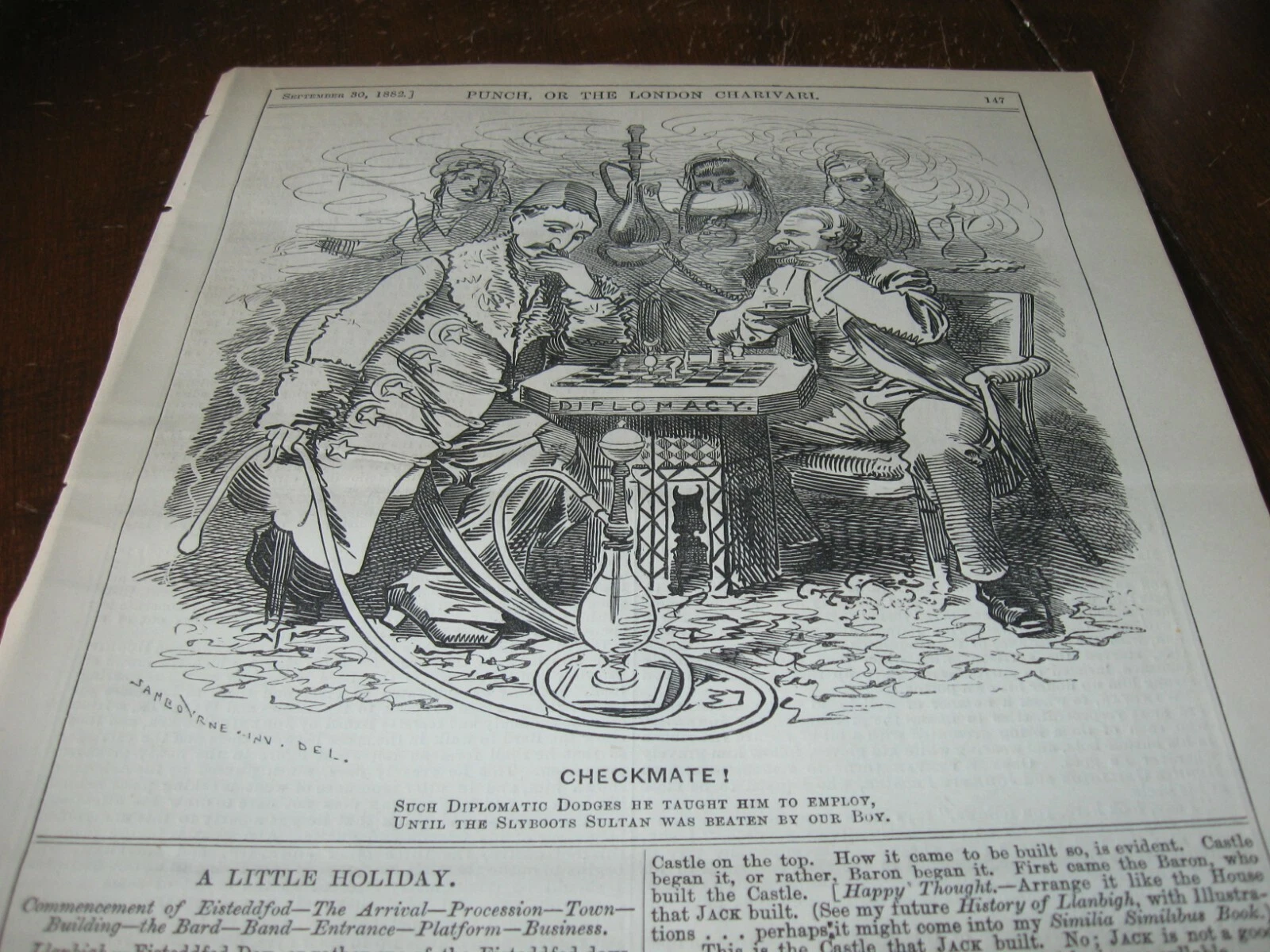
One last artistic element to note is the images that accompanied specialized chess books, such as those in the Handbuch des Schachspiels («Chess Handbook») by Bilguer and von der Lasa, already mentioned, or those by de La Bourdonnais, Walker, or Staunton. These books, alongside technical analyses, displayed images that evoked art and beauty.