Chess in the 19th Century: Milestones of 1898
By Sergio Ernesto Negri

Global Context
Following the explosion of the battleship Maine in Havana, the Spanish-American War began, with Cuba also intervening. The war ended with the Treaty of Paris, after which the European country lost its last colonies: Cuba, Puerto Rico, the Philippines, and Guam. These territories came under the control or influence of its rival in the armed conflict. This led to the emergence in Spain of the Generation of ’98, a group of intellectuals (including Miguel Unamuno, Antonio Machado, and Azorín, the pen name of José Martínez Ruiz) who reflected deeply on the country’s decline after the fall of its empire. The U.S., in its expansionist drive, occupied the Hawaiian Islands. Massive protests erupt in Italy over the price of bread, bringing the country to the brink of social unrest. A civil war breaks out in Bolivia. An earthquake devastates Turkey.

French scientists Marie (1867–1934) and Pierre Curie (1859–1906) announce the discovery of two new chemical elements: polonium (named after the scientist’s homeland) and radium. German physicist Max Planck (1858–1947) discovers an element that will eventually be called the photon. Spanish physician Santiago Ramón y Cajal (1852–1934) publishes the Neuron Theory. German Count Ferdinand von Zeppelin (1838–1917) patents his rigid airship design, laying the foundation for large-scale commercial aviation.

In January, the French writer Émile Zola (1840-1902) published his famous open letter, J’accuse…! («I Accuse…!«), in the newspaper L’Aurore, denouncing antisemitism and the injustice of the Dreyfus Affair. The British writer H. G. Wells (1866-1946) publishes War of the Worlds, one of the most influential works of science fiction of all time.

Chess in 1898
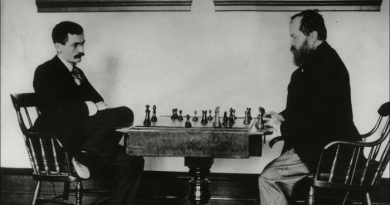
The Kaiser-Jubiläumsturnier Tournament is held in Vienna to commemorate the 50th anniversary of the reign of Franz Joseph I (1830-1916), a very demanding double round-robin tournament in which each player had to play thirty-six games. The Prussian Siegbert Tarrasch (1862-1934) and the American Harry Pillsbury (1872-1906) reached first place, with the former winning in the tiebreaker by 2.5 to 1.5. With the exception of the world champion, the Prussian Emanuel Lasker (1868-1941), the best players of that time participated, including the Frenchman (born in Belarus) Dawid Janowski (1868-1927), the former world champion, the American (born in Prague) Wilhelm Steinitz (1836-1900), the Austrian Karl Schlechter (1874-1918), and the Russian Mikhail Chigorin (1850-1908), who followed in that order, the latter tied on points with the Briton Amos Burn (1848-1925), who, for his part, won the German Congress, held in Cologne, ahead of Chigorin, the German Wilhelm Cohn (1859-1913), and the Czech Rudolf Charousek (1873-1900), tied for second place with Steinitz, Schlechter, and Janowski. stragglers.

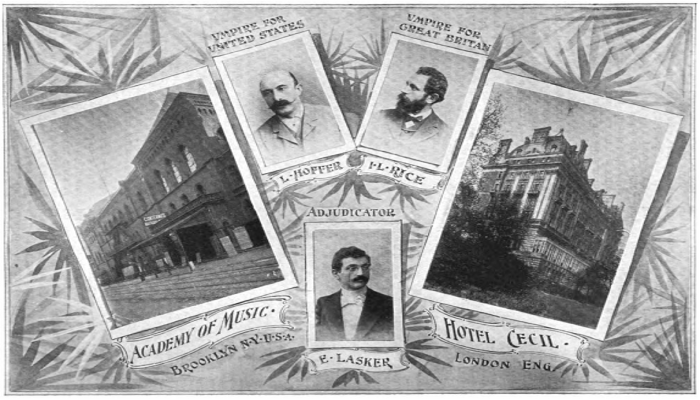
A third transatlantic match was held via telegraph between New York and London, with the Europeans winning 5.5 to 4.5. The first boards for the USA and Great Britain were, respectively, Pillsbury and Joseph Blackburne (1841-1924). It was broadcast through the Commercial Cable Company. Lasker was responsible for awarding unresolved games, and the Austrian Baron Albert Salomon Anselm Freiherr von Rothschild (1844-1911), a renowned patron of the arts, served as arbiter. It was a highly significant event at the time, not only in the specialized media, demonstrating the technological advancements and the possibility of long-distance communication. Following the model, at the end of the year there was another meeting of these characteristics, of shorter distances of course and without crossing the Ocean, between Stockholm and Gothenburg, with the victory of the team from the Swedish capital by 1.5 to 0.5.

According to Chessmetrics, as of December, the top 5 consisted of Lasker (who was notably inactive in chess that year: he was in Great Britain focused on academic studies and earned a living by giving lectures); Tarrasch; Janowski; Pillsbury; and Steinitz. EDO Historical Chess Ratings, in its annual ranking, lists Lasker, Tarrasch, Pillsbury, Charousek, and Janowski in the same positions (Steinitz is sixth)
In the English capital, the Gambit Chess Rooms (or simply Gambit) opened, a chess club that, curiously, was exclusively for men (as was usual at the time), but was managed by Edith Price (1872-1956), who would become English champion five times (1922, 1923, 1924, 1928, and 1948). In the early days, women could only work as waitresses at the club.

Several personalities linked to chess were born, such as the French filmmaker René Clair (1898-1981), director of the short film Entr’acte («Interlude»), from 1924, in which his compatriot Marcel Duchamp (1887-1968) and the American Man Ray (1890-1976) are shown playing chess,
Also born was the German playwright Bertolt Brecht (1898-1956), who as a young man demonstrated his rebellious streak by playing the lute and chess, with several references to the game in his work, such as when the protagonist of Leben des Galilei («The Life of Galileo») says the following when pointing out that the Earth revolves around the Sun:
«Overnigth the universe lost its centre and this morning – they are countless. Each and none at all is the centre. Suddenly there´s a lot of room. The ships go far on the sea, the stars go far into space ‘ – even in chess, nowadays, the rooks have taken to flying all over the board».
Also born was the Belgian painter René Magritte (1898-1967), who enjoyed playing chess more than painting itself, a game he used to play at the Café Greenwich in the city of Brussels.

The Spanish poet Federico García Lorca (1898-1936) is born. In La monja gitana («The Gypsy Nun»), he includes these beautiful verses:
«Through the nun’s eyes / two gypsy outlaws gallop. (…) / Ai, what a rising plateau / with twenty suns shining above! / And what rivers, rising on their feet, / has her fantasy has glimpsed! / But she endures with her flowers, / while, all / around in the wind, / the light plays the high game of chess / across the latticework of the windows».

And this year also marks the anniversary of the birth of the Argentine intellectual Raúl Scalabrini Ortiz (1898-1959), whol believed that: “Chaos only exists for those who are not leaders, for the simple soldier who must obey orders that do not originate from his own will, for those who are merely chess pieces on a board where others are playing.”
The British writer Lewis Carroll, whose real name was Charles Lutwidge Dodgson (1832-1898), also passed away. He was closely associated with chess, particularly for having conceived his character Alice as passing through the looking glass to assume the role of a pawn in a game on a human scale, a story that culminates in her being crowned queen and returning to reality after a oniric journey.

The British writer Herbert George Wells (1866-1946), who even imagined a game between God and the Devil, presents a rather critical essay on chess, aptly titled «Concerning Chess» in it, he asserts that the passion for this game is one of the most inexplicable in the world, a slap in the face to the theory of natural selection, since «It is the most absorbing of occupations, the least satisfying of desires, a directionless excrescence of life.»

The Scottish writer Arthur Conan Doyle (1859-1930), published a short story entitled The Adventure of the Retired Colourman. This story centers on a criminal—an avid chess player and retired art dealer—who has no qualms about murdering one of his chess rivals. In this context, he coined the following phrase: “An interest in chess indicates the existence of an intriguing mind.”