Chess in the 19th Century: Milestones of 1896
By Sergio Ernesto Negri

Global Context
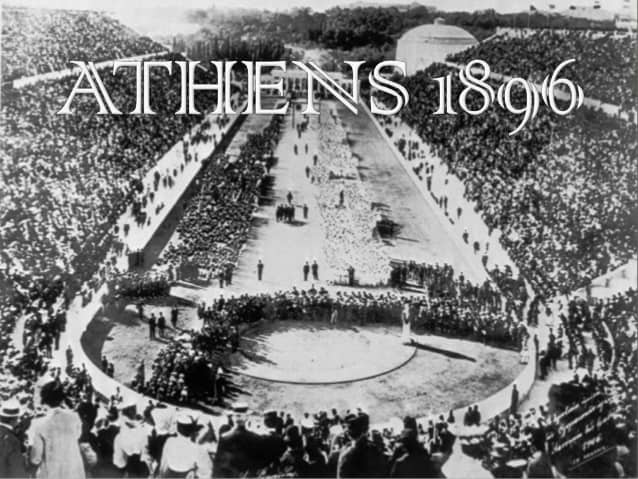
Thanks to the efforts of French Baron Pierre de Coubertin (1863-1937), the first Olympic Games of the modern era were held in Athens, with fourteen countries participating. The first Olympic champion was American James Connolly (1868-1957) in the triple jump, and his country topped the overall medal count. The first commercial film screenings took place in cities such as London, New York, Madrid, and Buenos Aires, with the French filmmaker Alice Guy-Blaché (1873-1968) directing La Fée aux Choux («The Cabbage Fairy«) considered the first narrative film (with a plot) in history. The French physicist Henri Becquerel (1852-1908), Nobel Prize in Physics in 1903, shared with the Curies, discovered natural radioactivity almost by accident while investigating the phosphorescence of uranium salts. News of the X-ray discoveries made the previous year began to spread. American Henry Ford (1863-1947) completed his first motorized vehicle, the quadricycle, marking the beginning of his automotive empire. Italian inventor Guglielmo Marconi (1874-1937) obtained the first patent in the United Kingdom for a wireless telegraphy system (the basis of radio).
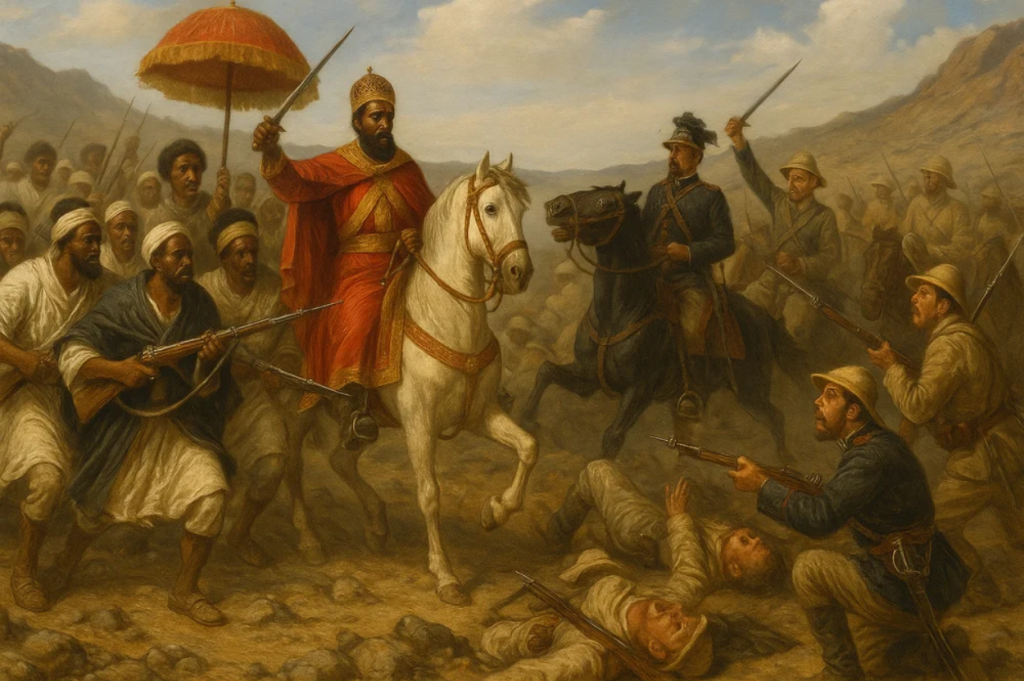
At the Battle of Adwa, the Ethiopian army defeated the invading Italian forces, marking the first time an African nation had defeated a European colonial power. The Cuban War of Independence against Spanish rule continued, with uprisings against the Spanish also breaking out in the Philippines. Zanzibar came under British rule. Two earthquakes, the first of which was followed by a tsunami, caused widespread destruction and thousands of fatalities in Japan. A massive fire destroyed half of the Ecuadorian city of Guayaquil. European anthropologists purchased the remains of indigenous people massacred in Paraguay in order to study the “missing link” between “monkeys and human beings.
Italian composer Giacomo Puccini (1858-1924) premiered the opera La Bohème in Turin, conducted by his compatriot Arturo Toscanini (1867-1957). The Island of Doctor Moreau by British writer H.G. Wells (1866-1946) was published, establishing science fiction as a literary genre. French mathematician Henri Poincaré (1854-1912) published his book on probability calculus.

Chess in 1896
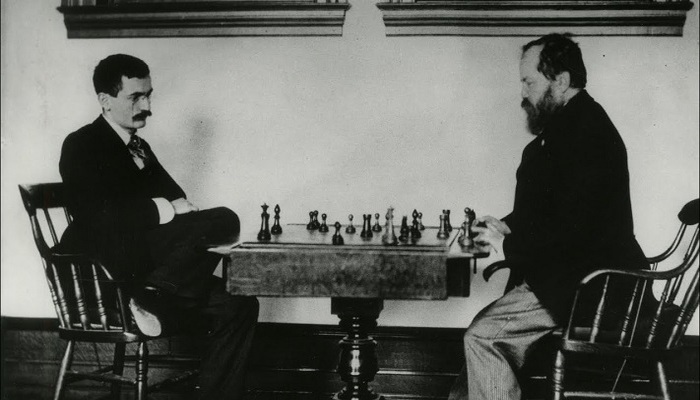
The rematch for the world title between the Prussian Emanuel Lasker (1868–1941) and the former champion Wilhelm Steinitz (1836–1900) —now an American, though born in Prague—began at the end of the year and concluded the following. It is played in Moscow, and Lasker clearly prevails with ten wins, two losses, and five draws. He was overwhelming, starting the match with four consecutive victories and, by the eleventh game, had already racked up seven wins.

At the beginning of the year, the St. Petersburg tournament—which had begun in 1895—came to a close, with Lasker emerging victorious, ahead of Steinitz, the American Harry Pillsbury (1872–1906), and the Russian Mikhail Chigorin (1850–1908). Thus, with that second-place finish, the former champion virtually secured his right to challenge for the crown again, since Pillsbury—who had just won at Hastings and had started the tournament in first place, positioning himself as the likely challenger—would no longer be, as he later suffered a collapse due to health problems, ultimately falling behind in the standings of this competition.
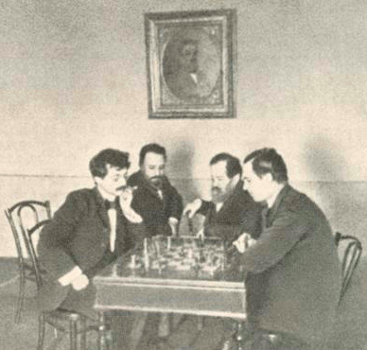
At the Nuremberg tournament, Lasker emerged victorious, ahead of the Hungarian Géza Maróczy (1870–1951), with Pillsbury and Prussian Siegbert Tarrasch (1862-1934) sharing third place; Steinitz finished sixth, in yet another sign of decline, having missed the opportunity to reclaim a world title he had once held.

In Budapest, the winners were Chigorin and the local player Rudolf Charousek (1873–1900), with the Russian prevailing in the tiebreaker; followed by Pillsbury, the Austrian Karl Schlechter (1874–1918), the Frenchman (born in Belarus) David Janowski (1868–1927), and, trailing behind, Tarrasch. At the Trebitsch Memorial in Vienna, the winner was the Romanian Georg Marco (1863–1923).
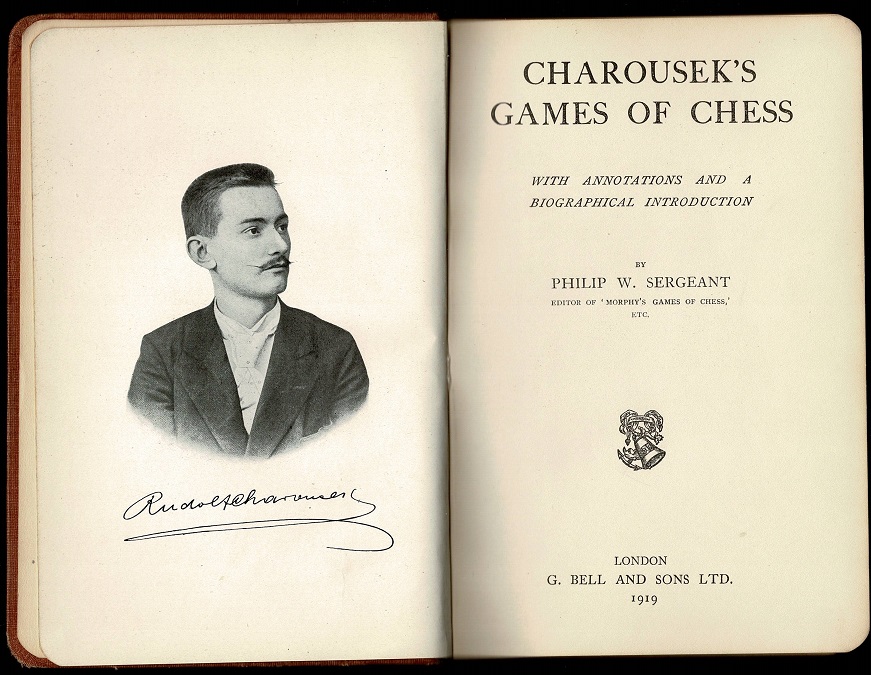
Charousek, a genius cut down in his prime
As of December, Chessmetrics lists the top rankings as follows: Lasker; Tarrasch; Chigorin; Pillsbury; German Curt von Bardeleben (1861-1924), with Steinitz relegated to seventh place, behind Schlechter. EDO Historical Chess Ratings, for its part, presents this top 5 for the year as a whole: Lasker; Tarrasch; Steinitz; Pillsbury; Chigorin.
The first telegraphic match took place, with communications crossing the Atlantic Ocean via transatlantic cables of the Commercial Cable Company, between the U.S.—with a team based in New York—and England—whose members were in London—resulting in a 4.5–3.5 victory for the former. The top boards were, respectively, Pillsbury and Joseph Blackburne (1841–1924), with the latter won the match. Technology, it was clear, could bridge distances, enabling matches that had previously been considered unthinkable, which received significant media coverage.

Born: in Germany, Friedrich Sämisch (1896–1975), one of the first recipients of the GM title awarded by FIDE in 1950, known for his outstanding tournament performances in the 1920s and significant contributions to chess theory; in Peru, Esteban Canal (1896–1981), who had an extraordinary career in Europe, where he even became the Hungarian champion, a player who was the best in South America in the first half of the 20th century; in Austria, Albert Becker (1896–1984), an Olympic champion in Buenos Aires for a Germany that had annexed his native country, who remained in Argentina, where he would spend his final days; the player will be remembered for his defiant proposal to create a Menchik Club, assuming that no man would be allowed to join since only those who lost to the queen would be admitted there; by divine justice, he became the first member after being defeated by the world champion, the Moscow-born British citizen Vera Menchik (1906–1944) and Hans Müller (1896–1971), individual bronze medalist at the 1933 Folkestone Olympiad; in Czechoslovakia, one of the founders of FIDE in Paris in 1924, Karel Skalička (1896–1979), who would also become an International Arbiter and, in Hungary, Árpád Vajda (1896–1987), national champion and a multiple medalist at the Chess Olympiads (team silver at the unofficial tournament in Paris in 1924; team gold at the unofficial tournaments in Budapest in 1926 and Munich in 1936; team gold in London in 1927 and The Hague in 1928; team silver in Hamburg in 1930 and Stockholm in 1937).

French writer André Breton (1896–1966), the father of Surrealism, was born. He mentioned chess in a critical tone in the movement’s Second Manifesto, angered because his friend, colleague, and compatriot Marcel Duchamp (1887–1965) had chosen to devote himself to the game rather than to art. There he exclaims: Il n’est pas admissible que Marcel Duchamp soit passé au jeu d’échecs, qu’il ait consenti à faire échec à tout ce qui n’est pas ce jeu même (“It is unacceptable that Marcel Duchamp should have turned to chess, that he has agreed to thwart anything that is not this very game”).

The Romanian poet Tristan Tzara (1896–1963), also born that year, coined the term “Dada” at the Café de la Terrasse in Zurich, Switzerland, where the future leader of the Russian Revolution, Lenin (1870–1924), played chess in front of him—a connection that was recreated in novel form by the Romanian writer Andrei Codrescu (born in 1946) in The Posthuman Dada Guide: Tzara & Lenin Play Chess.

The poet Gerardo Diego (1896–1987) was born in Spain; he wrote several poems centered on the game, including one specifically titled Ajedrez (“Chess”) published in his book Limbo, which is considered a quintessential example of the Ultraist movement. The poem includes these lines: Alguna vez ha de ser / La muerte y la vida / me están / jugando al ajedrez (“Someday it must be / Death and life / are / playing chess with me”). In other works, he imagines a skeleton playing chess in black gloves, compares it to bullfighting, and depicts God himself playing the game: Y se oyen débilmente las órdenes de Dios / que juega consigo mismo al ajedrez (“And faintly one hears the commands of God / who plays chess with himself”).