Chess, senet and the Egyptian idea of order
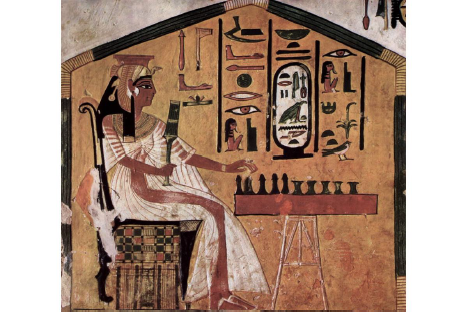
Chess can be read alongside Egyptian ideas of order, judgement and self-discipline. Beginning with senet and its symbolic links to the afterlife, the text follows the later arrival of shatranj in Islamic Egypt and considers how the chessboard became a useful metaphor for ethics, strategy and human limits. These connections are treated cautiously, avoiding claims of direct continuity where evidence is uncertain. | Image: Painting in tomb of Egyptian queen Nefertari (1295–1255 BCE)
Order, balance, judgement
Playing well at chess can be compared to building a pyramid: each move must be placed with care, because the structure only holds if its parts are coherent.
Ancient Egyptian culture did not know chess in its modern form, but it did develop a rich symbolic world in which order, balance and judgement occupied a central place. The concept of Maat, usually associated with truth, justice and cosmic harmony, shaped religious and moral ideas about how life should be lived. Within this framework, human conduct was often understood as part of a wider order that extended beyond everyday existence.
Egyptian beliefs about death and the afterlife also placed strong emphasis on preparation, judgement and moral balance. Funerary practices such as mummification and the use of religious texts were intended to assist the deceased in the journey beyond death. The well-known image of the weighing of the heart before Osiris, with the heart measured against the feather of Maat, reflects the importance given to justice and moral accountability in Egyptian religious imagination.
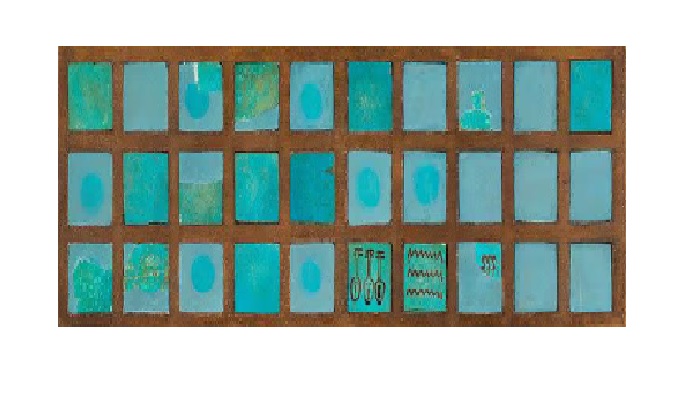
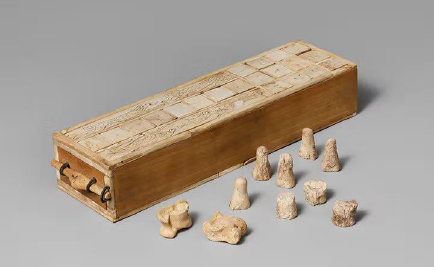
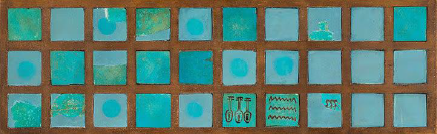
Against this background, senet occupies an important place in discussions of Egyptian board games. The game is attested in tombs and archaeological finds, and over time it acquired symbolic associations with the passage of the soul and the journey into the afterlife. It would be excessive to describe senet simply as a direct ancestor of chess, but it does show that board games in Egypt could carry meanings beyond recreation, especially when placed in funerary or religious contexts.
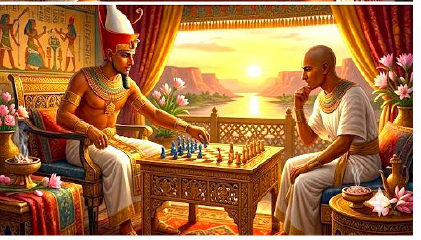
Chess itself reached Egypt much later, after the spread of Arab-Islamic culture and the transmission of shatranj from the Persian and broader Islamic worlds. Between the early Islamic period and the medieval centuries, Egypt became part of an intellectual environment in which chess was played, discussed and sometimes debated. Cities such as Al-Fustat and later Cairo provided settings in which the game could be connected with education, courtly culture and strategic thought.
In medieval Islamic societies, chess was not viewed in only one way. Some writers and jurists regarded it with suspicion, particularly when it was linked to gambling, distraction or excessive pride. Others saw in it a disciplined exercise of calculation, patience and judgement. In Egypt, as elsewhere in the Islamic world, this tension made chess a subject not only of leisure but also of ethical discussion.
The association between chess and inner discipline can also be read alongside strands of Sufi thought, though such connections must be made carefully. Figures such as Ibn Ata Allah al-Iskandari did not write about chess as a central topic, but his emphasis on detachment, patience and attention offers a framework through which the game can be interpreted. From this perspective, the ideal player is not merely one who seeks victory, but one who acts with concentration and restraint.
In the modern period, Egyptian intellectual life increasingly engaged with European ideas while continuing to draw on Islamic, Arabic and ancient Egyptian traditions. Reformers such as Rifāʿah Rāfiʿ al-Ṭahṭāwī and Alī Pasha Mubārak are often associated with education, rational inquiry and institutional reform. While specific claims about their direct use of chess should be treated cautiously unless firmly documented, the game fits naturally within the broader nineteenth-century interest in disciplined reasoning and moral education.
Twentieth-century Egyptian thought and literature offer further ways to understand chess as a metaphor. Ṭāhā Ḥusayn’s work, for instance, did not depend on chess as a subject, but his defence of critical thought, education and the classical heritage resonates with the values often associated with the game. In modern literature, including the work of Naguib Mahfouz, games and social spaces can serve as settings for questions of morality, power, isolation and change.
Seen in this wider context, chess in Egypt belongs less to a single uninterrupted tradition than to a series of symbolic and intellectual associations. From senet and the religious imagination of ancient Egypt to shatranj in the medieval Islamic world and later literary uses of the chessboard, games have offered a way to think about order, conflict, time and judgement.
Sources:
- Abu Zayd, N. H. (2006). Reformation of Islamic Thought: A Critical Historical Analysis. Amsterdam University Press.
- Ali Mubarak. (2000). Al-Khitat al-Tawfiqiyya al-Jadida (Nueva edición). Egyptian Book Organization.
- Al-Adli, M. b. T. (1994). Kitab al-Shatranj [El libro del ajedrez] (Reimpresión crítica). Dar al-Fikr.
- Al-Iskandari, I. A. A. (2005). The Book of Wisdom (al-Hikam) (V. Danner, Trans.). Paulist Press.
- Al-Tahtawi, R. (2002). An Imam in Paris: Account of a Stay in France (D. Newman, Trans.). Saqi Books.
- Asfour, G. (2001). Taha Hussein and the Enlightenment in the Arab World. Dar Al-Hilal.
- Ayoub, M. (1997). Islam: Faith and History. Oneworld Publications.
- Blanco Hernández, U. (2025). Ajedrez y Filosofía. Editorial Jaque Mate, México.
- Blanco Hernández, U. (2020, julio). Platón afirmó que el ajedrez fue creado por el dios egipcio Thot. ChessBase, 29/07/2020 –s://es.chessbase.com/post/platon-afirmo-que-el-ajedrez-fue-creado-por-el-dios-thot-uvencio-blanco-2
- El-Enany, R. (1993). Naguib Mahfouz: The Pursuit of Meaning. Routledge.
- Gutas, D. (2001). Greek Thought, Arabic Culture: The Graeco-Arabic Translation Movement. Routledge.
- Hanafi, H. (1995). Heritage and Modernity. University of Cairo Press.
by Dr. Uvencio Blanco Hernández, ID FIDE: 3902340

Born in Caracas, Venezuela (1955). He is an author, researcher, and lecturer. He is a FIDE International Arbiter, FIDE International Organizer, Lead Instructor of FIDE Chess Schools, and Chess Professor for the European Chess Union. He is a former Chairman of the FIDE Chess In Schools Commission, a member of the FIDE Chess and Education Commission, and a member of the FIDE History Committee. / uvenchuk@gmail.com