Chess in the 19th century. Milestones of 1889
By Sergio Ernesto Negri

Global context
France occupies Ivory Coast. Menelik II (1844-1913) is crowned emperor of Ethiopia. The Eiffel Tower, the Universal Exposition, and the Moulin Rouge open in Paris, where the Second International is founded, the organization of socialist and labor parties that declare May 1st as Workers’ Day. A pandemic emerges: the Russian flu. Emperor Pedro II (1825-1891) is deposed in Brazil, and a republic is established.
Four days apart, English actor Charles Chaplin (1889-1977) and German Adolf Hitler (1889-1945) are born, the genius and the genocidal maniac. Dutch painter Vincent van Gogh (1853-1890) paints The Starry Night and dies shortly afterwards. An American journalist, Nellie Bly (1864-1922), following the book by French author Jules Verne (1828-1905), begins a trip around the world that, in his case, will last seventy-two days (and a fraction). American inventor Thomas Edison (1847-1931) presents the first prototype of the kinetoscope, a precursor to the cinematograph.

Chess in 1889
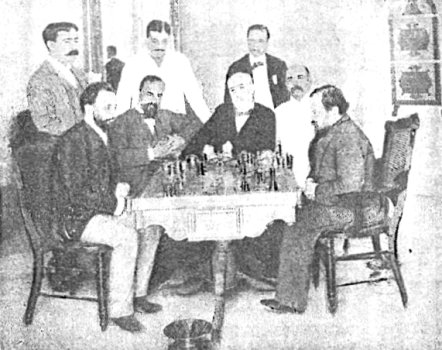
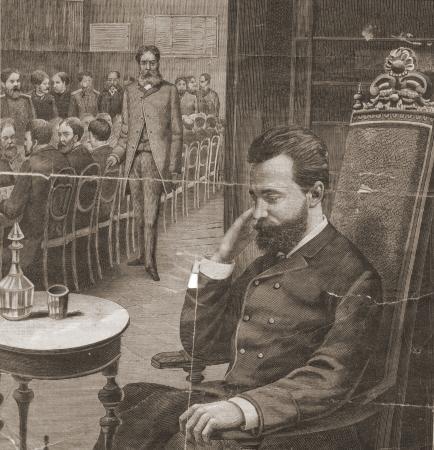
In a match for the world crown played at the beginning of the year, the champion Willhelm Steinitz (1836-1900), born in Prague but now playing under the flag of his country of permanent residence, the United States, to which he had emigrated in 1883, managed to retain the crown in Havana against Russia’s Mikhail Chigorin (1850-1908), defeating him by an overall score of 10.5 to 6.5.
The Havana club was the organizer, and it was Steinitz himself who chose his opponent. At that time, there was no world organization to regulate such a delicate matter, so the champions had a say in defining the conditions under which the respective matches would take place, generally giving priority to economic issues.
The contest, like the one in 1886 in which Steinitz became champion, began with a defeat for the latter, an unfavorable situation that continued until the third game and would be repeated in the seventh. However, from the eighth onwards, the reigning champion took control of the situation and, in fact, achieved the tenth victory necessary to retain his title after the twenty-first game of the twenty-four originally agreed upon. The Russian won six games and there were five draws.
Chigorin later achieved joint first place with Slovakian Max Weiss (1857-1927) at the American Congress held in New York, a monumental tournament due to the number and quality of the players involved. Both finished ahead of the English players (in the first case of Hungarian origin) Isidor Gunsberg (1854-1930), just half a point behind the winners, and Joseph Blackburne (1841-1924), two points behind the leaders. It was a virtual Candidates Tournament, but at the end, Chigorin chose not to face Steinitz again (for now) and Weiss decided to return to Europe, paving the way for Gunsberg to be the next challenger.
At the Congress held in Breslau (now Wroclaw), Siegbert Tarrasch (1862-1934) of Prussia prevailed, followed by Amos Burn (1848-1925) of England, with another German, Jacques Mieses (1865-1954), in third place (Gunsberg and Blackburne trailed behind). In Amsterdam, Burn won, ahead of the Prussian Emanuel Lasker (1868-1941) and the Irish-American James Mason (1849-1905); This tournament is particularly remembered for Lasker’s spectacular victory over the Czech Johann Bauer (1861-1891), in which he made a double bishop sacrifice that would become a classic. In London, victory went to local player Henry Bird (1829-1908) and Gunsberg, with Mason coming third

Englishwoman Mary Rudge (1842-1919) was the first woman to join the Bristol Chess Club, being admitted in 1872. This year, two important events took place in her career: she won the Challenge Cup of Bristol & Clifton Chess Club and became the first known woman to give a simultaneous exhibition.

For EDO Historical Chess Ratings, the top positions were held by Steinitz, Tarrasch, Lasker, Chigorin, and Weiss. Chessmetrics, on the other hand, listed the following players in the top positions for December of that year: Steinitz; Chigorin; Scottish-American George Mackenzie (1837-1891); Tarrasch; and Czech (a nation that was part of the Austro-Hungarian Empire) Berthold Englisch (1851-1897).
Three great players were born. On the one hand, the Ukrainian (in the Russian Empire) Yefim Bogoliubov (1889-1952), a very special case from the perspective of the national cause. He was born in Ukraine, but as that territory was then part of the USSR, he became the hope of Russia when he won the 1925 Moscow tournament, ahead of the Prussian Emanuel Lasker (1868-1941) and the Cuban José Capablanca (1888-1942), and in both Soviet championships. However, he ended his career as a leading player in Germany in general, and during the Nazi era in particular, despite the fact that this country had imprisoned him, along with other players, when he was participating in the Mannheim tournament in 1914 when World War I broke out. Throughout his rich and extensive career, he had two opportunities to win the world title, against the Russian-French Aleksandr Alekhine (1892-1946), another of those imprisoned at that time, who, however, did not allow his crown to be taken from him. In 1951, and not in 1950 as it should have been when the first awards were presented, FIDE rectified its previous omission and awarded him the title of GM, with which he would bid farewell to life.

On the other hand, there was the Czechoslovakian Richárd Réti (1889-1929), born in a city that at that time belonged to Hungary, who is especially remembered for having broken Capablanca‘s unbeaten streak by beating him with the opening that bears his name (beginning with 1. Nf3) in the 1924 New York tournament. In addition to his strong performance in international tournaments (including winning a national championship in Argentina, which was not recognized due to his status as a foreigner), for his work in spreading the new ideas of the hypermodern movement through his preaching and his books, in particular one published in 1921 in New York, entitled Die neuen Ideen im Schachspiel.
Also, in Poland, at a time when that territory was part of the Russian Empire, Grigori Levenfish (1889-1961) was born. He had outstanding performances in Soviet championships, including a solo victory and another shared victory, and was one of those anointed as GM in 1950 by FIDE.

Likewise, the Hungarian Lajos Asztalos (1889-1956) was born. Based in Yugoslavia, he represented that country in the Olympiads, winning a silver medal in the unofficial competition held in Budapest in 1926. Upon returning to his country, he died in the midst of a revolution against the established powers.
The Slovakian (a nation that was part of the Austro-Hungarian Empire at the time) Ignatz Kolisch (1837-1889) dies, who lost by a narrow margin in a 1861 match against the Prussian Adolf Anderssen (1818-1879), the best player of the time, winner of the 1867 Paris tournament, ahead of great figures, including Steinitz. Kolisch retired from chess to devote himself to finance, but with his accumulated capital, he became a renowned patron of a game that was always on his radar, to such an extent that he was the founder and editor of the magazine Wiener Allgemeine Zeitung.

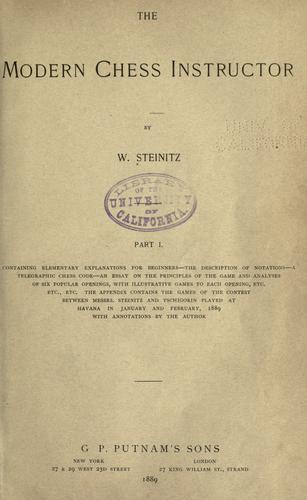
Wilhelm Steinitz‘s The Modern Chess Instructor is published in London, a text in which the author introduces the new ideas of a movement that will become the classical school of chess. The Spanish researcher and historian Antonio Gude translated it into Spanish and presented it as follows:
«It was his magnum opus, in which he expounded the principles of modern chess for the first time. It is no exaggeration to say that Steinitz’s writings have influenced all the great players since then. This 21st-century edition has converted the old descriptive notation into algebraic notation and reformatted the text to meet the expectations of the 21st-century chess player. The rare second part of The Modern Chess Instructor, with its exposition of the fundamentals of chess theory, published in 1895, has also been added. The result is a veritable treasure trove of original ideas along with an exposition of the fundamentals of modern chess theory. Every chess player will find The Modern Chess Instructor enjoyable and instructive, a journey to the theoretical roots of modern chess. Steinitz, catapulted to eternity by the excellence of his own game and his ideas spread by his great followers, Tarrasch and Laker, continues to envision the battles on the board, not from the illusions of romantic chess, but from a supreme objectivity, which elevated the rational and the logical to primordial categories in the chess struggle».
Zur Geschichte und Literatur des Schachspiels: Forschungen (Research on the History and Literature of Chess), by the Dutch scholar Antonius van der Linde (1833-1897), is published in Berlin. It is a collection of essays on the evolution of openings, an updated catalogue of chess books, and a definitive critique of the theory of the Scotsman Duncan Forbes (1798-1868) on the origin of the game.
Irish poet William Butler Yeats (1865-1939) published Time and the Witch Vivien this year, a work that deals with the death of a woman after losing a game of chess against Father Time, which includes this beautiful, albeit distressing, passage:
«[They play.]
Thus play we first with pawns, poor things and weak:
And then the great ones come, and last the king.
So men in life and I in magic play;
First dreams, and goblins, and the lesser sprites,
And now with Father Time I’m face to face.
[They play.]
I trap you.
Time. Check.
Vivien. I do miscalculate.
I am dull to-day, or you were now all lost.
Chance, and not skill, has favoured you, old father!
[She plays.]
Time. Check.
Vivien. Ah! how bright your eyes. How swift your moves.
How still it is! I hear the carp go splash,
And now and then a bubble rise. I hear
A bird walk on the doorstep. [She plays].
Time. Check once more.
Vivien. I must be careful now. I have such plots –
Such war plots, peace plots, love plots – every side;
I cannot go into the bloodless land
Among the whimpering ghosts.
Time. Mate thus.
Vivien. Already?
Chance hath a skill! [She dies.]».
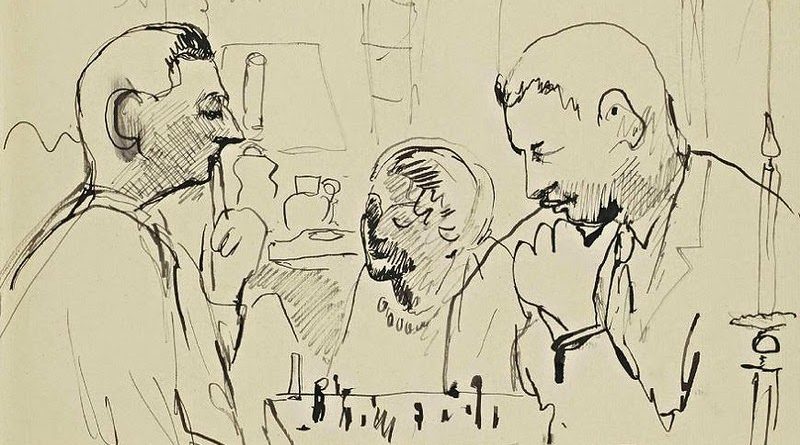
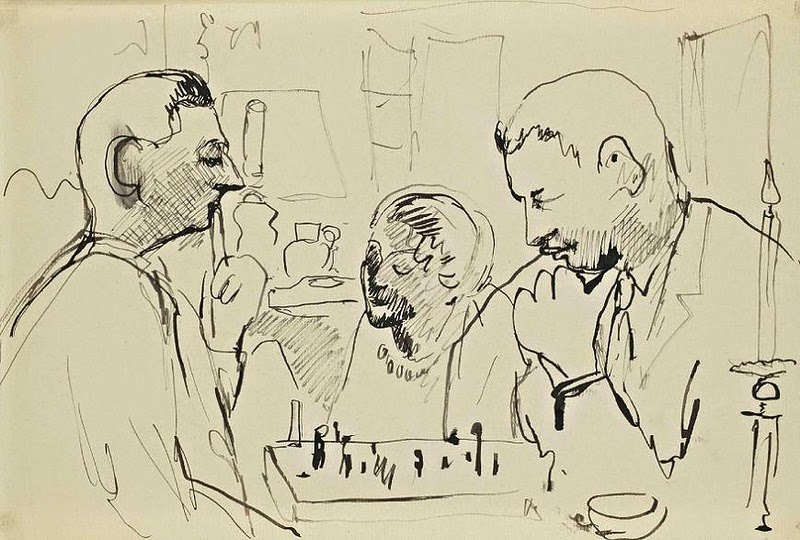
The French artist Jean Cocteau (1889-1963) was born, author of a beautiful watercolor in which he presents Jean Hugo and Pierre Colle playing chess, who in the French magazine L’Échiquier, published in 1936 a poem entitled La partie d’échecs («Game Chess«), about which the Spanish-French artist Fernando Arrabal (born in 1932), in his book Éxitos y fracasos sobre el tablero («Successes and Failures on the Board»), rescues the precious image about the horses being born “from the foam of the sea”.

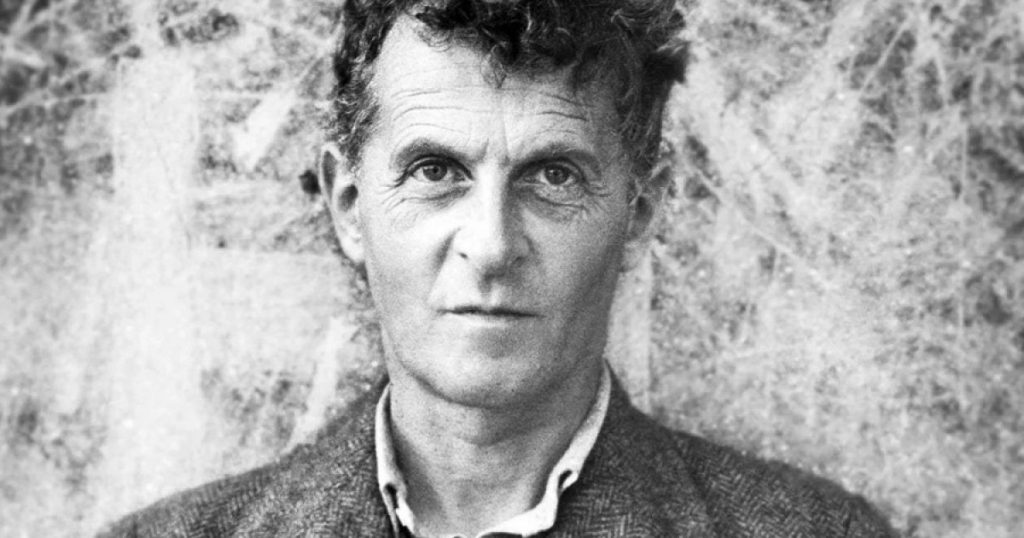
The Austrian philosopher Ludwig Wittgenstein (1889-1951) was also born. He was fascinated by the rules of chess, using them as a parallel to what he believed must necessarily be present in language and even in mathematics. For this thinker, although the language of chess is arbitrary in itself, it has a consistent internal logic that is self-explanatory and entirely coherent. That is why he considered that, when we talk about the spatial and temporal phenomenon of language:
“Wir reden von dem räumlichen und zeitlichen Phänomen der Sprache… Aber wir reden von ihr so, wie von den Figuren des Schachspiels, indem wir Spielregeln für sie angeben, nicht ihre physikalischen Eigenschaften beschreiben. Die Frage ‘Was ist eigentlich ein Wort?’ ist analog der ‘Was ist eine Schachfigur?’”
(Wittgenstein, Philosophische Untersuchungen, §108)
“We are talking about the spatial and temporal phenomenon of language… But we talk about it like the pieces of a chess game, by giving rules for it, not by describing its physical properties. The question ‘What is actually a word?’ is analogous to ‘What is a chess piece?’”
Another figure who comes to light this year is the Argentine writer Arturo Capdevila Igarzábal (1889-1967) who, within his multifaceted personality, which shows him as a judge, professor (of philosophy and sociology), and historian, would also stand out as a writer, one of prolific work, in which he contemplated the game, to which he dedicated a poem entitled Ajedrez («Chess«) and to which he contributed a philosophical and historical essay.

General Gerónimo Espejo (1801-1889) dies in Argentina. Having accompanied General José de San Martín (1778-1850) in his quest for independence, he records that San Martín was an avid player of the game in his spare time, during which he planned the expedition that would lead him to become the liberator of three countries.