Chess in the 19th Century. Milestones of 1890
By Sergio Ernesto Negri

Global Context
German Chancellor Otto von Bismarck (1815-1898) was forced to resign by the young Kaiser Wilhelm II (1859-1941). In France, Clément Ader (1841-1925) flies (20 centimeters high and 50 meters long) the first airplane in history. His compatriot Charles Riget (1850-1935), future Nobel Prize winner in Medicine, performs the first serum therapy injection on a human being. Another Nobel Prize winner, in Chemistry, the German Emil Fischer (1852-1919), synthesizes glucose, fructose, and mannose. Members of a Sioux tribe are massacred in the U.S., country where American inventor Herman Hollerith (1860-1929) designed a punched card system to process the 1890 census data.
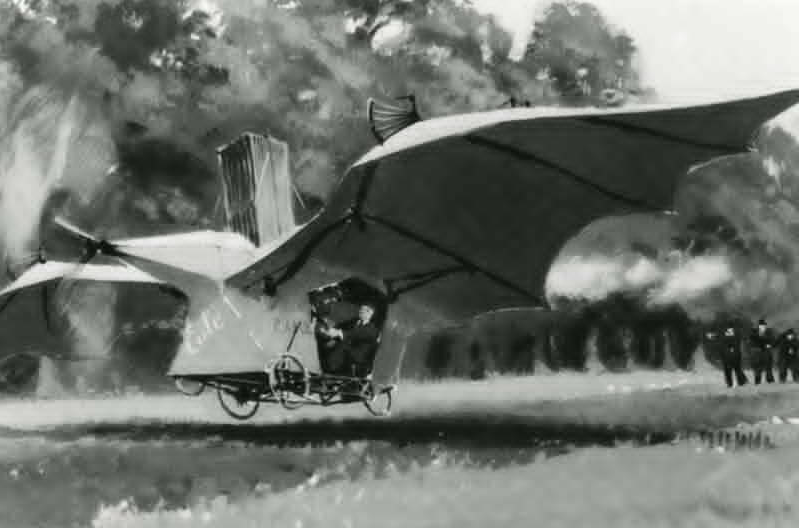
This device marked the beginning of flight.
The English writer Oscar Wilde (1854-1900) published The Picture of Dorian Gray, the French writer Émile Zola (1840-1902) did the same with his book La Bête humaine («The Beast in Man«), and the Russian composer Pyotr Tchaikovsky premiered his opera La Dame de Pique («The Queen of Spades«) in St. Petersburg. Wilde was linked with chess: he mentions in Lord Arthur Savile´s crime, work of 1887 where he says: «Were we merely chess pieces, moved by an invisible power, vessels the potter molds at will, for honor or shame?«. The punch card was invented. The Union of American Republics was established in Washington.
Several notable figures associated with chess were born this year. In England, Agatha Christie (1890–1976), who, in her 1927 novel The Big Four, included a chapter titled “A Chess Problem”; in Russia, the writer Boris Pasternak (1890–1960), who may have been inspired by a chess player for the character in his novel Doctor Zhivago; in Argentina, the writer and patron Victoria Ocampo (1890–1979), who, among other figures, brought the French literary critic Roger Caillois (1913–1978) to the country, whom she questioned in a letter using chess analogies, and, in the U.S., the artist Man Ray (1890–1976), a close friend of the Frenchman Marcel Duchamp (1887–1968), with whom he shared the screen in the 1924 film Entr’acte, having designed a beautiful set of pieces, among other contributions he made to the game of chess, which he was passionate about.

Chess in 1890
Around the turn of the year, the world championship match was held in New York, in which the Prague-born, now American citizen, Wilhelm Steinitz (1836–1900), defended his title against the Hungarian (resident in England) Isidor Gunsberg (1854–1930), with the champion winning 10.5 to 8.5.
Gunsberg had replaced the Russian Mikhail Chigorin (1850–1908) and the Slovak Max Weiss (1857–1927), who, in principle, had priority to assume the role of challenger after having shared the lead in the major tournament held in this same city the previous year; however, they declined to do so. Additionally, at the beginning of the year, Gunsberg had been the protagonist of a grueling match held in Havana against Chigorin, with nine wins each and five draws, thus demonstrating that he was capable of facing the champion.
In the title match, somewhat surprisingly, the challenger held the advantage by the fifth game; however, by the seventh game, Steinitz took the initiative, which he maintained until the end, in a contest where the winner secured six victories, suffered four defeats, and nine draws were recorded.
Steinitz and Chigorin began playing a two-game match by correspondence, using the telegraph; one was in the United States (New York), the other in the Russian Empire (St. Petersburg). It was the Russian who prevailed in both games, and decisively so, in a clash of styles where the champion’s modern ideas faltered in the face of his rival’s creativity. The match began on October 23, 1890, and ended on April 28, 1891.

In Manchester, the Prussian Siegbert Tarrasch (1862–1934) triumphs undefeated (winning twelve games and drawing seven), followed by local player Joseph Blackburne (1841–1924) and, further back, the Scottish-American George Mackenzie ( 1837–1891), the Englishman Henry Bird (1829–1908), the Irish-American James Mason (1849–1905), and the Hungarian-Englishman Isidor Gunsberg (1854–1930).
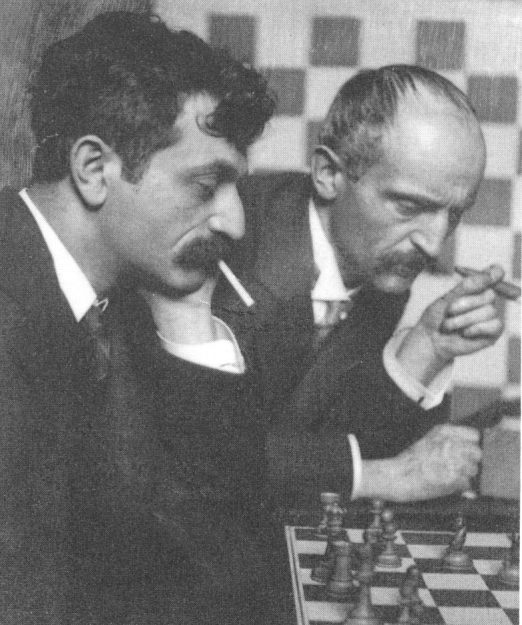
The Slovak Miksa Weiss (1857–1927) wins the first Trebitsch Memorial held in Vienna. The Lasker brothers, Berthold (1860–1928) and Emanuel (1868–1941), do the same at a tournament in Berlin. Emanuel, in turn, defeats his compatriot Jacques Mieses (1865–1954) in a friendly match in Leipzig by a score of 6.5 to 1.5; in Liverpool, he does the same against Bird, 8.5 to 3.5, in a generational showdown, and in Vienna, he defeats the Czech Berthold Englisch (1851–1897) 3.5 to 1.5. But in Graz, he finished behind the Hungarian Gyula Makovetz (1860–1903) and the Czech Johann Bauer (1861–1891).
The Chessmetrics ranking for December lists the top positions as follows: Lasker; Tarrasch; Chigorin; Weiss; Steinitz. According to EDO Historical Chess Ratings, the overall ranking for the year is as follows: Tarrasch; Steinitz; Lasker; Makovetz; Bauer; Chigorin is tenth and Weiss sixth in this rating system.
Two highly influential books on the history of chess are published. In Spain, by the Catalan José Brunet y Bellet (1818–1905), El ajedrez. Investigaciones sobre su origen («Chess. Investigations into its Origin») (Librería de Massó y Casas, Barcelona, 1890), in which he puts forward the highly controversial idea that chess has Egyptian origins; and in England, local author Howard Staunton (1810–1874) published The Chess Player’s Handbook – A Popular and Scientific Introduction to the Game of Chess (George Bell & Sons, London, 1890), an introductory manual on the game that enjoyed great popularity. The Austrian Johann Berger (1845-1933) also published Theorie und Praxis der Endspiele («Theory and practice of endgames«), a highly acclaimed book that focused on the final phase of games.

El noventa, una evolución política argentina (The 1890s: A Political Evolution in Argentina) is a book by the Argentine Juan Balestra (1861–1938) that recounts the Revolución del Parque («Revolution of the Park»), which took place that year and gave rise to the century-old political party known as the Civic Union (later renamed the Radical Civic Union), a party that, despite its defeat, challenged the ruling power. The main scene in which the conflict was decided is described as a military operation in which the chess move known as the “Pastor Checkmate” was employed to launch a simultaneous attack from two flanks against the insurgent forces.