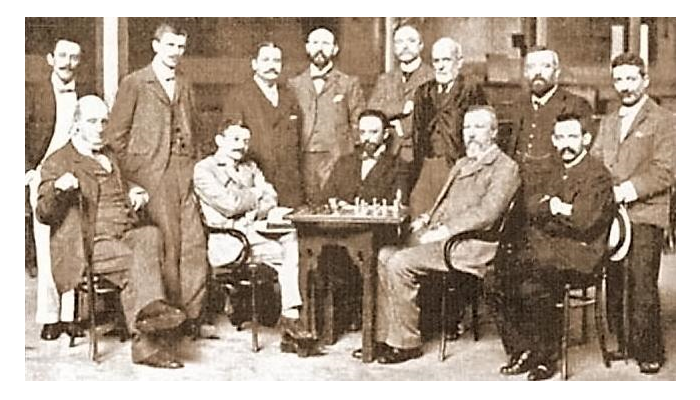
Chess in the 19th Century. Milestones of 1899
By Sergio Ernesto Negri

Global Context
The conflict between the British Empire and Dutch settlers, known as the Boer War, begins in South Africa. One of the bloodiest civil wars in Colombia’s history breaks out, lasting until 1902. The first Hague Peace Conference is held, with the aim of establishing laws of war and mechanisms for disarmament, serving as the precursor to the current International Court of Justice. Cuba gains independence from Spain, which sells the Caroline, Mariana, and Palau Islands to Germany. In Australia, it is decided to build the country’s capital in Canberra. The Philippine-American War continues. Following clashes between armed factions, Bolivia decides to move the capital from Sucre to La Paz. Earthquakes strike Alaska, Turkey, and Indonesia, with thousands of deaths in the latter two cases. Pope Leo XIII (1810–1903) opens the Holy Door on the occasion of the 1899–1900 Jubilee.
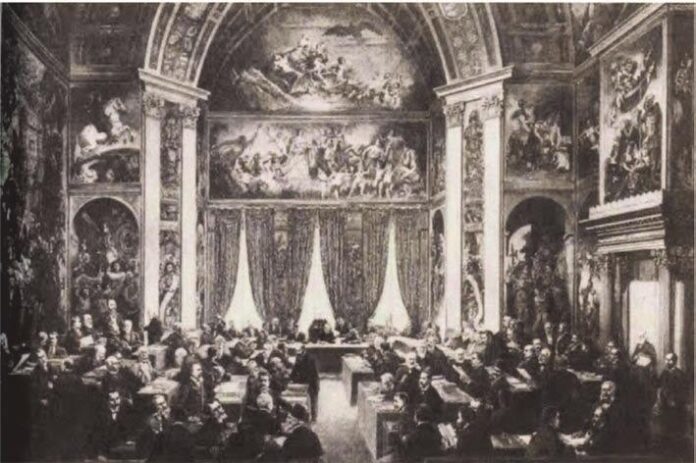
The German company Bayer registers “Aspirin” as a trademark, marking the beginning of modern pharmacology. Danish scientist Valdemar Poulsen (1869–1942) patents the telegraphone, the first device for magnetic sound recording, while his Italian colleague Guglielmo Marconi (1874–1937) achieves the first radio transmission across the English Channel, connecting England and France without wires. The following companies are founded: Fabbrica Italiana Automobili Torino (FIAT) in Turin, Italy, and Opel in Germany, while the term “automobile” is used for the first time in the mass media.

The Art Nouveau movement was in full swing, particularly in Paris and Vienna. The Austrian Sigmund Freud (1856–1939) published Die Traumdeutung (“The Interpretation of Dreams”), which, although dated 1900, went on sale at the end of that year, forever changing our understanding of the human mind. Cinema is gaining momentum with several short films, including Cléopâtre and Le diable au couvent (“Cleopatra” and “The Devil in the Convent”) by the pioneering French filmmaker Georges-Jean Méliès (1861–1938).

Chess in 1899
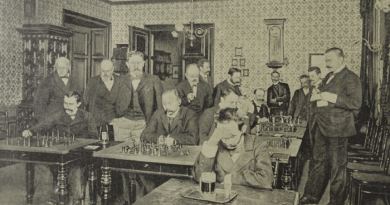
In London, the world champion, the Prussian Emanuel Lasker (1868–1941), emerged victorious with 22½ points out of a possible 27, holding an overwhelming 4½-point lead over the chasing pack, which included the Frenchman (born in a Belarusian city) Dawid Janowski (1868–1927), the Hungarian Géza Maróczy (1870–1951), and the American Harry Pillsbury (1872–1906), while the former champion, the Prague-born American citizen Wilhelm (William) Steinitz (1836–1900), who finished in tenth place, in a fabulous tournament that also featured, among others, the local player Joseph Blackburne (1841–1924), the Russian Mikhail Chigorin (1850–1908), and the Austrian Karl Schlechter (1874–1918).
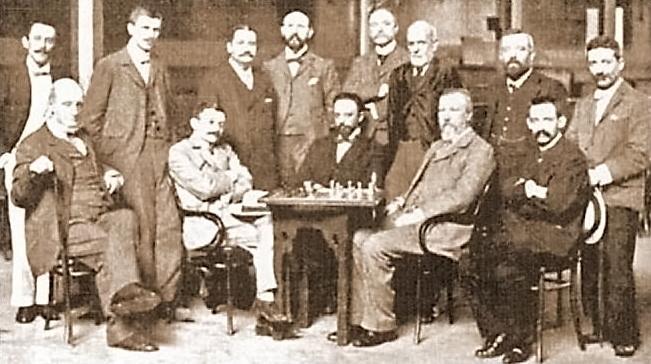
In Moscow, Chigorin won the All-Russia Tournament in convincing fashion, scoring twelve points out of thirteen, followed by Emanuel Schiffers (1850–1904), his former teacher, while in the U.S., the young and talented Pillsbury dethroned Jackson Showalter (1859–1935) as national champion by defeating him in a match held in New York, which had begun late the previous year, after recording eight wins, four losses, and two draws.
Telegraphic matches, in keeping with the advances of modernity that were so much in vogue—particularly due to the invention of the aforementioned Italian inventor Marconi—spread to various regions. In addition to the classic, masterfully executed match between the U.S. and England—now in its fourth edition, with the U.S. winning 6–4 this time, as Blackburne defeated Pillsbury in the first board—another match took place between those two countries at the collegiate level. And several more were contested between U.S. cities: Los Angeles vs. San Francisco; Boston vs. Chicago; and Seattle vs. San Francisco; and, two others in Australia, between Melbourne and Brisbane, in both cases against Sydney.
For the month of December, Chessmetrics presents this top 5: Lasker; Tarrasch; Janowski; Pillsbury; Maróczy, with veteran Steinitz occupying the last position in the top 10. EDO Historical Chess Ratings, in its annual review, presents this list in the top positions: Lasker; Tarrasch; Pillsbury; Maróczy; Janowski, with Steinitz relegated to fourteenth place.
Hugh Alexander (1899–1974) was born in Ireland. In addition to being a skilled chess player, he is remembered for his role as a cryptanalyst at Bletchley Park; during World War II, having been promoted to the rank of colonel, he was a key member of the team that broke the German Enigma Code—the means by which Nazi submarines communicated—working under the orders of his compatriot, the mathematician Alan Turing (1912–1954), and eventually succeeding him as head of the section. His ability to decipher codes was so highly valued that, after the war, the British government prohibited him from playing in tournaments in Soviet-bloc countries for fear that he might be kidnapped because of the secrets he possessed. As a player, he was twice British champion, having finished first, and undefeated, in the 1953–54 Hastings tournament alongside the Soviet player David Bronstein (1924–2006), whom he defeated in their head-to-head match. He played in six Chess Olympiads, with the 1939 Buenos Aires event being particularly notable, as England withdrew during the final stage when World War II broke out, prompting the players to return home in haste; in that context, Alexander dedicated himself to the cause that would lead them to decipher the aforementioned Code.
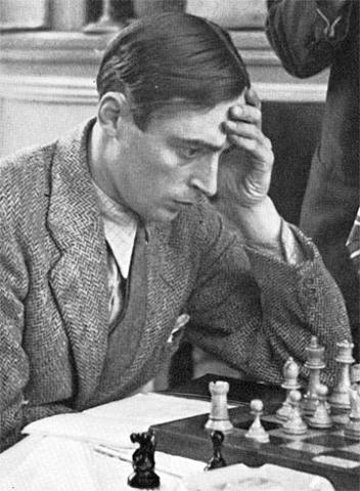
Also born were the Dane Holger Norman-Hansen (1899–1984), individual gold and team silver medalist at the 1927 London Olympiad; the Czech Jan Schulz (1899–1953), a member of his country’s team that won the gold medal at the 1924 Paris Tournament of Nations (an unofficial Olympiad); and the Pole Izaak Towbin (1899–1941), one of the signatories of the founding of FIDE in the French capital in 1924, who would later fall victim to the Nazi Holocaust.
The German Tassilo Baron von Heydebrand und der Lasa (1818–1899) has passed away. A chess master and one of the best of his time (Chessmetrics ranked him as the best for fifteen months), he was unable to demonstrate his prowess at the 1851 London Tournament because he was devoted to his duties as a diplomat. He was the author of renowned books (Handbuch des Schachspiels and Zur Geschichte und Literatur des Schachspiels: Forschungen) and founder in 1846 of the first German chess magazine: Schachzeitung der Berliner Schachgesellschaft. Another German who dies is Max Lange (1832–1899), editor of Deutsche Schachzeitung, winner of several tournaments in his country, one of the world’s best players in the 1860s, who is remembered for the variation in the Two Knights’ Defense that bears his name. Also passing away is the Italian Serafino Dubois (1817–1899), who, in the 1862 London Tournament, finished in fifth place, tied on points with two other players, including the Prague-born (Austro-Hungarian Empire) Willhelm Steinitz (1836–1900), in a tournament won by the Prussian Adolf Anderssen (1818–1879).

The Dutch engineer Meijer van der Gracht (1863–1943) introduced the rocker mechanism, refining the system of levers or pushers that connected the two clocks in chess. His design allowed the pendulum of one clock to be mechanically stopped by pressing a button, instantly releasing that of the opponent’s clock. His design was produced by the Dutch firm V.D. Gracht and, after being used in tournaments in Netherlands, became the standard for European tournaments in the early 20th century. Meanwhile, his compatriot Hendrik Meijer (1852–1925) introduced the small metal piece (the flag) that drops when the minute hand reaches twelve, eliminating disputes over whether time had run out exactly.

Chess first appeared on screen in October 1899 in the British short film A Game of Chess and Kisses, a production by GAS Films, directed by the Englishman George Albert Smith (1864–1959), a pioneer of the Brighton School of Cinema, who is credited with the first close-up, the division of a scene into different shots (editing), and shots that are considered the actor’s point of view. Although the film is lost, its title suggests that the game was part of a courtship, a recurring theme in which chess was always present as a metaphor or excuse for love.
Argentine writer Jorge Luis Borges (1899–1986) is born. He create a universe around a game that was so close to his heart, ever since his father introduced him to the magic of philosophy and thought using a checkered board. He mentions it repeatedly in his vast body of work, and his Ajedrez (“Chess”) sonnets are particularly famous—perhaps the finest poetic expression one could conceive of regarding the ancient game. For the writer, in another of his poems: “Mysterious chess is poetry, whose board and pieces shift as in a dream, and over which I shall lean after I have died.” Surely, in the world of the transcendent, he is leaning over that prodigious chess game so well combined with poetry.

Vladimir Nabokov (1899–1977), the Russian-born writer who later became an American and Swiss citizen, is born; he is one of the literary figures most closely associated with chess. In fact, he was passionate about the game, which he mentions repeatedly in his work, particularly in his 1929–1930 novel The Luzhin Defense, one of the most accomplished works in terms of recreating the personality of a chess player. But, in addition he includes chess in many other works like Poems and Problems. As its name suggests, it features both poems and chess problems of his own creation.

Another writer born this year is the Nobel Prize laureate in Literature Yasunari Kawabata (1899–1972), a passionate Japanese Go player to whom he dedicated his last book, The Master of Go, in which one the grandmaster of Go (and passionate chess player) Cho Chikun (born in 1956), says the following:
“When I play chess, I have to sing. Please excuse me. I like chess. I wonder and wonder, and in my whole life I can’t understand why I became a Go player instead of a chess player. I’ve spent more time on chess than on Go.”

In his Tradiciones Peruanas («Peruvian traditions»), a collection of texts that began publication in 1872 and was completed this year, Peruvian writer Ricardo Palma (1833-1919) recounts the story of the first Spaniards who played chess in the Viceroyalty of Lima. It is within this context that the story of the Inca Atahualpa (c.1500-1533) stands out; he can be considered the first indigenous person from the southern part of the American continent on record to have played chess, and how this game may have been key to his own death.

The British writer H. G. Wells (1866-1946) published When the Sleeper Wakes. In the chapter «The Rearing of Mankind,» he describes the mental and educational order of the new World State. In that context, he refers to an aid he calls «Basic English,» which combines language with a system of symbolic logic and ideographic shorthand, asserting:
«In process mathematics particularly, this aid had been of singular service, and it was now invariably invoked by such players of chess and games of manual dexterity as were still to be found. In fact, all operations conducted under finite rules, of a quasi-mechanical sort that is, were now systematically relieved from the wanderings of imagination and emotion, and brought to an unexampled pitch of accuracy.»