The Italian peninsula—with Gioachino Greco as its foremost figure—was the epicenter of chess in the 17th century
By Sergio Ernesto Negri

Global Context
The 17th century in Italy was an era of profound contrasts, marked by the artistic splendor of the Baroque—featuring preeminent figures such as the painter Caravaggio (1571–1610), the sculptor and architect Gian Lorenzo Bernini (1598–1680), and the architect Francesco Borromini (1599–1677), as well as the birth of opera, pioneered by Claudio Monteverdi (1567–1643)—all occurring against a backdrop of deep economic and social crisis, alongside political fragmentation under foreign domination.
Indeed, the peninsula was divided: the Duchy of Milan, the Kingdom of Naples, Sicily, and Sardinia were directly subject to the Spanish Crown. Alongside these, there existed sovereign powers such as the Republic of Venice, the Grand Duchy of Tuscany, the Papal States, and the Duchy of Savoy. Furthermore, the Catholic Church, operating from Rome, exerted absolute ideological and cultural control through institutions like the Inquisition. This constrained scientific freedom—a fact exemplified by the 1633 trial and conviction of Galileo Galilei (1564–1642)—who, nonetheless, managed to lay the foundations for modern physics amidst significant astronomical discoveries.

It was precisely from that peninsula—the Italian one—where events were unfolding in such a vibrant, albeit somewhat chaotic, manner that the most significant developments in chess would emerge. Gioachino Greco stands out as the foremost figure of the era, alongside the appearance of instructional books that would set a lasting standard.
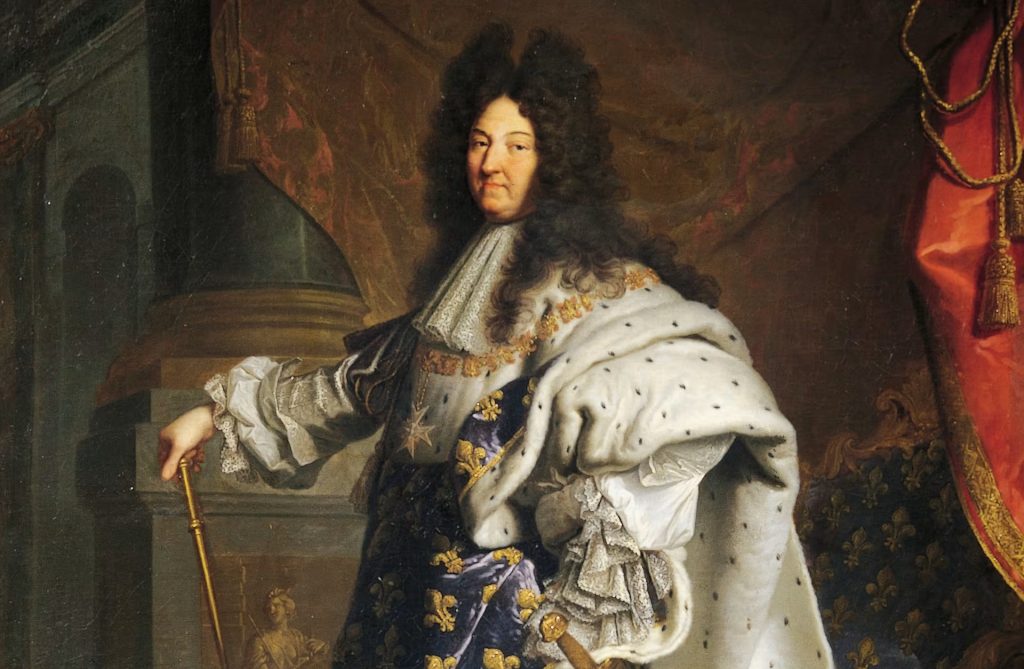
Beyond the events taking place on the peninsula, from a political perspective, the century was characterized by the zenith of monarchical absolutism—encapsulated in the famous maxim of the French king Louis XIV (1638–1715), L’État, c’est moi (I am the State)—in which the monarch’s power was considered to be of divine origin, a concept with foundations laid by Cardinal Richelieu (1585–1642).
In the economic sphere, mercantilism prevailed—a system that measured a nation’s wealth by its accumulation of precious metals (gold and silver), while promoting strong state protectionism, colonial trade monopolies, and favorable trade balances. In this context, the American colonies took on great significance. It was also a period marked by a profound agrarian crisis, famines, and popular uprisings, fueled by the tax burdens imposed to fund constant warfare.
Key historical milestones include the Thirty Years’ War (1618–1648)—a European conflict rooted in both religious and geopolitical issues that devastated Central Europe and culminated in the Peace of Westphalia, which established the modern system of sovereign states—as well as the English Revolution (1642–1688), a confrontation between the monarchy and Parliament that led to the execution of King Charles I (1600–1649), instigated by Oliver Cromwell (1599–1658), laiding the foundations for a parliamentary monarchy.
In the scientific realm, this period saw the 1687 publication of the Principia (Philosophiæ Naturalis Principia Mathematica) by the Englishman Isaac Newton (1643–1727)—a pivotal moment in the Scientific Revolution that unified terrestrial and celestial physics under universal mathematical laws.

In the view of the British historian Eric Hobsbawm (1917–2012), the 17th century can be characterized as a period of general crisis, during which late feudalism was overcome, paving the way for the consolidation of the structural conditions of modern capitalism. While the economies of Mediterranean and feudal Europe stagnated or collapsed (as in the cases of Spain and Italy), the Atlantic nations—most notably England and the Netherlands—succeeded in restructuring their agrarian, commercial, and political relations, thereby creating the market and the bourgeoisie necessary for the subsequent Industrial Revolution.
Outside of Europe, China saw the fall of the Ming dynasty and the establishment of the Qing (Manchu) dynasty in 1644. In Japan, the Tokugawa shogunate solidified its policy of isolation, closing the country off from Western influence for more than two centuries. In India, the Mughal Empire reached its greatest territorial extent and cultural splendor under Emperor Aurangzeb (1618–1707). In Africa, the slave trade intensified, linked to the Americas, where colonial exploitation deepened through plantation systems and extractive mining.
From a cultural, social, and scientific perspective, this was the era of the Baroque, the Scientific Revolution, Rationalism (the belief that reason is the primary source of knowledge and that the human mind possesses innate ideas independent of sensory experience), and Empiricism (the view that all knowledge derives from sensory experience, and that the mind is a tabula rasa—a blank slate—upon which sensations leave their imprint). This period marked the birth of modern philosophy, moving beyond medieval Scholasticism; it brought to the fore questions regarding the nature of knowledge (gnoseology or epistemology) and the search for a reliable method to attain truth.
It was the era of the Frenchman René Descartes (1596–1650), the foremost exponent of Rationalism; the Dutchman Baruch Spinoza (1632–1677), who proposed metaphysical monism (God and Nature are one and the same: Deus sive Natura); the German Gottfried Wilhelm Leibniz (1646–1716), who—in addition to his philosophical contributions—developed infinitesimal calculus independently of (and in parallel to) Newton; and the Englishmen Thomas Hobbes (1588–1679)—who, in Leviathan, argued that in the «state of nature» human life is solitary, poor, nasty, brutish, and short («war of every man against every man«), thereby justifying the creation of a social contract and a strong State to ensure peace—, and John Locke (1632–1704), the father of classical liberalism.

CHESS IN THE 17TH CENTURY
The 17th century represents a transitional phase in the history of chess. Following the great revolution of the Renaissance—when the modern rules for the queen and the bishop were established in the late 15th century—the game became firmly rooted in the European courts of the Baroque period. It began to evolve from a mere aristocratic pastime toward a subject of systematic, analytical study. In this sense, the first steps were taken for chess to move beyond being solely a social activity, embarking on a long journey that would eventually establish its competitive dimension as its primary aspect.
The central figure of this period—and a true precursor in this regard—is Gioachino Greco (1600–1634), a native of Calabria and the first player in history who could be considered a top-tier master. Former world champion Mikhail Botvinnik (1911–1995) even classified him as the game’s first true professional.
Known as Il Calabrese (The Calabrian)—a name derived from his birthplace, the town of Celico in the Calabrian province of Cosenza (in present-day Italy, though at the time it was part of the Kingdom of Naples)—, he came from a humble background. A Sicilian priest named Mariano Marano (c. 1600 – c. 1634), himself an enthusiast of the game, acted as his mentor, providing the financial support that allowed Greco to develop his chess skills. Over time, he would have to travel from one point to another in Europe, demonstrating his skills on the board in front of enthusiasts who gave financial recognition so that, from now on, it was no longer inconceivable that a chess player would at least try to support his life thanks to the game.
Greco, in the Historical and Critical Dictionary (Dictionnaire Historique et Critique) edited in 1697 in Rotterdam by the French philosopher Pierre Bayle (1647-1706), was described in this way:
« Gioachino Greco jouait aux échecs avec tant d’habileté, qu’il ne faut pas trouver étrange que je lui consacre un petit article. All ceux qui excellent dans leur profession jusqu’à un certain point, méritent cette distinction. Ce joueur ne trouva son pareil nulle part. Il alla dans toutes les cours de l’Europe, et s’y signala aux échecs d’une manière surprenante. Il trouva des joueurs fameux à la cour de France, tels que le Duc de Nemours, M. Arnaud, Chaumont et La Salle; Mais quoiqu’ils are crossed more skillful than others, even though they are not capable of playing with anyone, nor of anyone who resists ensemble. C’était aux échecs un reître, qui cherchait par tous les pais quelque lque famousux chevalier pour breakre une lance avec lui, et il n’en trouva point qu’il ne surmontât. »
“Gioachino Greco played chess with such skill that it should come as no surprise that I have dedicated a short piece to him. Anyone who excels in their profession to a notable degree deserves such recognition. This player had no equal anywhere. He traveled to all the royal courts of Europe, where he distinguished himself at chess in an astonishing manner. He encountered renowned players at the French court—such as the Duke of Nemours, Monsieur Arnaud, Chaumont, and La Salle—but although they considered themselves more skilled than others, none of them could hold their own against him, nor could they collectively withstand him. In the world of chess, he was like a wandering knight-errant, traveling from land to land in search of a worthy opponent to cross lances with—and there was not one he did not overcome.”

Il Calabrés was considered the preeminent player of his time, although Alessandro Salvio (1570–1640) believed his play was inferior to that of Marano himself. He had other rivals and patrons in Italy, such as Cardinals Savelli (1574–1644) and Francesco Buoncompagni (1592–1641).
In any case, he laid the foundations for an Italian school of chess characterized by an aggressive style of play—featuring spectacular sacrifices, a penchant for dynamism, and an unbridled pursuit of checkmate, with little regard for one’s own defense or for medium- to long-term considerations. It was, one might say, pure tactics; strategy would have to wait until it was introduced a century later by the Frenchman François-André Danican—the great Philidor (1726–1795)—who, in his own time, also had no significant rival. Regardless, the style of play employed by Greco and other proponents of the Italian school anticipated the approach that would later emerge within what is known as the Romantic movement in chess.
He traveled throughout the courts of Europe—starting from Italy and reaching France, England, and Spain—showcasing his talent and defeating the best players of the era. His journey eventually took him to the Americas, where he passed away—likely in the Dutch Antilles or perhaps at sea—at the age of only thirty-four. By that time, chess had enabled him to amass a modest fortune, which he bequeathed to the Society of Jesus; it is worth noting that it was Marano who had guided Greco toward his formal education at the Jesuit College in Cosenza.
In 1619, he composed a celebrated work titled Trattato del nobilissimo Gioco de Scacchi, il quale è ritratto di Guerra & di Ragion di Stato (Treatise on the Most Noble Game of Chess, Which Is a Representation of War and the Art of Statecraft), which circulated in manuscript form among the royal courts before being published for the first time in London—edited by Herringman under the title The Royall Game of Chesse-Play – Sometimes The Recreation of the late King, with many of the Nobility. Illustrated with almost a hundred gambits, being the study of Biochimo (SIC) the famous Italian. This publication appeared in 1656, translated and adapted by Francis Beale (whose background remains undocumented). The original text was dedicated to Henry II, Duke of Lorraine (1563–1624)—Greco’s patron during his time in France.
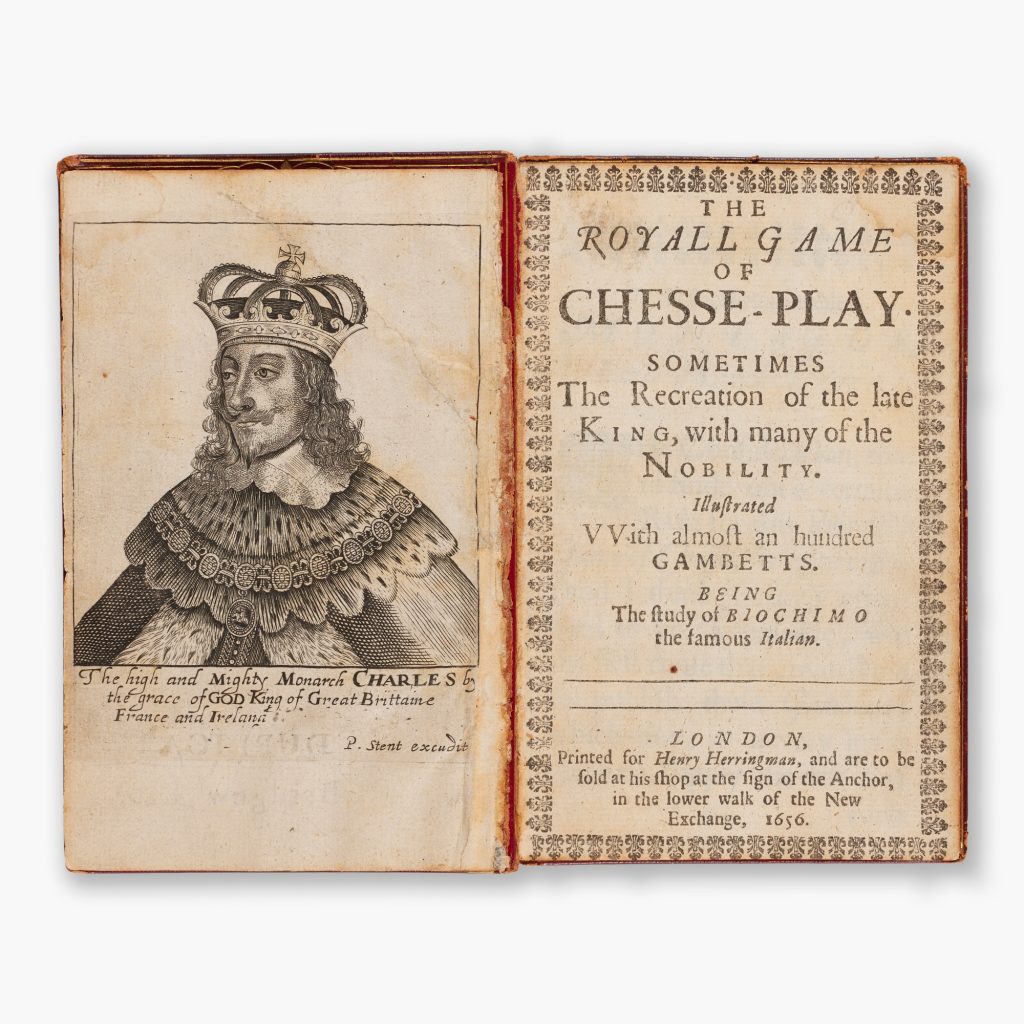
The text would see numerous subsequent reissues in various languages, the first of which appeared in 1669 in Paris under the title Le Jeu des Eschets; Traduit de l’Italien de Gioachino Greco Calabrois, printed by Perpingvé; another edition followed in the same city in 1689, published by Jacques Le Febvre. Before long, editions in Dutch and German also appeared. For the purposes of this work, we have specifically consulted another English version, published in London in 1819 by the British author William Lewis (1787–1870).

The book contains nearly a hundred model games or practical exercises—some of the earliest historical records of brilliant combinations, such as Fool’s Mate, devastating attacks within the King’s Gambit, and the famous Hook Mate. These games are presented as having been played against opponents—though, in some instances, they are likely more in the nature of theoretical analysis than actual matches. Within this framework, the rules of chess are clarified, as is the recommended approach to playing the game.
The work aims to categorize the most representative tactical attacks and traps; for example, to illustrate the proposed style of play, it presents the Greco Attack within the Italian Game—arising from the sequence: 1. e4 e5 2. Nf3 Nc6 3. Bc4 Bc5 4. c3 Nf6 5. d4 (as opposed to 5. d3, which would have led to the setup known as the Giuoco Pianissimo). The clear intent was to pursue an attack at all costs, favoring it over a slower, more cautious approach.
The book also includes composed positions, such as a well-known example that illustrates the concept of the «bad bishop.» As the modern system of using figurine symbols for chess pieces had not yet been adopted, the notation for the moves is rather cumbersome.

Orazio Gianuzio della Mantia (1550–1610) was another prominent Calabrian player; in 1593, he presented a manuscript titled Libro nel quale si tratta della Maniera di Giuocar’à Scacchi, con alcuni sottilissimi Partiti (Book dealing with the manner of playing chess, including some highly ingenious game positions). Even more notable—though hailing from other parts of the Italian peninsula, and also active at the turn of the century—were Giulio Cesare Polerio (c. 1555–c. 1610) and Alessandro Sàlvio (1570–1640).
Polerio—a confidant of Giovanni Leonardo di Bona (or da Cutro), known as «Il Puttino» (1533–1578), one of the greatest chess players of the 16th century—was also born in the Kingdom of Naples, in the town of Lanciano (in the province of Chieti, in the Abruzzo region). By the end of the century, he was considered the best player in Rome, the city where he settled and eventually died. There, he enjoyed the patronage of the Duke of Sora, Giacomo Buoncompagni (1548–1612), son of Pope Gregory XIII (1502–1585).
He was also highly regarded for his work as a compiler and analyst, becoming the first to study the gambit that now bears his name (also known as the Muzio Gambit), which arises from the following sequence of moves: 1. e4 e5 2. f4 exf4 3. Nf3 g5 4. Bc4 g4 5. O-O. Furthermore, he wrote seven codices that served as a foundation for Greco’s own work; he is also credited with L’elegantia sottilità verità della virtuosissima professione de’ scacchi—a translation of the Libro de la invención liberal y arte del juego del axedrez (The art of the Game of Chess), a highly useful and beneficial book by the Spaniard Ruy López (c. 1530–c. 1590) which can be found in the National Library in Florence.
Sàlvio was born in Bagnoli Irpino, in the Campania region of the Kingdom of Naples, into a well-to-do family. He distinguished himself as a chess player and is remembered for his blindfold exhibitions. In 1606, he defeated another renowned chess player, Geronimo Cascio (1571–?), a victory that established him as the leading figure in the local chess scene.
His didactic work was exemplary; he authored the Trattato dell’Inventione et Arte Liberale del Gioco Degli Scacchi (Treatise on the Invention and Liberal Art of the Game of Chess, 1604)—one of the first comprehensive and systematic treatises on chess, covering opening principles, strategy, and tactics. The work was dedicated to his patron, Fulvio di Costanzo, the Marquis of Corleto. In it, Sàlvio defines chess not merely as a symbol of war—a tragic composition, as it were—but also highlights its connection to reason and science, linking the game to arithmetic, geometry, and the art of statecraft.

Also attributed to him is La Scaccaide (The Chessiada), a tragic poem inspired by the game, which he produced in 1612 (though it has not survived). Furthermore, he authored Il Puttino, altramente detto, il Cavaliero Errante del Salvio, sopra il gioco de’ Scacchi, con la sua Apologia contra il Carrera, diviso in tre libri («The Little One»—Il Puttino—also known as «The Knight-Errant of Sàlvio,» concerning the game of chess, including his Apology against Carrera, divided into three books). This three-volume work, published in Naples in 1634, combines a biography of the player with chess analysis and a sharp rebuttal to the criticisms leveled at his treatise by his contemporary, Pietro Carrera—a matter we shall discuss later—thereby staunchly defending his professional pride. It is in this text that the rook-and-pawn endgame technique known as the «Lucena position» is described for the first time (contrary to what the name might suggest, it does not appear in the book by the aforementioned Spaniard; rather, it is believed to be the creation of a Neapolitan player named Scipione Genovino (about whom little is known), who presented it in 1634).

There is an opening that bears his name: the Salvio Gambit—a variation within the King’s Gambit Accepted—which arises from the following sequence: 1.e4 e5 2.f4 exf4 3.Nf3 g5 4.Bc4 g4 5.Ne5 Qh4+ 6.Kf1. He was also an author of sonnets, including one in which he describes a game played by Il Puttino, which he did as follows:
«Re, Donne, Afier, Cavalli, Rocche, e Fanti,/ Guerreggiano tra lor nel bianco e nero, / Nel campo d’un quadrato, e bel Scacchiero: / Che ne morie, ne orror reca, ne pianti, / Ma d’onesti diporti aggio, fra quanti / Degni potesse oprar nobil guerriero: / Che fortuna non già, ma volar vero / D’ingegno ivi s’adopra adopra in modi tanti: / Onde invito ciascun, venga a sì degno / Teatro, che a noi mostra a un tempo insieme /Guerra, schermo, duel, tragedia , e giuoco. / E s’avverrà, ch’alcun arrivi al segno / De’ primi, avrà oltre il diletto, speme / Certa d’util, d’onore in ogni loco». (In original language)
«Kings, Queens, Bishops, Knights, Rooks, and Pawns / Wage war upon one another in black and white, / Across the square field of a fine chessboard— / A conflict that brings neither death, nor horror, nor tears, / But offers, among all the noble pastimes a warrior might pursue, / A true display of the soaring intellect, / Exercised in a myriad of ways. / Thus, I invite everyone to come to this worthy / Arena, which presents to us, all at once, / War, a feat of arms, a duel, a tragedy, and a game. / And should one reach the level / Of the masters, then beyond the sheer delight, / One may be certain of gaining both profit and honor everywhere.»

Another relevant figure of the period was Pietro Carrera (1573-1647), born in Militello in Val di Catania, who also became a priest, translating his life to the island of Sicily, highlighting that, in those times, the game was particularly important in the southern part of the peninsula. At the end of the previous century, he met Paolo Boi (1520-1598), the legendary player of brilliant performance in the previous century, including his step in the Madrid tournament of 1575.

He wrote a poem in Latin in hexameters, called Pessopedia (The Chess Poem), a name that alludes to the meaning of the movement of the pieces of ajedrez, which was lost until, in 1617, producing a treatise presented in Militello, entitled Il gioco de gli scacchi di D. Pietro Carrera diviso in otto libri (The game of chess by D. Pietro Carrera divided into eight books), dedicated to the aristocrat Francesco Branciforte (1575-1622). There, systematically, is collected and elaborated existing information from other authors at the time, which was presented as a «delight for scholars due to the variety of erudition outside the obscurity of antiquity». and refers to the origin and history of the game, the theory of openings, its strategy and endings, starting a controversy with Alessandro Sàlvio, here are some questions about his postures in his treatise of 1604.

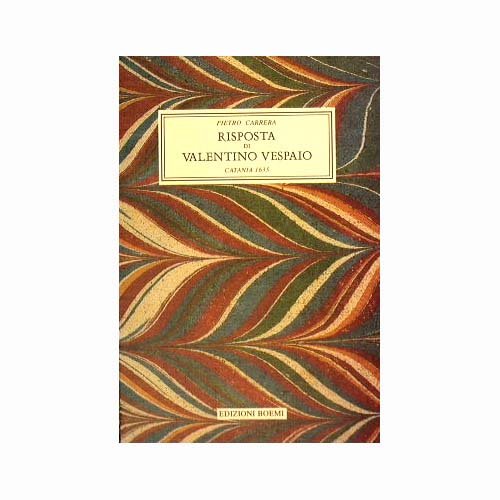
Moreover, this work was answered by Sàlvio who, in 1634, in the aforementioned work, defends his position with criticisms of Carrera who, for his part, under the pseudonym Valentino Vespaio, the following year in Catania, published the Risposta di Valentino Vespaio contro l’apologia di Alessandro Salvio (Response of Valentino Vespaio against the Apology of Alessandro Salvio), marking a fierce and unresolved debate that transcends the individuals involved, as it pits the Neapolitan school (represented by Sàlvio) against the Sicilian school (defended by Carrera), discussing tactical subtleties, traps, and game variations over the board.
Carrera also designed a variant of the game played on a table of 8×10, which he presented in his work of 1617, introducing two new pieces, the campione (champion), who moved like a tower and a knight, and the centauro (centaur), who moved like a knight horse and a bishop, a clear antecedent of the Capablanca´s Chess presented in the 20th century.

Carrera’s chess coexisted temporarily with another experiment, Courier chess (or, in the original German language, Kurierspiel), which is played on a 8×12 board featuring novel pieces, namely: the rath or mann (the king); the counselor or follower, which moves one square in any direction; the schleich (informer, smuggler, or trickster) or trülle, sometimes represented as a jester, which moves one square orthogonally and, in the case of the queen, moves like the oriental vizier, that is, one square diagonally; as well as the old or wise man (der weise), which moves like the medieval bishop, jumping over one square diagonally to the second square.
The courier piece, kurier or läufer (the runner), moves like the modern bishop and gives its name to a game developed in Germany in the 12th century, which became the favorite pastime of Germanic courts and the cultured bourgeoisie during the Late Middle Ages and the Renaissance. It was immortalized in the painting De schakers (The Chess Players), painted around 1508 by the Dutch artist Lucas van Leyden (1495–1533). By the 17th century, it was still active, especially in the German village of Ströbeck, a legendary locality where chess was part of the community identity.


As seen from the aforementioned mentions, chess, in its conventional form, was practiced in Italy, but this also took place in other parts of Europe, mainly in the salons of the nobility, royal courts, and ecclesiastical circles. The cafés, so popular from the beginning, began to appear only at the end of this century, such as the Café de la Place du Palais-Royal, founded in 1681 which, over time, was transformed into the mythical Café de la Régence, and Le Procope, inaugurated in 1686, from which it began to play chess (and the cards and the chaquete), both located in Paris, with such establishments appearing also in London around the same period. We are witnessing bustling spaces where playing matches under a betting system prevailed.
From Spanish territories, we have the case of Alfonso Cerón (c. 1535–1600), one of the participants in the tournament played on the outskirts of Madrid in 1575—the first international one—who, around 1673, presented De latrunculorum ludo (On the Game of Chess), a text about the game that is now lost.
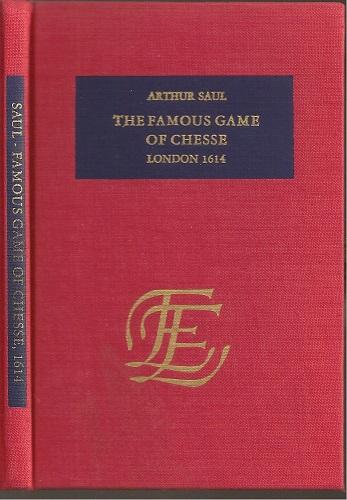
Another didactic book of the period, is Traite du Ieu Royal des Echecs (Treatise on the Royal Game of Chess), dated 1690, or sometimes before, written by Benjamin Asperling de Rarogne (1650-1710), published in Lausanne. And one more, originating in England, is from Arthur Saul (c. 1570-1617), the first manual of chess wrote in the island, called The Famous Game of Chesse-Play, which was published in London in 1614: the life of this writer is something mysterious, little is known about him, except that he fell into prison in Newgate in 1617; in the book the types of mate are classified and the positions of the stalemate, in which the player who placed the other in this one lost the game.
In England, it will be true that the admisión of the major movement in the game of the queen, which was even more demoralized compared to the past in other points of the continent (except Russia), coincided with the reign of the powerful Isabel I (1533-1603).
The design of the pieces varies considerably according to the region, being an important hit in the 1616 publication in Leipzig of The Schach-oder König-Spiel (The Game of Chess or The Real Game), the first book about the game written in Germany, by Gustavus Selenus, second name of the German Duke of Brunswick-Lüneburg Augustus II (1579-1666), a Renaissance prince, of encyclopedic tone and fine images at the time of the edition (they were used grabbed on plates of wood), whose illustrations stood out as a type of elegant, high and styles (the canon known as Selenus), very popular in central and northern Europe, which also includes flower petals, which is why it is also known as the set of tulip-style pieces. Pure design, refined structure but perhaps of limited functionality.


In this text, it is also mentioned the Rithmomachy, the game of the philosophers, the medieval mathematical idea based on Pythagorean proportions that came from the XI century, in which the arithmetic calculation is combined with military strategy, in which the pieces are numbers and their form evokes to arithmetic, geometric and harmonic progressions.

From a historical perspective, the Englishman Thomas Hyde (1636-1703) presented in 1689, De Ludis Orientalibus (On Oriental Games), amplifying it in 1694 with his second volume entitled Seu Historia Shahiludii Mandragoria (Concerning the History of Chess: Mandragor), text on oriental games, where it is determined, what will delve into further work of different authors, arguing that chess is of Indian origin, documenting his entry into Persia. and its further diffusion through the Muslim channel finalizing in Europe.

Marco Aurelio Severino (1580-1656), an Italian anatomist and surgeon, who was Calabrian like Giovanni Leonardo Di Bona (Il Puttino) (1533-1588) and Greco, dissected chess in two works. In La Filosofia ó vero il perche degli Scacchi (Philosophy or the truth about chess), is added to the title expanded in the way of a promise:
“…first we can show the artifice of the universal fabric, after the particular reason of the order and the tendencies of the leadership”.
Also to this author belongs Dell’antica Pettia, overo che Palamede non è stato l’ inventor degli scacchi (On Ancient Petteia or that Palamedes was not the inventor of chess), as the title indicates, refers to the game of petteia of the Greeks, refuting the hypothesis that chess was invented by Palamede. Both works were published posthumously, in the year 1690.
This author compares the pieces of chess with celestial bodies and, in one case, to a constellation: the king is the Sun (the source of life); the queen (also called lady, virgin, amazon or vicar general) is Júpiter (the most important planet in the tradition of the Chaldeans and Ptolomeo); the bishops correspond to the sign of Taurus in the Zodiac (in this space the planet Venus, the god of love and harmony, is located); the knights (to the one who calls the centaur, who adopts the double form of the animal and from the one who once leads him, whereby the issue of the duality between horse and knight is resolved) to Mars (by the combative passion of the knights he appropriates it to the god of war); the rooks to Saturn (which is the planet that embodies the vision of the hard, the rigid) and the pawns to the Moon (which is the lowest celestial body found on the interplanetary scale).
The moral tone, as typical of the works of the time, appears implicitly or explicitly in the story, although we can decide that it was not the central purpose of the author here, on the other hand, it pretends to refer to the reasons of a game that he admired to require, unlike others, imagination and intellect. The moral question appears, by chance, when the movement of the bishop is described, and it is emphasized that the king transmitted it to this piece on his part and, therefore, the bishops are the «bearers of the royal standard».

In those years it is also the Religio Medici (The Religion of a Doctor), a work of spiritual content from 1643, by the English philosopher Sir Thomas Browne (1605-1682) which, from its title, which alludes to religion and medicine, highlights the tension existing between faith and science. The author includes some metaphysical and even esoteric reflections when referring to a fantastic game that the protagonist played with the devil, who offered him a dream come true. True to the evil one, this gesture concealed the audacity of winning the queen and undermining his faith. The corresponding passage reads as follows:
“Thus the Devill plaid at Chesse with mee, and yeelding a pawne, thought to gaine a Queene of me, taking advantage of my honest indeavours; and whilst I labored to raise the structure of my reason, hee strived to undermine the edifice of my faith”.

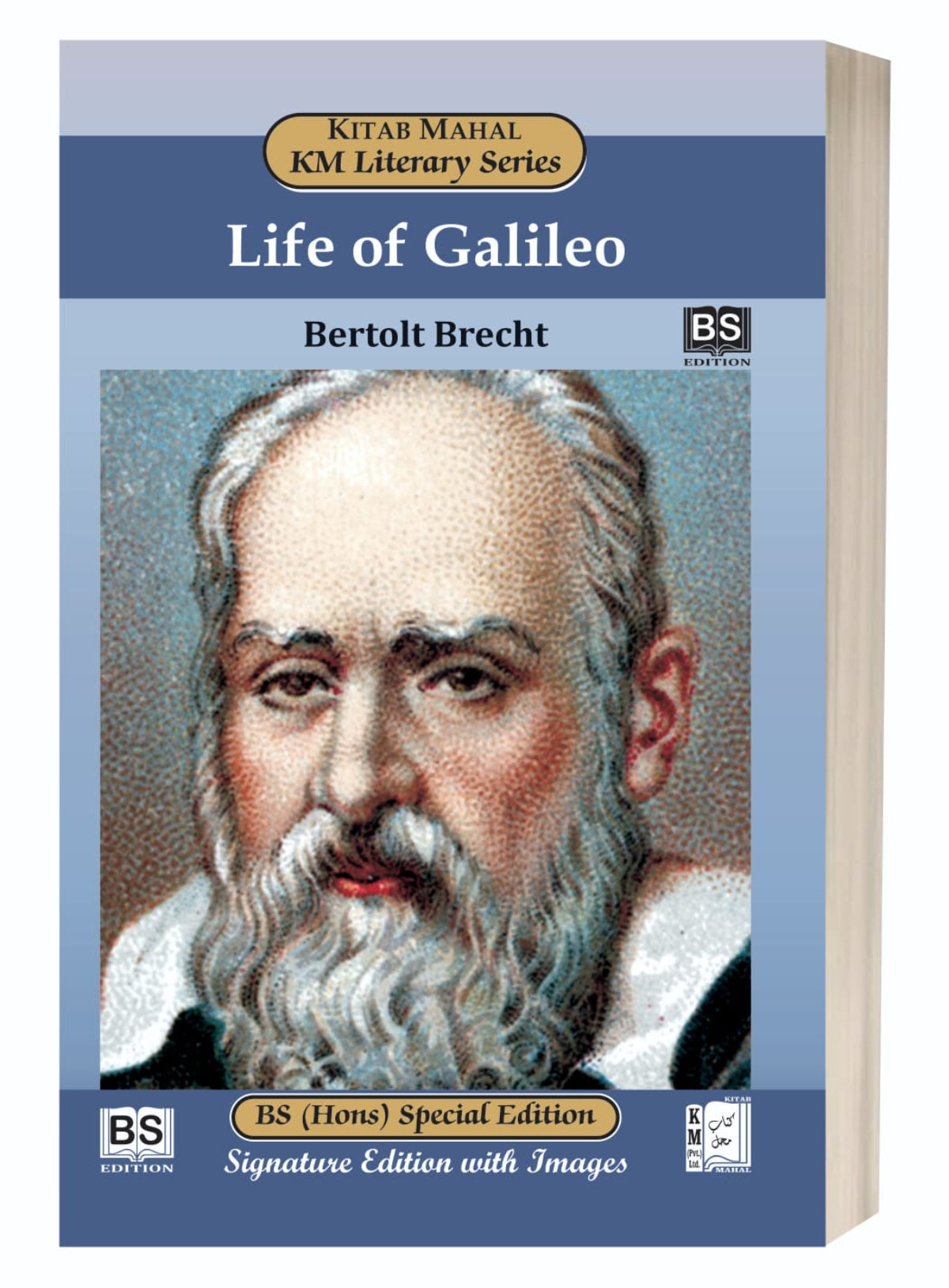
Much later, a work by the German playwright Bertolt Brecht (1898-1956), a drama called Leben des Galilei (Life of Galileo or Galileo Galilei), shows a scene that took place on 5 March 1616, in the house of Cardinal Bellarmino, in Rome whence a bail takes place, while in the vestibule of ecclesiastical secretaries they play chess. In this context, Galileo questioned all the current paradigms, moment in which he concerns players about:
«Why play the old style chess? Narrow, narrow. Today the big pieces move all over the board. The rook like that. He demonstrates. — the bishop like that — the Queen like that and that. Space, new problems, new strategies».
It is that the chess, in the years in which Galileo lived, between 1564 and 1642, as was previously the case, was going through his own process of transmutation, seeing the queen with expanded movement, extension of the radio of the moment that this would also be the case in the case of the bishop.
And while religious people were not the only ones who did not admit that the Earth was not the center of the universe, it was clear that they also failed to recognize it in modern times. While Galileo had to publicly retract his theory on June 22, 1633, Federzoni, one of his assistants, played him against the Hermann Fulgencio in the Palace of the Florentine embassy in Rome. And, above all, in these areas, the variant with the actualized rules was used, marking, in some way, a duality between modern ajedrez/ciencia vs. However, to be honest, it is precise to point out that, as I said, Fulgencio was a religious person and, as he saw it, he had embraced the new rules (did he also accept that geocentrism had already happened?). It is to broaden the vision of the universe by the hand of the expansion of the movement of the pieces of the game, addressing the eternal dilemma between obscurantism vs modernity, a dilemma that, over time, will definitively be resurrected, allowing the new transcendence to the old. In science. And also in chess.
An issue that gained strength prior to the 16th century was the prohibition of chess, whether due to the distractions it generated or, even more so, because it was associated with the betting regime. In this sense, it was very relevant, at least in the Christian world, from the perspective of the bishop of Geneva, the future Saint Francis de Sales (1567-1622), to whom we owe the Introduction to the Devout Life of 1604, where it is stated:
«Those games, in which the gain serves as a prize or recompense for the dexterity and industry of the body or of the mind, such as tennis, football, pall-mall, running at the ring, chess, and backgammon, are recreations in themselves innocent and allowable ; it is only necessary to guard against excess, either in the time one spends in them, or in the sum one plays for; for if one spends too much time in them, they are no longer an amusement, but an occupation; one refreshes neither the mind nor the body, but on the contrary stupifies and oppresses them. After playing five or six hours at chess, the mind is altogether fatigued and exhausted. To play long at tennis is not a recreation but a fatigue to the body. Or if the stake played for is too great, the affections of the players become disordered ; besides, it is unjust to hazard so much upon kinds of skill and industry of so little importance as those which are exercised at play. But, above all, Philothea, take especial care not to set your affections upon these amusements ; for how innocent soever any recreation may be, it is a vice to set our heart upon it. I do not say that you must take no pleasure in your sport whilst at play, for then it would be no recreation ; but I say, you must not fix your affection on it, nor let it take up too much time, nor be too eager after it».
This is said in chapter XXXI, entitled “Of Pastimes and Recreations, and first, of such as are lawful and commendable”. In another part of this work, Sales contrasts chess with another class of meditations, stating:
«We have seen gentlemen and ladies pass the whole night, nay many nights together, at chess or cards, and can there be any state of mind more painful, more melancholy and more gloomy than theirs? and yet the world does not say a word, and their friends never trouble themselves about that; but if we spend an hour in meditation, or rise in the morning a little earlier than ordinary to prepare for communion, everyone runs to fetch the doctor to cure us of hypochondria and low spirits».

Beyond the reproaches, the game was very popular at this time in Europe, and in its modern format, that is, with the queen and the bishop of expanded movements, modifications to the game that were introduced from the late 15th century onwards, which consolidated over the course of the years, leading to the practice being called «Mad Queen’s chess».
However, the rules were not uniform, regarding the castle, the handling of the stalemate situation and other questions. In Italy and parts of Spain, for example, the tradition persisted of allowing the king to make a special jump in his first movement (being able to displace various squares or even locate himself in positions combined with the rook following the rigid modern procedure), always and when it was not in check nor crossed threatened squares. Meanwhile, in England it was painful for the player to put his rival king in this situation, causing him to lose the game, unlike the situation of conflict that was stable in this class of situation in France and in countries on the south of the continent.
In the case of the Russian Empire, across two continents, not in the form of the game but in that respect to the pieces that formed part of the battle, the ancient vizier (and not the queen) was here accompanied by the king, on his side, from the beginning, and the piece of the rook, called Ladya, was represented in the menu with the form of embarcation, following an old model of the game which, in the original versions of the chaturanga, was shown to this piece, alternately, as a chariot or a boat.
However, during the era there was a strong suspicion from the Russian Orthodox Church, which considered it a sinful game associated with dice and bets. But, given the moral restrictions and ecclesiastical prohibitions (such as the impulses of Ivan the Terrible in the era XVI), the game was extremely popular both in the upper spheres of the court of the tsars as well as in a clandestine and traditional manner within the local people.
In America, the product of colonization, European cultural values were instilled, including the practice of chess. Cuba was, in this sense, a pioneer territory, where people began practicing the game at least since 1518, especially in the eastern location of Bayamo, once part of the Supreme Chief and ecclesiastical representatives.
This also happened further in the South, whence it happened that the Archbishop of Lima Fray Jerónimo de Loaysa (1498-1575), a charge of the greatest Archdiocese in the world, who accused him of distracting from his obligations to concentrate on the game, and the Inca Atahualpa (c. 1500-1533) who is usually characterized as the first native who, at least in the southern part of the continent, learned to play chess.
By the way, we can understand that a bridge between European and indigenous cultures was given by the Inca Garcilaso de la Vega, born in Cuzco (under the Government of New Castilla, today in Peru) in 1539 and died in Córdoba (España) in 1616, who considers it an important historian and writer of two cultures. In his Comentarios Reales de los Incas (Royal Commentaries of the Incas), which first appeared in the year 1609, he mentions:
«The other tale is that in Spain I knew a youth of humble family who lived in need, for though he was a good goldsmith he had no capital and worked as a journeyman. He was in Madrid in 1572 and 1573, and lived in my lodgings. He was passionately fond of chess at which he used to lose all he earned at his trade; I often chided him, telling him he would be reduced to great straits by betting, but one day he replied: ‘“They can’t be any greater than the straits I’ve been through, for I reached this capital on foot with only fourteen maravedis in the world.” This poor youth tried to escape from his misery by embarking for the Indies to engage in the pearl trade…».

In the 16th century, concentrating on America, in what would be Mexico, we know that the Viceroy Luis de Velasco and Castilla (1534-1617) practiced it and, previously, by the frail Dominican Vicente de las Casas (c. 1500-1586) and the governor of Yucatán Guillén de las Casas (c. 1540 – c. 1595) and, in Nicaragua, by the bishopo of this city, Fray Antonio de Valdivieso (c. 1495-1550).
Even at the south of the continent, as from 1610, there was a residence in the full port of the Viceroyalty of the Río de la Plata, in a solar that was owned by the Spanish citizens named Juan Vergara and Simón de Valdez located on the current streets Bolívar and Alsina of the city of Buenos Aires: it is the Sociedad del Cuadrilátero (Society of the Quadrilateral) to which they belong, which decided to diversify its businesses, establishing a casino there, cards, dice and chess are practised, also offering the service of «loved women».
Not only Spanish people introduced chess in America. What also happened with English and Dutch in the territories that, over time, will be the USA, as is evidenced by excavations of colonial enclaves very early in that era (such as in Jamestown, Virginia, founded in 1607), where pieces of chess bone-carved of European proceeding appeared, being played the game by members of the colonial elite.
In other geographies, the chess in its European format was not prosperous. In the Muslim world, in Africa and the Middle East, shatranj was the game that followed in force; in China, it was xiang-qi, which in the past was related to the origin of the chess, being a favorite practice, along with the much more ancient wei-ki (the Go); in Japan, it was shogi, a game in which the captured pieces could turn to play, and, in India, they still followed the echoes of the chaturanga, with designs of its further evolution, even if it was managing a new thing that would change everything that with the creation in 1600 of the British Company of the Eastern Indias, which for a few years was only of a commercial character, then, starting from the Plassey battle of 1757, lead to the British domination of the territory and, in this context, it was possible to introduce the chess, which was reformed in Europe starting from the primitive oriental practices, returning home more in their new form.
CHESS, POLITICS AND SOCIETY
During the 17th century, chess consolidated itself as a pastime for the intellectual elite, the absolutist rulers and the most influential ecclesiastical circles in Europe. The main figures of the culture, the power and the royality with affinity for the game, include King Charles I of England, who was arrested in prison in 1647, in the Castle of Carisbrooke (Isle of Wight), while playing a match; in this circumstances was interrupted to receive the news that the deputies had agreed to join the parliamentary forces and, soon after, it will be executed; in previous and best times he practiced it with William Laud (1573-1645), his advicer. His son, Charles II (1630–1685), played the game too; and Louis XIII of France (1601–1643), who was immortalized by the writer Alexandre Dumas (1802-1870) playing chess with Cardinal Richelieu (1585–1642), an strategist inside and outside the table. The quote from this author, corresponding to the book The three musketeers, is the following:
«The Cardinal meanwhile was determined to be even with the King in this respect, and when he saw the King’s formidable bodyguard, he at once made up his mind that he as the second, or perhaps the first, power in France ought to have one too. Accordingly he raised a company of Musketeers to act as his bodyguard, and thenceforth these two great rivals vied with one another in ransacking every province of France, and even foreign states, to secure for themselves the most celebrated swordsmen. The merit of their respective bodyguards was a common subject of discussion between the King and Cardinal Richelieu when they met in the evening to play chess. Each boasted of the magnificent physique and courage possessed by his .own guards, and while publicly protesting against duelling and quarrelling, they privately rather encouraged them to fight, and were intensely interested in the results of the combats. All this we know from the memoirs of one who took part in many of these numerous conflicts, and generally on the winning side».

Other monarchs who practiced it were: King Philip IV of Spain (1605 – 1665); Christina, Queen of Sweden (1626 -1689); the King of England and the State of the Lower Countries Guillermo III of Orange (1650 – 1702), during his reinstatement, opened cafés where it practiced it and, between one century and another, Louis XIV of France (1638 – 1715), who encouraged table games, especially cards, moreover to chess, always as court activity.
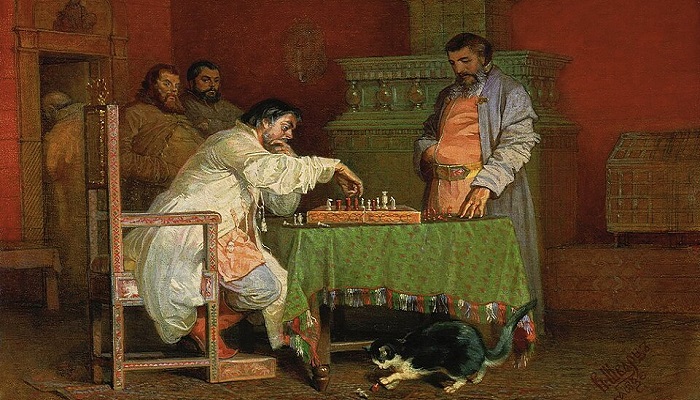
In the case of the Russian Empire, the Tsar Alexis Romanov I (1629-1676) was a lover of the game, who practiced it at the court because of the fact that he had in his time a crusade against the table games; his son, the future Tsar Peter the Great (1672-1725), would lead the game to the consideration of being the epitome of modernization, pushing on social passtime, unlike his success in the past: the connection of the tsars with the game, was immortalized by the painter in Этюд из жизни русских царей (Игра в шахматы) (Etude of the life of the Russian Tsars), 1865 painting by the Russian Vyacheslav Schwarz (1838-1869).

In the field of science, we look to Gottfried Wilhelm Leibniz (1646–1716), the famous German mathematician, logician and philosopher, to him are used to adjudicating the phrase: «Chess is too much of a game to be a science, and too much of a science to be a game.»; however, strictly speaking, it would not belong to him. Nouveaux essais sur l’entendimiento humain (New essays on human understanding), work published in posthumous form, belongs writings from the period 1663-1690, include several references to chess, one of them links with it Arab tradition:
«‘Place’ is either particular, as considered in relation to this or that body, or universal; the latter is related to everything, and in terms of it all changes of every body whatsoever are taken into account. If there were nothing fixed in the universe, the place of each thing would still be determined by reasoning, if there were a means of keeping a record of all the changes or if the memory of a created being were adequate to retain them — as the Arabs are said to play chess on horseback by memory. However, what we cannot grasp is nevertheless determinate in the truth of things».
In the glossary of one of the editions of the text, when speaking of games, the following is said:
«Games. Leibniz speaks of the human mind as ‘paraissant mieux dans les jeux’ than in more serious pursuits (p. 466). This could mean that the mind is more thoroughly displayed in games, or that it appears to perform more creditably in games. The latter reading, which we opt for in the translation, expresses an opinion which Leibniz certainly held (LPG 111, pp. 621, 667 and Iv, p. 570). He envisaged ‘a comprehensive study of games, dealt with mathematically’: first ‘all the games which rely on numbers’; next, ‘the games which also involve position, such as backgammon, checkers and especially chess’; and after them ‘the games which involve motion, such as billiards and tennis’».

ART, LITERATURE AND CHESS
The XVII century is the era of the Baroque, an era of profound existential crisis, dramatic contrasts and an intense creative explosion. If you abandon the balance, harmony and classic serenity of the Renaissance in order to seek emotion, movement, effect and theatricality.
Writers of note will give timless works, from Miguel de Cervantes (1547–1616) to William Shakespeare (1564-1616). The theatre, which had not resumed since the era of the Greeks, will tend to have a definitive resurgence, with figures such as Lope de Vega (1562–1635) and Thomas Middleton (1580-1627). The four authors, among others, repaired in their respective works to chess, in some cases with notable intensity and, in all, with high expressiveness, an unequivocal signal that the game was a very important element of cultural, intellectual and social perspectives.
Spanish Golden Age shows tha names of Cervantes and Lope de Vega and, among others, Luis de Góngora (1561-1627) and Francisco de Quevedo (1580–1645), all with love for the game.
Without doubt, that the highest point is given with Lope de Vega, the pioneered to include chess in the genre of modern theater, something that did once and again in his immense work, so that he could well be baptized like the Phoenix of chess in the world of literature.
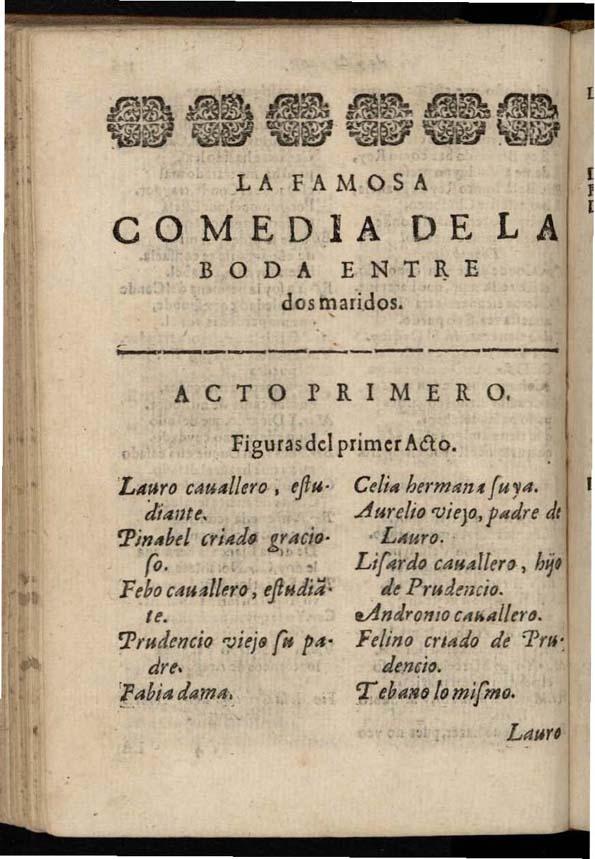
The first time that chess appears in its text, and in the modern theater as a whole, is in La boda entre dos maridos (The wedding between two husbands), which was conceived and written between the years 1595 and 1601, where this parliament is included:
“Hízome Febo este engaño, / o alomenos Lauro fue, (…) / Con mi fortuna inhumana / juego al Axedrez, y pierdo / la vida que el tiempo gana. / En Lauro, en Febo, y en ti / tres casas muda mi fama, / el mate viene tras mí, / pues no ay peón que a la dama/ no diga la que de aquí. / Desesperada me voy, / de mi voluntad corrida, (…)”. (in original language)
“Phoebus played this trick on me, / or at least Lauro did, (…) / With my inhuman fortune / I play chess, and I lose / the life that time wins. / In Lauro, in Phoebus, and in you / my fame changes three squares, / checkmate comes after me, / for there is no pawn that to the queen / does not say what [it says] from here. / Desperate I go, / vexed by my own will, (…)”
Starting from this mention the author returns to chess in these other works: La fuerza lastimosa (The Piteous Force); El genovés liberal (The Liberal Genoese), whence includes this precious image: “Piezas somos de ajedrez, / y el loco mundo es la tabla, / pero en la talega juntos / peones y reyes andan” (“We are chess pieces, / and the mad world is the board, / but in the bag together / pawns and kings walk around”); El primer Fajardo (The first Fajardo), where he places the game in the club of territorial conquest: “Jugando estaba el rey moro / en rico ajedrez un día / con aquese gran Fajardo, / por amor que tenía. / Fajardo jugaba a Lorca, / y el rey gaba a Almería, / que Fajardo aunque no es rey, / jugaba four o seis villas./.” (“The Moorish king was playing / a rich game of chess one day / with that great Fajardo, / for love that he held. / Fajardo played for Lorca, / and the king for Almería, / for Fajardo, though not a king, / played for four or six towns.”); La obediencia debida (Due obidence); El servir como mala estrella (Serving as an ill omen), whence the game appears as a courtly cultural value: “Córrese una cortina y se vé al Rey DON ALFONSO jugando al ajedrez con el Rey Moro DORAICEL, y alrededor sentados DOÑA MARCELA, DOÑA CLARA, DOÑA SANCHA y DOÑA HIPÓLITA, caballeros, criados y músicos” («A curtain is drawn and King Don Alfonso is seen playing chess with the Moorish King Doraicel, and seated around them are Doña Marcela, Doña Clara, Doña Sancha, and Doña Hipólita, along with knights, servants, and musicians.”); Noche toledana (Toledan night); El gran duque de Moscovia y emperador perseguido (The Grand Duke of Muscovy and Persecuted Emperor) where it is distinguished high pieces from vile pieces: “No hay en este ajedrez tretas sutiles, / porque se acaba el juego de manera / que los reyes, las damas, los arfiles / junta la muerte, sin quedarse fuera / Las piezas altas ni las piezas viles» (“There are no subtle tricks in this chess, / because the game ends in such a way / that death gathers together the kings, the queens, the bishops, / leaving no one out / Neither the high pieces nor the vile pieces.”); Los melindres de Belisa (Belisa’s Prissiness); Servir a señor discreto (Serving a wise master), where life is presented in such a way and is told about the union of a young man with a mulatta, so that this situation could be given: “El astrólogo me dixo / verdad pura, que sí tengo / hijos axedrez, serán / pues serán blancos, y negros.” (“The astrologer told me / pure truth, that if I do have / chess children, they will be / for they will be white, and black.”); La dama boba (The Foolish Lady), where Leandro -Le- and Liseo -Li- hold a dialogue in which people can be seen as pieces of chess: “Le. Es Madrid una talega / de piezas, donde se anega / cuanto su máquina pare. / Los reyes, roques y arfiles / conocidas casas tienen; / los demás que van y vienen / son como peones viles: / todo es allí confusión. / Li. No es Otavio pieza vil. / Le. Si es quien yo pienso, es arfil, / y pieza de estimación…” (“Le. Madrid is a bag / of pieces, where everything that its machinery gives birth to is drowned. / The kings, rooks, and bishops / have well-known houses; / the rest who come and go / are like vile pawns: / all is confusion there. / Li. Otavio is not a vile piece. / Le. If he is who I think, he is a bishop, / and a piece of high esteem…”); Obras son amores y no buenas razones (Actions speak louder than words); El píncipe perfecto (The Perfect Prince) where, calling for no confusion, he says: «Talega de ajedrez con piezas tales, / Que son en ti confusamente iguales, / Y del peón al Rey no hay diferencia.” (“A chess bag with such pieces, / that within you they are confusingly equal, / and from the pawn to the King there is no difference.”); Los locos de Valencia (The Madmen of Valencia), where chess appears like a mirror of life: «Bien parece que esta vida / Es un juego de ajedrez.” (“It well appears that this life / Is a game of chess.”); Lo fingido verdadero (What Seemingly Is True), where it is established the relationship between chess and theatre: «el teatro parece un escritorio / con diversas navetas y cortinas. / No hay tabla de ajedrez como su lienzo» (“The theater resembles a desk / with various small drawers and curtains. / There is no chess board like its canvas.”); La gallarda toledana (The Gallant Woman of Toledo) shows the link between love and chess: “Erraste en no me advertir, / que los que juegan no ven / En el ajedrez de amor.” (“You were wrong not to warn me, / that those who play do not see / In the chess of love.”); Discurso de la nueva poesía (Discourse on New Poetry), included in La Filomena (The Fiomena); La Dorotea (The Dorotea), and, not in the theater genre, but in a gloss, included in Rimas divinas y humanas del licenciado Tomé de Burguillos (Divine and Human Rhymes by Licentiate Tomé de Burguillos), when describing the moment of the lighting of Jesus says: “Ya retozan in the prado / Los corderos, y cabritos / Los blancos, y los escritos, / Piezas de axedrez parecen.” (“Already frolic in the meadow / The lambs, and little kids / The white ones, and the spotted ones, / They look like chess pieces.”).

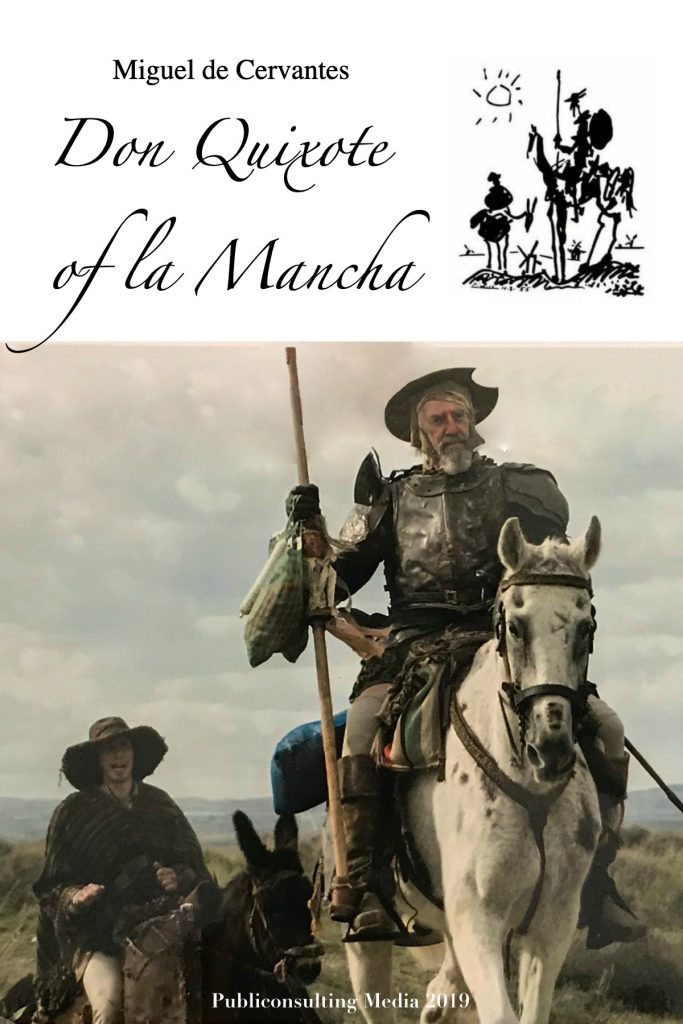
The greatest writer in the Spanish language, Miguel de Cervantes Saaavedra (1547-1616), refers to the game in his exceptional Don Quijote de la Mancha (Don Quixote of la Mancha), a work created by two separate parties in the years 1605 and 1615, standing out in this parliament in particular:
«-Pues lo mismo -dijo don Quijote- acontece en la comedia y trato de este mundo, donde unos hacen los emperadores, otros los pontífices, y finalmente todas cuantas figuras se pueden introducir en una comedia; pero en llegando al fin, que es cuando se acaba la vida, a todos les quita la muerte las ropas que los diferenciaban, y quedan iguales en la sepultura.
-Brava comparación -dijo Sancho-, aunque no tan nueva, que yo no la haya oído muchas y diversas veces, como aquella del juego del ajedrez, que mientras dura el juego, cada pieza tiene su particular oficio; y en acabándose el juego, todas se mezclan, juntan y barajan, y dan con ellas en una bolsa, que es como dar con la vida en la sepultura« (In original language)
“—Well, the same thing—said Don Quixote—happens in the comedy and business of this world, where some play emperors, others pontiffs, and finally all the figures that can possibly be introduced into a comedy; but upon reaching the end, which is when life finishes, death strips away the garments that differentiated them all, and they remain equal in the grave.
—A fine comparison—said Sancho—, though not so new that I haven’t heard it many and various times, like that one about the game of chess, where while the game lasts, each piece has its particular office; and when the game is over, they are all mixed together, joined, and shuffled, and thrown into a bag, which is just like casting life into the grave.”
In Pedro de Urdemalas, another work by the author, which dates back to 1615, he invokes the game as a weapon of seduction (in the fragment it is clear that the roque corresponds to the name of the era for the piece of the tower and, in the text, it is the name of the protagonist of the story):
“Será así, / porque es el Roque tal pieza, / que no hay dama que se esquive / de entregalle su belleza; / y aunque en estrecheza vive, / es muy rico en su estrecheza”. (In original language)
“It will be thus, / because the Rook is such a piece, / that there is no lady who escapes / surrendering her beauty to him; / and though he lives in narrow straits, / he is very rich within his narrowness.”

The Spanish poet Luis de Góngora, also mentions the game in his work, always alluding to a love context, as when including some erotic connotation, and alluding to the situation of coronation, he says:
«Dicen que hay casas de fama / como ajedrez en valor, / que cualquier pieza menor / entrando llega a ser dama» (In original language)
“They say there are famous houses / like chess in value, / where any lesser piece / entering comes to be a queen.”

Francisco de Quevedo Villegas (1580-1645), another great Spanish literate of the time, also included chess in his literary work, including mentions in some verses. An example of this is the following passage:
“Estos iban á todas las fiestas á enamorarse, haciéndolas días de trabajo; y á que andaban de casa en casa, como pieza de ajedrez, sin poder nunca coger dama. Unos decían mas que sentían, y otros sentían, y no decían palabra…”. (In original language)
“These men went to all the festivities to fall in love, making workdays out of them; and there they wandered from house to house, like a chess piece, never able to capture a queen. Some said more than they felt, and others felt, and didn’t say a word…”

The greatest feather in the English world, William Shakespeare (1564-1616), in The Tempest, one of his last works (d. 1610/1611), includes a scene where Miranda and Ferdinand, the pair of lovers who star in the story, play chess in the island of Prospero, a clear metaphor of the amorous procession and, in the context of its plot, also of political stakes, has a clear idea that it is on the road to restoring the legitimate power of the Duke of Milan, the father of the youth.
There, it´s a passage titled “The entrance of the Cell opens and discovers Ferdinand and Miranda playing at chess”. In the dialogue, in which Alonso, the King of Naples and father of Ferdinand, also takes part, the following is said:
«Miranda. Sweet lord, you play me false. Ferdinand. No, my dearest love, I would not for the world. Miranda. Yes, for a score of kingdoms you should wrangle, And I would call it fair play. Alonso. If this prove A vision of the island, one dear son Shall I twice lose».

A Game at Chess, was a play performed at the Globe Theater in London on 6 August 1624, authored by the other great English playwright of that time, Thomas Middleton (1580-1627). It is a political satire that was considered a patriotic drama, which used the lyrics of the chess to harshly criticize geopolitical relations and marital flirtations between the British and Spanish crowns. It was a roundabout outcome for the public until the censorship, driven by the criticism of Spain, which was less disdainful for the treatment that was given to its representatives, prohibited it, even ordering the capture of the actors and the author.

The work recreat the state of tension of these powers, applying itself to the parable of a game of chess, using narrative resources of gruesome steps and with a result hoped for that could not be anything else than agonal. On one side, the good ones, the English people, play with the white piezas; while the blacks will correspond to the Spaniards, to those who are characterized by the worst possible form, by their ambitions and, including, by their libidinous inclinations, in the face of the asceticism of their rivals.
The focus is placed on the figure of Diego Sarmiento de Acuña (1567-1626), the ambassador before the court, who was commissioned in England between 1613 and 1622, to which he was accused of having had too much influence on the English king and, among others, on Ignacio de Loyola (1491-1556), the future saint, to whom he does not precisely present himself here in his virtues, but who assumes it as ambitious, demanding a universal Church. To the creator of the Order of the Jesuits, which was particularly persecuted by Isabel I of England (1533-1603), a recognized player of chess on the other hand), he is exhibited in his earthly pleasures.
Middleton, in Women Beware Women, an earlier work (most likely from 1623 or perhaps even from that same year 1624, although it became known subsequently), includes a scene with mention of chess:
«LIVIA. Alas, poor widow, I shall be too hard for thee.
MOTHER. You’re cunning at the game, I’ll be sworn, madam.
LIVIA. It will be found so, ere I give you over.
She that can place her man well—[Aside] As I shall, wench—[Back to Mother] can never lose her game.
[Mother offers to move at chess]
Nay, nay, the black king’s mine.
MOTHER. You play well the whilst.
LIVIA. How she belies her skill! I hold two ducats, I give you check and mate to your white king, Simplicity itself—your saintish king there«.


A joint theater work by the Englishmen John Fletcher (1579-1625) and Philip Massinger (1583-1640), although previously attributed to their other compatriot, Francis Beaumont (1584-1616), is The Spanish curate, where as in the case of Middleton, they use the game in the plot of a game that took place in London in 1622. There, one of the characters, enters the stage in a given moment with a board of chess, challenging his rival, wondering to prove that was as clever as he said.

In painting, *chiaroscuro*—the use of strong contrasts between light and dark—would take center stage, serving to heighten the dramatic intensity of works. A key figure in this regard is the Italian artist Caravaggio (1571–1610); he is often associated with a painting that features a game of chess, though the work is actually attributed to one of his disciples and fellow countryman, Bartolomeo Manfredi (1582–1622). The painting, titled I giocatori di scacchi (The Chess Players), is believed to have been created early in the second decade of the century and is currently held in a private collection.

Around 1670, the Dutchman Cornelis de Man (1621–1706)—a Baroque painter of the Delft School—produced Het schaakspel (The Chess Players), which is now on display at the Museum of Fine Arts in Budapest.
Some beautiful game boards and pieces date from this period, continuing a long-standing tradition. One such example, held by the Metropolitan Museum of Art in New York, is an inlaid, varnished, and gilded wooden board with metal hinges. Originating from India, it is painted on both sides: one features an eight-by-eight grid—intended for chess or checkers—while the other side displays a board for backgammon. Dating from the late 17th century, the design incorporates symmetrical arabesques that decorate some of the squares, while the alternating squares feature depictions of flowering plants.
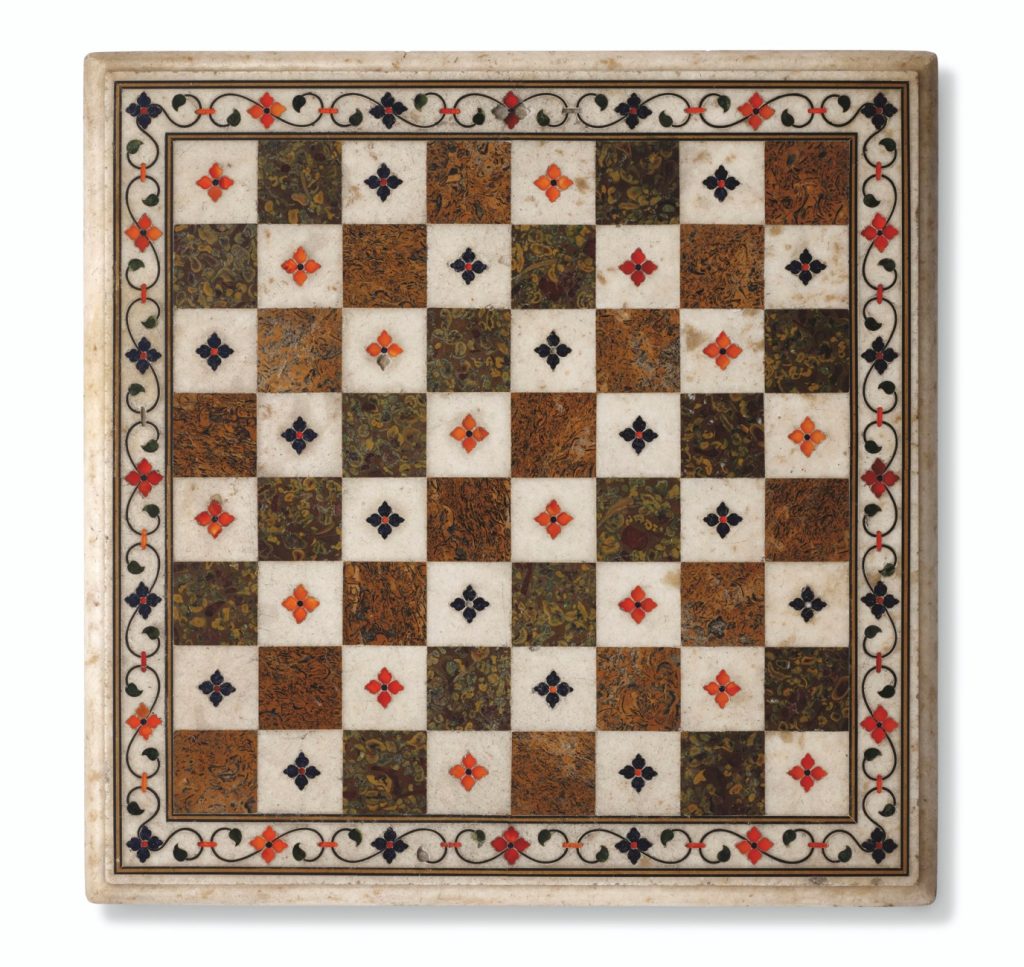
Also from northern India, dating to the period of Mughal influence—though it may perhaps belong to a later era—is a board featuring a checkered pattern of hardstones inlaid into a stone base, framed by borders with floral motifs characteristic of the Agra school.
From Europe—keeping in mind that chess sets can feature artistic and valuable designs—we can point to a set of German origin; although it dates from the 19th century, it represents the style used during the 16th and 17th centuries, with the white and black pieces crafted from ivory.
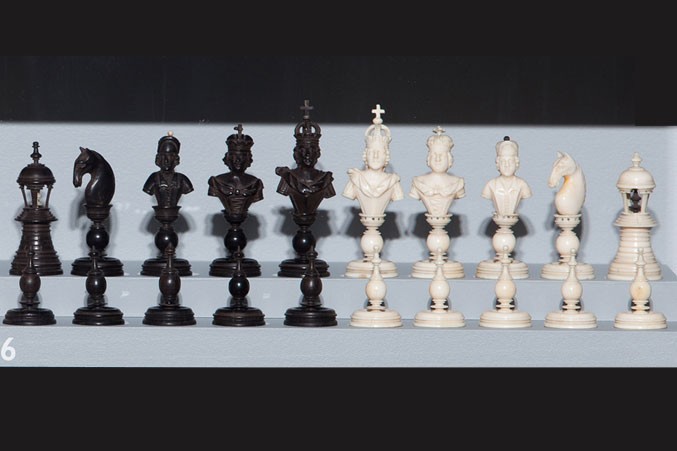
Selenus-style chess sets are characterized by their tall, elegant, and slender pieces, as well as their tiered, stepped ornamentation. They owe their name to their resemblance to a set depicted in an illustration by the Flemish Baroque painter, sculptor, and engraver Jacob van de Hayden (1572–1636) found in Das Schach oder König-Spiel—Chess or the King’s Game, the book by Selenus mentioned before. The following set, which dates to approximately 1790, originated in either Germany or the Netherlands, follows this model.
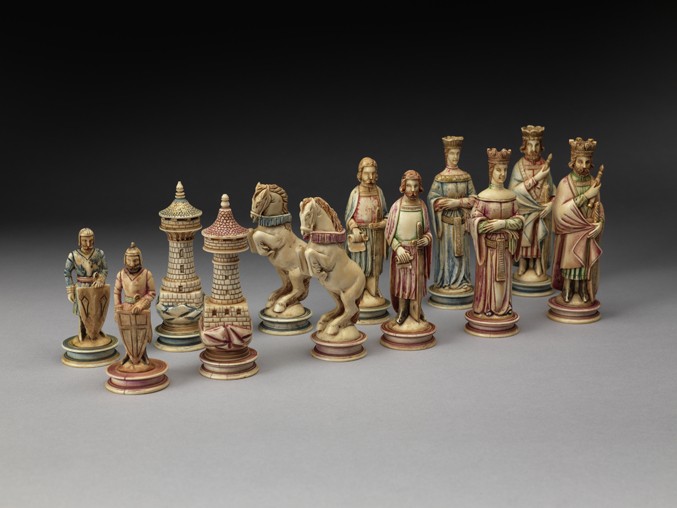
From Russia comes a set, dating to 1790, crafted from mammoth ivory—a resource abundant in the country’s north. This material gained particular significance in the mid-16th century, when master carvers from Kholmogory began working at the Kremlin Armoury in Moscow, a facility where weapons and decorative objects for the tsars were produced and housed. Under the patronage of the royal court, folk traditions merged with the aesthetics of courtly art, giving rise to chess sets carved from bone and ivory—a rich regional craft tradition, fostered by the local presence of walruses and mammoths.
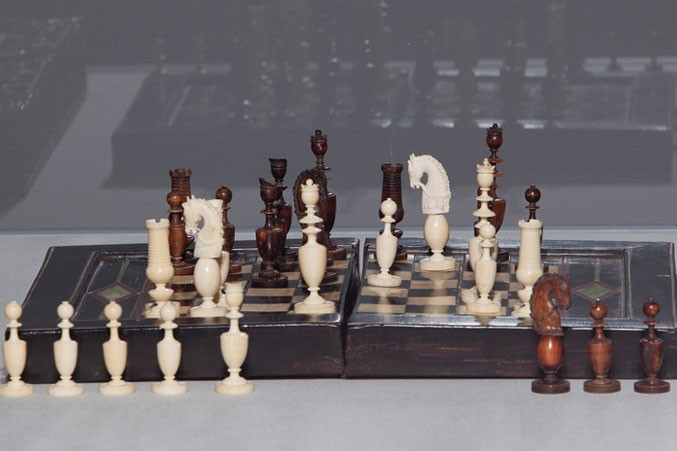
Years later, sets of pieces referencing the Thirty Years’ War (1618–1648) would appear—such as one made of cast iron around 1850 by the German firm E. G. Zimmermann, founded by Ernst George Zimmermann (1807–1873) in Hanau.
King Henry IV of France (1553–1610)—grandfather of Louis XIV—shared his grandson’s interest in chess. During his reign, one of the earliest known instances of the game being linked to music took place: on February 22, 1607, the Ballet des Échecs (Chess Ballet) was staged at his court, with dancers costumed to represent the pieces of the game.
This was one of several court ballets from that period; that same year, other ballets were performed, themed around such subjects as the elderly, the white and the black, senators, blacksmiths, the forgetful, magicians, and rogues.

Music and chess, then, represent a new way of linking art and culture with the game—a contribution from the 17th century, a period in which, thanks to figures like Gioachino Greco and other developments centered on the Italian peninsula, chess —in its modern form—began to spread its influence throughout Europe, gradually reaching the Americas and the rest of the world.