Chess in the 19th Century: Milestones of 1897
By Sergio Ernesto Negri

Global Context
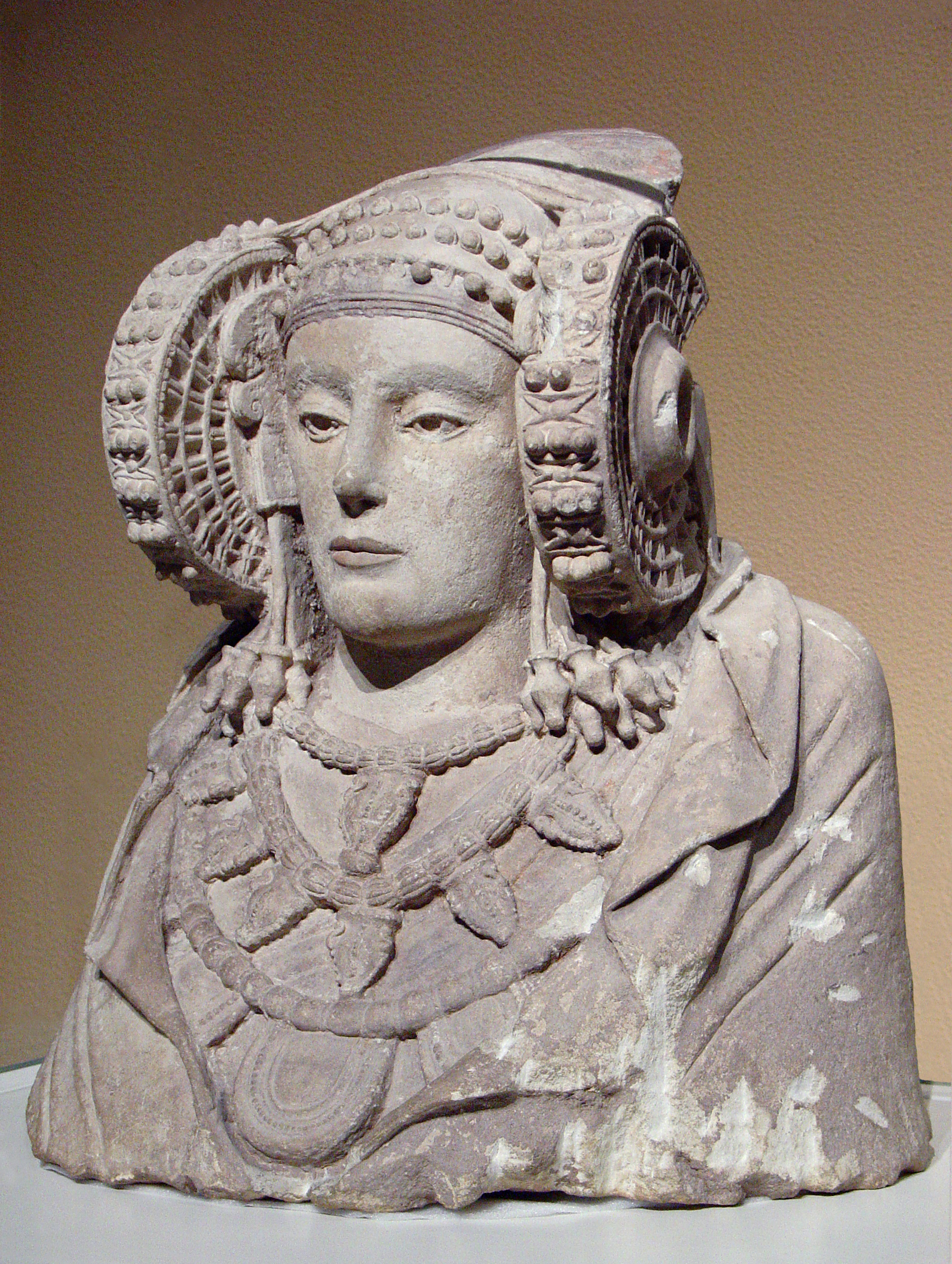
Queen Victoria’s (1819–1901) Diamond Jubilee marks the height of the British Empire. Organized by the Hungarian-born Theodor Herzl (1860–1904) in Basel, Switzerland, the First Zionist Congress is held, which will serve as a precursor to the future creation of the State of Israel. Saomon Andrée (1854–1897) set out in a hot-air balloon from Svalbard in an attempt to reach the North Pole, but the expedition ended in tragedy with the disappearance of the Swedish explorer. An earthquake claimed many lives in India, and others, followed by tsunamis, struck the Philippines. A war broke out between Greece and the Ottoman Empire. Spain grants autonomy to Puerto Rico and, in this country, a sculpture from the 5th and 4th centuries BC belonging to the Iberian people is discovered; it is named the Lady of Elche.
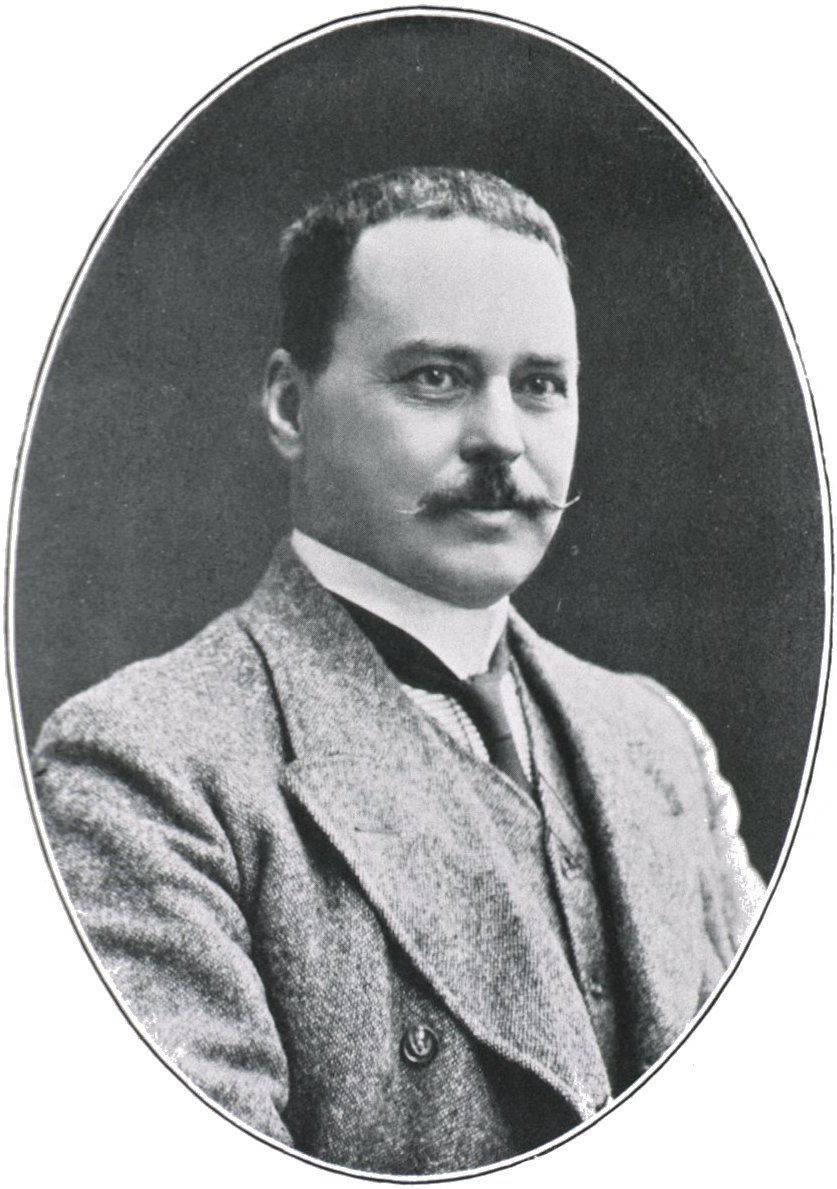
British physicist Joseph John Thomson (1856–1940) announced the discovery of a particle much lighter than the atom, which he called a “corpuscle”; it would later be known as the electron. German chemist Felix Hoffmann (1868–1946) synthesized a stable form of acetylsalicylic acid, giving rise to aspirin: this breakthrough marked the beginning of modern pharmacology. The Scottish-born (in India) Ronald Ross (1857–1932) demonstrated that mosquitoes were the vectors transmitting malaria, a discovery that would earn him the Nobel Prize. The Italian inventor Guglielmo Marconi (1874–1937) obtained the British patent for wireless telegraphy, laying the foundation for radio communications. In Munich, the German (born in Paris) Rudolf Diesel (1858–1913) successfully presented his high-efficiency internal combustion engine.
The Czech musician and composer Gustav Mahler (1860–1911) begins directing the Vienna State Opera. The first film studio dedicated exclusively to film production, founded by the Frenchman Georges Méliès (1861–1938), opens in Montreuil, France. American Thomas Edison (1847–1931) patents the kinetoscope, the first movie projector. The Library of Congress opens in Washington. The play Cyrano de Bergerac by the Frenchman Edmond Rostand (1868–1918) premieres. The British author H. G. Wells (1866–1946) publishes The Invisible Man, and the Irish Bram Stoker (1847–1912) Dracula, in which chess is mentioned in a highly suggestive manner in the following passage:

«The Count is a criminal and of criminal type. Nordau and Lombroso would so classify him, and quâ criminal he is of imperfectly formed mind. Thus, he be so clever in his private movements, and in the scheme of self-protection that he has been preparing for by the centuries, but he is at the same time an infant, or a child. He cannot think of more than one thing at a time, or he would not have been so foolish as to come to London, where there are so many people to see him. If he were as wise as he is cunning, he would have been like a player in a game of chess, who can see his opponent’s move before it is made.»
Chess in 1897
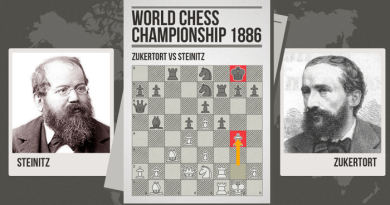
This year, in Moscow, the rematch for the world championship—which had begun in late 1896—between the Prussian Emanuel Lasker (1868–1941) and the American (born in Prague) Wilhelm (William) Steinitz (1836–1900), with a resounding victory for the champion, following ten wins, two losses, and five draws. The contest began with four consecutive wins by Lasker, and by the eleventh game, he had racked up seven victories; then came a modest comeback by the veteran former champion, who won two games in a row, but the outcome of the contest had already been decided long before.

In Berlin, the Hungarian Rudolf Charousek (1873–1900), whose career was as brief as it was brilliant, prevailed over the German (born in the Netherlands) Carl Walbrodt (1871–1902), who finished half a point behind, and the British player Joseph Blackburne (1841–1924). In Vienna, local player Karl Schlechter (1874–1918) triumphed, ahead of the Polish (later American) Max Judd (Maksymilian Judkiewicz) (1851–1906) and the Romanian Georg Marco (1863–1923).
Following his dazzling victory at Hastings in 1895, the American Harry Pillsbury (1872–1906) began performing prodigious exhibitions (often playing twenty blindfold games while playing whist, a type of bridge) and reciting lists of complex words, in demonstrations that reinforced the perception that we were in the presence of a “superhuman” prodigy. On the chessboard, he defeated his compatriot Jackson Showalter (1859–1935) in a match in New York, 11.5 to 9.5.
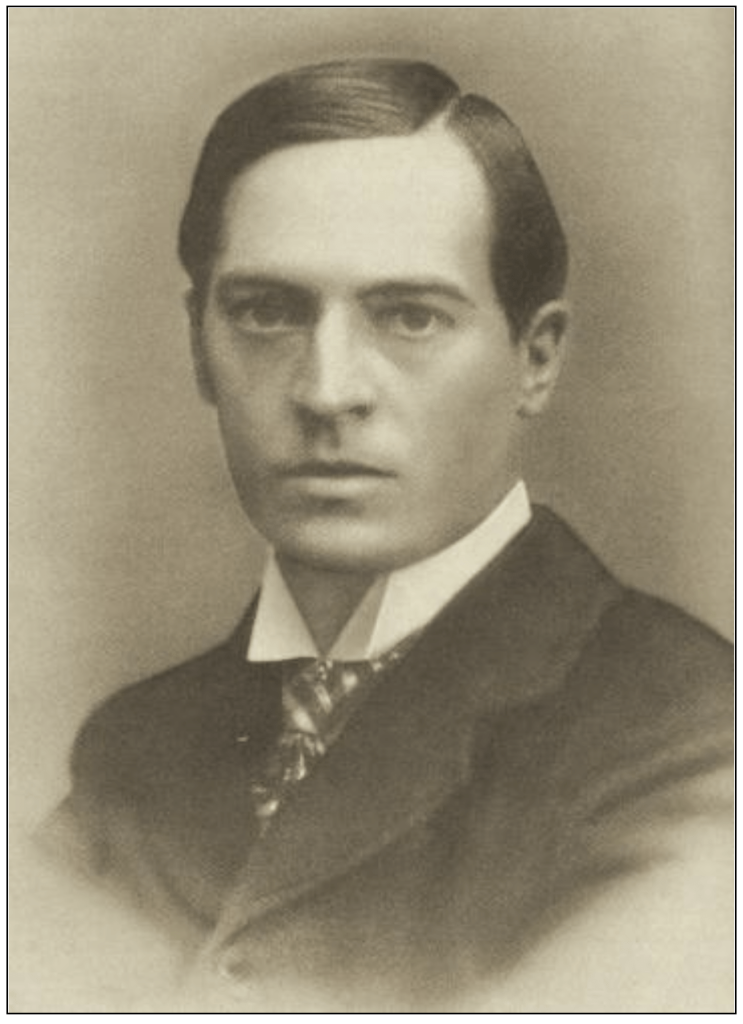
Harry Pillsbury
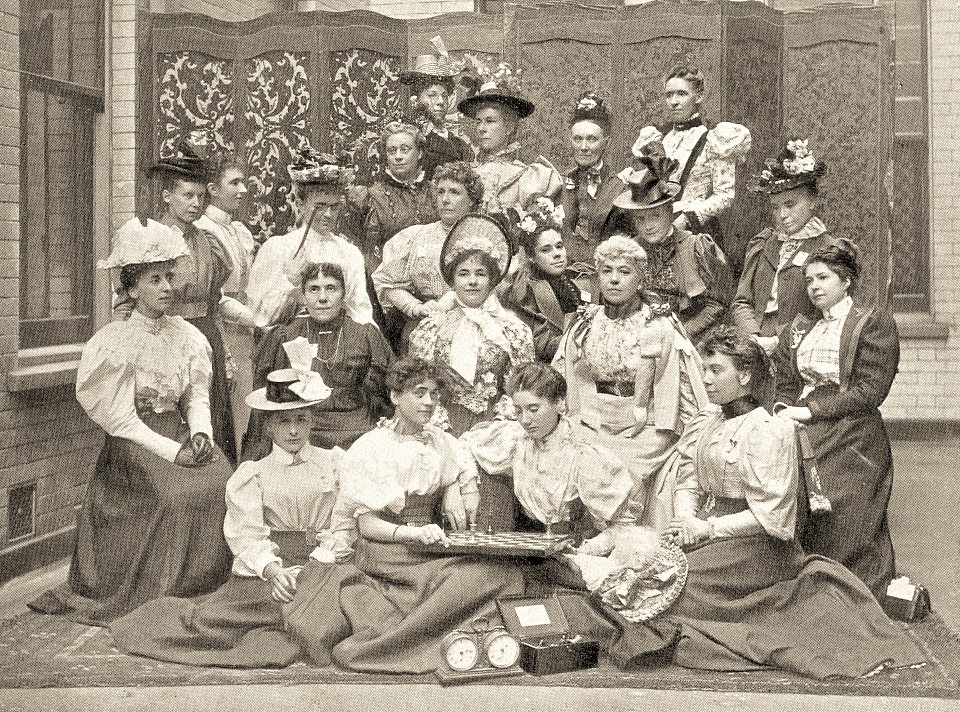
With the resounding victory of local player Mary Rudge (1842–1919), the first international women’s tournament was held in London, featuring nineteen participants; second place went to Louisa Fagan (1850–1931), who was born in Italy but made England her home: the winner conceded only one draw throughout the tournament. The second telegraph match between the U.S. and England took place, with victory this time going to the European country, 5.5 to 4.5: once again, Pillsbury and Blackburne led their respective teams; the Prince of Wales, the future King Edward VII (1841–1910), sent his greetings, demonstrating the match’s national significance.
As of December, Chessmetrics presents the following ranking of the top players in the world: Lasker; the retired Prussian Siegbert Tarrasch (1862–1934); the Russian Mikhail Chigorin (1850–1908), who performed poorly in the Berlin tournament and was more focused this year on his role as organizer of the world title match in Moscow; the German Curt von Bardeleben (1861–1924), who finished in the middle of the table in tournament of Berlin; the Frenchman (born in a city in Belarus, Russian Empire) David Janowski (1868–1927), who finished fourth in that prestigious tournament in Germany, with Steinitz relegated to seventh place. In the case of EDO Historical Chess Ratings, in its year-end rankings, the top players were Lasker; Tarrasch; Charousek; Pillsbury; and Janowski, with Steinitz in sixth place.

Born: in Belgium, Edgard Colle (1897–1932), winner of several international tournaments beginning in the 1920s, remembered for a system of openings based on restricted pawn advancement with White that was once very popular; in Romania, Ion Gudju (1897–1988), one of the signatories of the founding of FIDE (then known as the FIE) in Paris in 1924, who would serve as Honorary Vice President of the organization from 1982 to 1988; in Poland, Jerzy Jagielski (1897–1955), a member of his country’s Olympic team that won silver at the unofficial 1936 Munich Olympics, and the Frenchman André Muffang (1897–1989), individual silver medalist at the 1928 Hague Olympics.
The Austrian Berthold Englisch (1851–1897), winner of several tournaments in the late 1870s and 1880s, passed away, as did the Dutch historian Antonius van der Linde (1833–1897), who amassed the largest private collection of chess books during the 19th century, having authored several works, notably Geschichte und Literatur des Schachspiels («History and Literature of the Game of Chess«) from 1874—perhaps the most influential text of the 19th century—a two-volume work published in Berlin that debunks the legends surrounding the game’s origins in favor of theories more aligned with historical facts, in addition to serving as a catalog of all works on chess published up to that date, to which the following may be added: De schaakpartijen van Gioachino Greco, a biography of the Italian player Il Greco (1600–1634), published in 1865; Das Schachspiel des 16 («The Chess Game of the 16th Century«), in which he examines the transition from old to modern chess, published in 1873; Quellenstudium zur Geschichte des Schachspiels («A Study of Primary Sources on the History of Chess«), in which he revisits his earlier work, emphasizes Arabic chess and the iconic text by Spanish Alfonso X (1221–1284), and challenges the theory of the Scottish theorist Duncan Forbes (1798–1868), published in 1889; and Het schaakspel («The Game of Chess«), published in 1875—unlike the previous works, this one written in Dutch—which serves as a sort of condensed compendium of his earlier works.

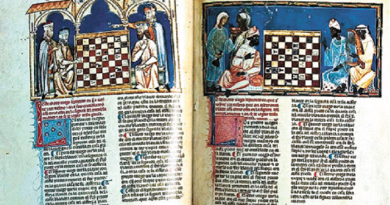
Published in Leipzig, Zur Geschichte und Literatur des Schachspiels («On the History and Literature of Chess«), a work by the German scholar and great chess player Tassilo, Baron von Heydebrand und der Lasa (1818–1899), is a virtual summary of all his distinguished previous work, featuring analyses of manuscripts from the Middle Ages and the Renaissance; his research on the evolution of chaturanga into shatranj as the game spread from East to West; and serving as a catalog of all works on chess published up to that point, which he comments on and examines for the accuracy of their content and significance, drawing on his experience and his prodigious personal library.

In an article published in American Chess Magazine in September, titled “Oriental Women Chess Players” and written by the American journalist Margherita Arlina Hamm (1867–1907), mentions several female chess players who were prominent in China, such as the last wife of diplomat Li Hongzhang (1823–1901) or, even earlier, the wife of Cantonese merchant Howqua (1769–1843). Women could be recognized as chess players in areas far from the centers of competition at the time.
The French writer Louis Aragon (1897–1982), in addition to being a writer, was a chess player, having mentioned the game in several of his works, including the following verses:
“…Dans la mine ou dans la nature / L’homme ne rêve qu’au future / Joueur d’échecs dont la partie / Perdus ses chevaux et ses tours / Et tout espoir anéanti/Pour d’autres rois sur d’autres cases / Pour d’autres pions sur d’autres bases / Va se poursuivre lui parti…”. (In original French)
(“…In the mine or in the wild / Man dreams only of the future / A chess player whose game / Has lost its knights and rooks / And all hope destroyed / For other kings on other squares / For other pawns on other bases / He will go on, having left…”.)

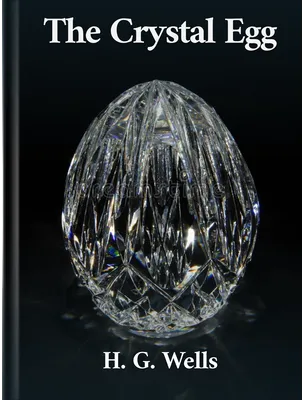
The British writer H. G. Wells (1866–1946) published The Crystal Egg, in which, while listing the objects in the window of an antique dealer’s shop—alongside the zygote (which would ultimately come to represent the planet Mars and its inhabitants), the object that gives the work its title—he mentions the presence of a chess set:
«There was, until a year ago, a little and very grimy-looking shop near Seven Dials, over which, in weather-worn yellow lettering, the name of “C. Cave, Naturalist and Dealer in Antiquities,” was inscribed. The contents of its window were curiously variegated. They comprised some elephant tusks and an imperfect set of chessmen, beads and weapons, a box of eyes, two skulls of tigers and one human” (and the list continues…)
The American novelist William Faulkner (1897–1962), born this year, references chess in the very title of one of his most famous works, Knight’s Gambit, published in 1949. It has been suggested that the main character of this work may have been inspired by his compatriot Paul Morphy (1837–1884), in which, among other references to chess, at one point it is said:
«Yet two strangers had burst not only into his home but into liis private sitting room, and delivered first a peremptory command and then a threat and then burst out again, and his uncle had sat calmly back to an interrupted chess game and an interrvipted pipe and completed a planned move as though he had not only not noticed any interruption but hadn’t actually been interrupted«
Also born was the Russian (later Soviet) filmmaker Nikolai Shpikovsky (1897–1977), screenwriter and assistant director of the film Shakhmatnaya goryachka («Chess Fever«), which was made in 1925 based on that year’s Moscow tournament, in which the then-world champion, the Cuban José Capablanca (1888–1942), played a starring role.