Chiaroscuros of life – The 1939 Buenos Aires Nations Tournament as a turning point for european chessplayers
By Sergio Ernesto Negri

Numerous European chess players were exterminated, confined to concentration camps, or subjected to persecution, torture, and exile due to the prevailing terror during World War II.
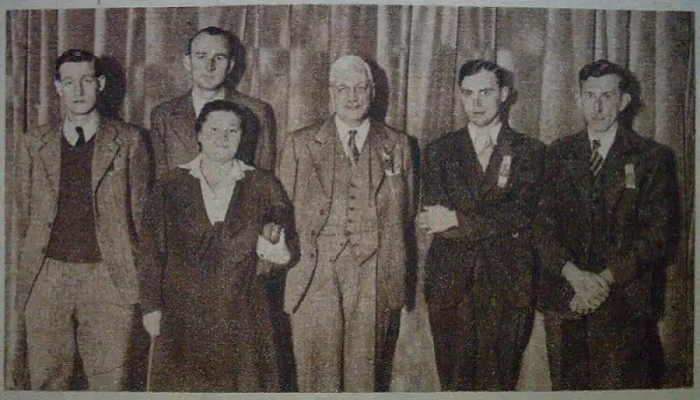
On September 1, 1939, as the conflict formally began in Europe (Hitler ordered to invade Warsaw on that fateful day), the final phase of the Chess Olympiad, the first held outside Europe, was commencing in peaceful Buenos Aires, the capital city of Argentina.
Many chess players who participated in that event, by the force of providence that caused them to be away from their homes at that moment, were able to survive, with a large number of them ending up in South America.
But others, unfortunately, having remained on a continent that would soon erupt in flames, would suffer tremendous consequences, including the premature deaths of many chess players.
Therefore, we share with our readers this «Inventory of Horror,» the name of the chapter wrote, included in the first volume «The Pioneer Generation – 1924/1939» (from the collection History of Argentine Olympic Chess, published by the Argentine Senate in 2012, by Sergio Negri and Enrique Arguiñariz). This served as the basis for the present work.

In these chess players, of course, we can see reflected the situation of so many other human beings affected by the consequences of the horror of a war, the last global one to strike a humanity that does not always find the path to peace and harmony.
As a cruel paradox, while those who traveled to Buenos Aires were able to survive without returning home (at least temporarily for several of them), those chess players who could not participate in the Olympiad did not fare well, especially those of Jewish origin. Boarding the ship south could be considered a safe passage to life.
One of those destined for South America was the Polish chess player, later to become Argentine, Miguel Najdorf (1910-1997) (El apasionado, resiliente y legendario Miguel Najdorf and La Astrología y el Destino: Miguel Najdorf), who not only saved his own skin but was also able to reinvent himself in the south, relaunching his career (which would reach higher peaks from then on) and completing his successful life cycle in lands so far from home.
Najdorf would realize that nothing remained of his past, destroyed by the Nazis in his native Poland. In fact, wanting to know if any of his family had survived, he played simultaneous blindfold exhibitions, first in Rosario (Argentina) and then in Sao Paulo (Brazil), breaking the world record for the specialty, so that, thanks to the resulting journalistic coverage, someone might contact him.
But, it didn´t happen and once the armed conflict ended, upon being able to return to Europe, he would find that nothing was left, so the master decided to continue in the south, becoming the most important Argentine chess player in history.
His progress there would be astonishing: according to some considerations, such as Chessmetrics, he was the second-best player in the world for almost three years in the 1940s and was unjustly excluded from the possibility of becoming world champion when, in 1948, FIDE, under Soviet pressure, excluded him from the tournament to decide that title, for which he had previously qualified.
However, his situation was far from joyful. In Poland, his wife, his young daughter (both unable to accompany the master on his trip due to an illness afflicting her, which tragically marked the course of events), and a very large family (including his parents) had remained, all of whom would perish during the Nazi occupation of a devastated country.

Including Najdorf, more than twenty chess players remained on South American soil. Permanently, among others, were the Austrian Erich Eliskases (Semblanza de Erich Gottlieb Eliskases, ajedrecista nacido en Austria con destino argentino), who in the late 1930s was a serious contender for the world title (Chessmetrics ranked him in the top 10) and had seconded the champion, the French (Russian-born) Alexander Alekhine, in the match where he regained the crown against the Dutchman Max Euwe.
Eliskases, an Austrian, led Germany (his native country had been annexed by Nazism in 1938) to Olympic victory in Buenos Aires, playing as the top board for the team.
Although Eliskases would later excel as an Argentine chess figure (he would be an Olympic representative and quickly attain the Grandmaster title), unlike Najdorf (his contemporary), his progress curve stagnated, and he could not achieve the same results in America that he had obtained as an exponent during his European years.
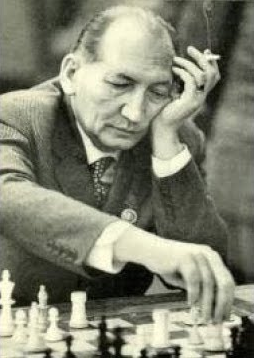
It is notable that other members of that team decided not to return, such as Ludwig Engels, Heinrich Reinhardt, Albert Becker (also Austrian and somewhat paradoxically captain of the Germans: El primer integrante del Club Vera Menchik: Albert (Alberto) Becker, gran ajedrecista austriaco-argentino), and Paul Michel.


All of them would end up residing in Argentina, except for Engels, who settled in Brazil, with the peculiar case of Eliskases who, initially, also resided in that South American nation before finally opting for Argentina.
The German Friedl Rinder, who participated in the women’s world championship held in the Argentine capital (finishing fourth among twenty participants), experienced a very special situation upon deciding to return: she barely managed to find space on the last passenger ship sailing to Europe. That vessel was intercepted by British warships in the Strait of Gibraltar and, only after days of interrogation, she was allowed to continue her journey. She was suspected of being a German spy because no one could imagine someone traveling so far just to play chess…
Adolf Seitz, another German who traveled south as a journalist, would only return to Europe (living in Switzerland and West Germany) after the war ended. His time in Argentina is remembered for its acrimony, due to some controversies he had with local figures, particularly with the father of Argentine chess, Roberto Grau.

Another significant case is that of the German, though repudiated by the Nazi regime, Sonja Graf (Sonja Graf: el ajedrez como camino hacia la libertad), the world runner-up (in Buenos Aires and previously), the best female chess player of the era, after the Russian-Czech-English Vera Menchik (Vera Menchik and La Astrología y el destino: la vida de Vera Menchik), who remained in Argentina for several years before eventually moving to the U.S., where she would complete her life.

Here we have a case that, for the purposes of this story, is prototypical. While Graf was able to survive by initially staying in the south, Menchik, who was, as always, world champion in Buenos Aires, upon returning to her home on the outskirts of London, would die in 1944, along with her sister Olga (another renowned chess player) and her mother, from the impact of a German missile that destroyed their house and their lives.
The Nazis had already signaled their destructive force, and, for example, on September 23, 1940, during their attack on London, they completely burned down the National Chess Centre, then the world’s largest chess club with over seven hundred members. All its contents were entirely destroyed. This club had opened ten years earlier, coinciding with the Buenos Aires Olympiad and the beginning of hostilities in World War II; Vera Menchik herself was in charge of this Centre, which would only reopen in 1952.

In 1940, the Nazis destroyed the London Chess Centre with a missile

The Swedish chess player Gideon Ståhlberg (Gideon Ståhlberg, a Swedish Lion in Argentina), stayed in Buenos Aires for a long time, integrating into and enriching the local circuit. He was a participant and winner of several editions of the classic Mar del Plata international tournament and, in 1943, won the Argentine Major Tournament. However, due to his foreign status, he did not receive the corresponding national title. This player, with a distinguished international career upon his return to Europe, nevertheless showed that his time in Argentina coincided with the best of his play, largely in the intense confrontation he had with Najdorf.

The Polish Moshe Czerniak, another chess player who would fully integrate into the Argentine circuit, had the utmost responsibility for assembling a Palestine team, which had previously been formed for the 1935 Warsaw Olympiad. This squad appeared in 1939 based on European Jewish players residing in British-administered Asian territories, corresponding to a nation not yet recognized.
This consequently placed a great responsibility on the player when forming the team, as those excluded could not be part of that veritable Noah’s Ark that the trip to Buenos Aires entailed. This crucial, make-or-break decision made the team’s mentor reflect bittersweetly. Some were saved, others suffered the worst of fates.
Czerniak, after his prolonged stay in Argentina, would eventually settle in Israel, a country recognized in peacetime, where he would become national champion.

Playing for Palestine in Buenos Aires were Víktor Winz (Víktor Winz se afincará un tiempo en la Argentina tras el Torneo de las Naciones de Buenos Aires 1939), who after a few years in Argentina would decide to return to his native Germany, and the Latvian Zelman Kleistein, who, unlike Winz, would find his final destiny in the country that welcomed him in 1939. Also from this team, Meir Rauch stayed in Buenos Aires, though he later moved to Israel in 1945.

From the Polish team, besides Najdorf, Paulino Frydman (Paulino Frydman, el ajedrecista polaco de destino sudamericano), winner of the Warsaw tournament four times and Polish representative in eight Olympiads with ten medals obtained (six team and four individual), also remained in Argentina. Although he retired from playing for health reasons, in 1955 he would receive the International Master title from FIDE.

In his new home, he would manage a chess club in Buenos Aires (at Café Rex), where another of his prominent compatriots, who resided in the south for a long time, the great writer Witold Gombrowicz (El renacer de Witold Gombrowicz en Buenos Aires: el Ferdydurkismo, Gombrowicz renació con la traducción de Ferdydurke en una sala de ajedrez de Buenos Aires and Precisos y preciosos registros del ajedrez en la intensa vida de Witold Gombrowicz), could often be seen. Gombrowicz, for his part, had also come to the Argentine capital in 1939 without being able to return as planned.

Also, though only remaining for a time in Argentina, we see Franciszek (Frank) Sulik, who played in the national Major Tournament in 1940, but whose final fate would lead him to Australia.

In Buenos Aires, a team played under the name Protectorate of Bohemia and Moravia, due to the occupation of Czechoslovakia by Nazi forces that dominated that territory. From the powerful team that represented it, Karel Skalička (Karel (Carlos) Skalička, el jugador checo-argentino miembro fundador de la FIDE) and Jiří Pelikán would definitively remain in the South American capital.
The former, a lawyer and military man, had been a founding member of FIDE in 1924, and, just as Roberto Grau did the same representing Argentina, it would historically happen that two chess players who would end up being Argentine appear as founders of the world entity.


From Estonia, two players remained in Argentina. The great Paul Keres, though for a very short time (one could say he extended his chess tour far from home rather than settling), who, upon returning to the USSR, would face serious integration problems, as he was initially seen as a Nazi collaborator until he was accepted (which was far from the truth). And Ilmar Raud that, unlike most who decided to remain in South America, had serious adaptation difficulties, leading to his premature death at only twenty-eight years old.


One who had better fortune in his adopted home was Markas Luckis (Markas (Marcos) Luckis, el ajedrecista lituano-argentino) from Lithuania, who had a long life in Argentina. For his part, although he would die at only forty-two, which might suggest a difficult adaptation, the Latvian Movsas (Movša) Feigins also remained in Buenos Aires.

Also, remaining in the Southern Cone until the end of their lives, were the Dutchman Christian de Ronde (he had been Rotterdam champion) and the Irishman John Francis O’Donovan.


Playing in the 1939 Women’s World Championship, representing France, although born in territories that belonged to a Ukraine always occupied by regional powers, we have the case of Paulette Schwartzmann (Paulette Schwartzmann, la campeona francesa que se quedó en Argentina por la Segunda Guerra Mundial), who not only stayed in Buenos Aires but would also dominate the local women’s scene, becoming multiple Argentine champion until her death.

The Frenchman Aristide Gromer (El ajedrecista francés Aristide Gromer en Buenos Aires), on the other hand, although he stayed in the south for several years (and even played in a national Major Tournament), would later return to his homeland after the conflict ended.

A very particular situation occurred with the English representatives. As already mentioned, Menchik finished her world championship in Buenos Aires, to win it again (as she had since 1927). The Olympic team, which had qualified for the final stage, unlike her, immediately abandoned the competition (they had qualified for the final stage), hastily returning to the island.
In addition to seeking safeguards, it is notable that several of the chess players would later play a prominent role during the war, as part of the team led by the scientist Alan Turing (Alan Turing, precursor en el vínculo del ajedrez con la computación y los desarrollos tecnológicos) that deciphered the Enigma Code, a task that allowed them to discern enemy codes which, in some views, was central to shortening the armed conflict. This was the case for Hugh O’Donel Alexander (who would be promoted to colonel), Harry Golombek, and Stuart Milner-Berry.


We’ve already seen how Najdorf and other Polish players were saved by remaining in the south. The leader of that team, Savielly Tartakower (Galería de Maestros: Savielly Tartakower, «un hombre de honor»), who actually resided in France, a country that would definitively become his own, returned to Europe and, in fact, was a combatant, known in that capacity by the surname Cartier, placing himself at the disposal of the resistance forces led by Charles de Gaulle.

Another who would be considered a war hero is the Yugoslav Svetozar Gligorić (Gligorić, el ajedrecista partisano (a cien años de su nacimiento)), who defended the partisan cause and, in peacetime, would become one of the best chess players in the world.

Returning to the Polish cases, many of their citizens, particularly if they were of the Jewish faith, would perish. Among them, Isaac Appel (1905-1941), about whom Najdorf once made a reference that, seen from a distance, would have been entirely inaccurate and unintentionally injurious (Reivindicación de Izaak Appel by Juan Morgado).
Appel was found by the outbreak of war living in Lviv (Lwów), a territory historically disputed between Poles and Ukrainians. In that context, he was seen participating in a tournament in Kyiv in 1940 (won by Isaac Boleslavsky).
However, by June of the following year, all trace of him was lost, fearing the worst of fates, which could have changed dramatically if he had qualified to join his country’s team in Buenos Aires 1939 (and Najdorf, despite his statements, had nothing to do with this impossibility of access), something he had done before when he had even won a team bronze medal in Stockholm 1937, the previous Olympic competition.

The most notable Polish chess player, besides Akiba Rubinstein, and the active Tartakower and Najdorf, who did not attend Buenos Aires, was Dawid Przepiórka (David Przepiórka), the first Polish national champion in 1926, who in Amsterdam was no less than world runner-up at the amateur level in 1928 (the champion was Max Euwe), in addition to being a multiple Olympic representative with a personal gold medal and sharing collective successes.
Despite these credentials, it is clear that by 1939 he was already on the downward curve of his career, seen in a leadership and patronage role (he was a promoter who enabled his country’s team to attend by contributing his own funds). In fact, he had already been absent from the Polish team in the two previous Olympiads (in 1935 in his Warsaw and in 1937 in Stockholm).
Nevertheless, if he had been part of the delegation heading south, and he had more than enough merit for it due to his role as a promoter of the trip (since it wasn’t only players traveling, of course), he would have been saved from the dire consequences he faced at home.
Because, first, he would see his apartment destroyed, and later, he would be arrested for being present at a prohibited meeting of the Warsaw Chess Circle, where those present were detained, with the Jews among them later becoming victims of a mass execution perpetrated in the Palmiry concentration camp (Poland), an event that occurred in March or April 1940.

At Palmiry, the following chess players also lost their lives: Stanislaw Kohn (a doctor), whom the Nazis once beat for not carrying the armband identifying him in his faith, a player who had represented his country in the unofficial 1924 Paris Olympiad; Moses Łowcki (Moisey Lovtzky) who, strictly speaking, was born in Ukraine, but later moved to Warsaw where he lived and pursued his chess career (he became a formidable rival of Rubinstein); Henrik Młynek (Mylinka); and Achilles Frydman. The latter was suffering from a mental illness (he appeared naked to play in the Łódź 1938 tournament when he was supposed to play against Tartakower), which was far from generating any compassion from his tormentors.


The first chess player to fall victim to the world war was a Pole, Jan Kleczyński, a renowned pianist, who also represented his country in Paris at the 1924 Olympiad. Just a few days after the Buenos Aires Olympiad ended, in September 1939, he died during a bombing raid on Warsaw.

Days later, still in the same month, during the siege of the Polish capital, chess player Karol Piltz, another participant in that unofficial event in the French capital, also died. And the fourth member of the Polish team in that inaugural Olympic event (we already discussed Kohn’s adverse fate earlier), Dawid Daniuszewski, Rubinstein’s second in the Łódź tournaments in 1906 and 1907, would lose his life in 1944 in the context of the ghetto established in that city.


In that Łódź ghetto, chess players Moshe Hirschbein and Salomon Szapiro also died; the latter was a Bible scholar (he published a commentary in Hebrew). While the exact conditions of these deaths are unknown, both occurred before they reached old age, which was already highly unlikely to attain in such difficult contexts.
In the Warsaw ghetto, meanwhile, Jacub Kolski perished in 1941 (in 1935, in Łódź, he had achieved his best tournament, placing third behind American Reuben Fine and Czechoslovak Karel Opočenský, ahead of Tartakower and Lajos Steiner), and Izaak Towbin, one of the directors who signed the founding act of FIDE in 1924, both likely in distressing circumstances, as malnutrition, among other ills, was rampant in those contexts.

Also, in that year of 1941, Aron Zabłudowski, in the context of the burning of the synagogue in the city of Bialystok (where another ghetto operated), was horrifyingly burned alive along with the other occupants of the temple.

In Auschwitz, a year later, Leon Schwartzmann (curiously there is a very good Argentine chess player, León Schwartzman, who was born in 1924 in Buenos Aires) died. In the 1920s and 1930s, he had settled in France (he was Paris champion in 1926).
Another Pole in misfortune was Salo Landau, a resident of Rotterdam, Netherlands, a nation he represented twice in Olympiads. He was the subject of brave protection from the world champion, the Dutchman Max Euwe against Nazi persecution. But he would be arrested at the Belgian border while trying to escape with his family to Switzerland, and taken to a concentration camp in Gräditz, where he would die.
Landau did not travel to Buenos Aires to join his adopted country’s Olympic delegation, even though he had every right to: in that same year of 1939, he played a match against Euwe for the national title. That decision, not to attend the event in the south, was certainly fatal for him personally, but he probably did not want to leave his family unprotected. Indeed, his wife Susanna and daughter Henriette would perish «gassed» in the ominous Auschwitz concentration camp.

One can enumerate, though inevitably risking omissions, several other Polish citizens with tragic fates. Henryk Friedman, a two-time Olympic representative in Warsaw 1935, in the unofficial Munich 1936 event, a bronze and silver medalist at the team level, respectively, and with an individual silver in the latter of those competitions (he was also President of the Polish Correspondence Chess Association), met his death in 1942, after being arrested the previous year in Lviv, where he resided: it is believed he may also have died in a concentration camp.

Abram Szpiro, who after being arrested in the Warsaw ghetto (he finished second in a tournament there in 1942), would die in Auschwitz in 1943. Edward Gerstenfeld, murdered in 1942 or 1943, who had been competing in championships in Ukraine under Nazi occupation, met a similar fate. León Kremer, Poland’s sixth board in the unofficial Munich 1936 Games, and once Warsaw champion, is listed as dead, though without further details, during the Holocaust, specifically in 1941. And the seventh of that team, Henryk Pogorieły, who had won a tournament in the Warsaw ghetto in 1942, disappeared in 1943 in Pawiak prison in the Polish capital, with his wife and child suffering the same fate.
One more, though with prolonged residence in France: Josef Cukierman, champion of the Moscow tournament in 1920-21, of Paris in 1930 (with Tartakower) and third (behind the Cuban José Capablanca and the Ukrainian-French Nicholas Rossolimo) in Paris in 1938, committed suicide in 1940 (at least that’s what Alekhine claimed and it’s plausible, the context did little to help in the struggle for a life in those years subject to so many threats).
Less clear, though also tragic, was the fate of Kalikst von Morawski, who may have died during the Soviet occupation in Lviv around 1941, in exile, or even, it was supposed, confined to Siberia. This player, who was in his sixties when the war broke out, was appointed honorary president of the Chess Club of that Polish city in 1924.
Almost miraculously, the greatest Polish player in history, Akiba Rubinstein (Rubinstein), was able to survive, especially since he was Jewish. He had his best years of play between 1907 and 1912 when, according to many estimates, he was better than the world champion, the Prussian Emanuel Lasker; but he never had the opportunity to face him for the crown, either due to a lack of financial resources, the incumbent’s hesitations and resistance to accepting the challenge, or the beginning and subsequent course of World War I.
For twenty-five consistent months, starting in May 1908 and ending in April 1914, he was the world number 1 according to Chessmetrics. In Olympiads, he represented Poland when they were champions in 1930, being the best player in the entire tournament with no less than fifteen points out of seventeen, winning the personal Olympic gold. In 1931, he would bid farewell to this type of Games, his country winning a silver medal that time.
When World War II was declared, Rubinstein was virtually retired from playing (and public life more generally), and by then he was suffering from mental problems. It has been said that he had schizophrenia and a phobia of people and society.
Paradoxically, it seems that these health issues were his salvation. Confined to a sanatorium in Belgium, it is said (though it is probably just part of a legend) that when visited by Nazi officials, he was asked if, since he had said he was not happy in that residence, he preferred to go to Germany and work for the armed forces. When Rubinstein enthusiastically replied, «With pleasure,» his interlocutors concluded that he was indeed insane. Although we believe that this may have been a masterful move on his part to please his interlocutors and, in this way, to continue in the wheel of destiny.

If the Palestine team was formed, as stated before, with European Jewish players, one might believe that the old Austrian master Rudolf Spielmann (Rudolf Spielmann: un hombre sobre un viejo tablero), given his chess abilities, would have had the right to join it. He had a hard time in his home country but managed to escape to Sweden. There, his adaptation was still very precarious, and he died quickly of malnutrition. This player was considered «The last king of the King’s Gambit» due to his fondness for this opening variation, and in 1913 he reached the number 6 position in the world, according to Chessmetrics measurements, representing his country twice in Olympiads.

His compatriot, Ernst Klein, on the other hand, had already preemptively moved to the United Kingdom (he would become national champion in 1951), where he continued a very long life. These were very agonizing decisions in each case, whether to go to one place or another, whether to adapt or not, with completely diverse consequences. Even fatal ones.

Heinrich Wolf, the Austrian of Jewish faith who was the world’s 11th best player for Chessmetrics between 1906 and 1907, and Lasker’s analyst in the title match he played against the also Prussian Siegbert Tarrasch in 1908, was killed in the Riga ghetto. His compatriot Simon Rubinstein, on the other hand, ended his days in the Auschwitz concentration camp.

Another Austrian, Wolfgang Weil, eighth board for his country in the unofficial Berlin 1936 Olympiad (individual gold medal for the player), died from the effects of a grenade in his Croatia in the winter of 1944-1945.
His compatriot Arthur Kaufmann, born in territory that strictly belongs to Romania, annexed to the Austro-Hungarian Empire, who as proof of his level had won matches against the Czechoslovak Richárd Reti and Savielly Tartakower in 1915 and 1916, respectively, and a notable legal scholar besides, had already lost a good part of his fortune in World War I, dying in 1938, either by suicide or heart attack, according to various sources. What is certain, and there is no controversy about it, is that his tomb would be destroyed by a Nazi bombing. Even in burial, this chess player could not find peace.

We’ve been talking about the Austrians. It’s time to do so regarding the Hungarians, with whom they shared imperial destiny not long ago. Although, it goes without saying, due to the birth date of the players, the cases correspond precisely to the time of the Austro-Hungarian Empire, which fell after the end of World War I, so at the source, they were all compatriots.
In that regard, let’s begin by recording the tragic fate of Endre Steiner (Endre Steiner, fuerte ajedrecista de destino trágico), who would die in a concentration camp near Budapest. He was a multiple Olympic representative for his country but was unable to travel to Buenos Aires, and perhaps survive, due to an unexpected circumstance: Hungary did not participate in that competition (unlike the Austrians who did attend, being added to the German team), which they had always enlivened (with a gold medal for the country in London 1927). And, by then, the player was going through the best moment of his career, according to Chessmetrics measurements.
This chess player’s journey in the Games had been very meritorious. He debuted in 1924 in Paris, being part of the Olympic runner-up team, while in other unofficial games, those of Budapest ’26, he led his country’s team to victory.
Already in London 1927, the first official Olympiad in history, he was part of the champion team, as a reserve. Hungary won another gold medal in The Hague 1928, where Endre was the second board. In Hamburg 1930, he was again a substitute, with his team winning a silver medal. In Prague 1931, he was the first board (his brother Lajos was the second), of a pale team that finished tenth. After two Olympic absences in 1933 and 1935, he returned in the unofficial Munich 1936 tournament, which his team won. His farewell to this type of competition would be in Stockholm 1937, when Hungary won a silver medal, and Endre, for the first time, achieved an individual medal of the same metal.

His brother Lajos (Lajos Steiner, el ajedrecista que debió emigrar de Europa a Australia para sobrevivir), another great chess player, would end up as far away as possible, having settled in Australia in 1939, which would be his definitive residence. The Latvian Karlis Ozols, individual bronze medalist in the unofficial Munich 1936 Olympic Games and future Australian champion, adopted the same path, serving as a military man defending the Nazi cause, and not being exempt from war crimes that, in his case, went unpunished.


That virtual escape from home would allow Lajos to survive, unlike what happened to his brother and father, among other relatives with tragic fates, and even enabled him to reappear in Europe at the 1948 Interzonal, after the armed conflict had ended.
With his native country, he had had a distinguished Olympic participation, occupying the second board in 1931 and 1933, the first in 1935, and, again, the second in the unofficial 1936 Olympiad. This journey included two individual silver medals and a team gold, when Hungary triumphed in Munich 1936. In his new oceanic homeland, he would be multiple national champion.
Kornél Havasi, champion of Hungary in 1922, died in 1945 in Bruck/Leitha (Austria), a place where there was a military camp, where he had to serve in his last years as forced labor for the Nazis.
Havasi represented his country in the 1924 Paris Olympiad, where he reached the final, and later had perfect attendance in all Olympiads, including the unofficial Munich 1936 event. During this time, he won six team medals (three gold and three silver) and one individual silver medal, achieved in Warsaw 1935, the peak of his career.

Very curious, and not without tragedy, was the fate of the former Hungarian champion (the first to be so, in 1906, although it was not an official competition; he would later repeat, though shared with another player, in 1911) Zoltán von Balla, who died, according to one source, in a traffic accident when the vehicle he was in was hit by a Russian tank in Budapest on April 1, 1945. On the other hand, it has been maintained that his heart actually failed during the siege of that city.

Another born in Hungary, but who became Yugoslav (in 1936 he represented this country in the unofficial Munich Olympiad), would meet a fatal destiny. This is Mirko Bröder, who in 1943 fell into the hands of the Nazis.
László Szabó, one of the greatest chess players of the post-war era, fared better. He was in a forced labor unit in his country, where he was captured by the Russian army, remaining as a prisoner of war until after the end of World War II.

For his part, the Czechoslovak Karel Treybal, the world’s fifteenth-best player according to Chessmetrics at the peak of his career in the 1920s, a team silver medalist in the Folkestone 1933 Olympiad, and also a participant in the 1930 and 1935 editions, was arrested by the invaders in May 1941 during the occupation of his country. He was accused of illegal possession of weapons and supporting the resistance, sentenced to death, and executed in October of that year. These were false charges in a trial conducted by «Nazi justice.»

On the other hand, his compatriot Emil Zinner (Czinner), a bronze medalist on the third board of the unofficial Munich 1936 games, and with a good performance in the Stockholm 1937 Olympiad, not repeating his presence in Buenos Aires (for the Protectorate of Bohemia-Moravia), ended up dying in 1942 in the Majdanek concentration camp (and had previously been confined in Auschwitz), located in Poland, near the border with Ukraine.

The best player from that country, and a serious contender for the world title in the 1930s, Salomon Flohr (Salo Flohr, el gran migrante (1908-1983)), who was Jewish and protected by Mikhail Botvinnik, found refuge in the USSR, after a previous stay in Sweden. He would integrate into the USSR, playing several Soviet championships and acquiring citizenship in 1942.
In Olympiads, Flohr represented his native country, which won the silver medal in Folkestone 1933 and the bronze in Prague 1931, with individual golds in 1935 and also in Stockholm 1937, remaining undefeated in these two cases. Personally, he also won silver in Hamburg in 1930 and bronze in 1933.
He became, according to Chessmetrics, the world’s number 2 player for ten months between March 1935 and May 1936, preceded in the early months by Alekhine, and in the later months by Euwe.

Ándor Lilienthal (Andryusha, querido por todos: biografía de Andor Lilienthal) was actually born in Moscow, but settled in Hungary at the age of two, followed a similar path to Flohr, finding refuge in the country where he was born and which, after a long interregnum, would end up being his own.
He became a Soviet citizen in 1939, becoming national champion in 1940, co-leader with Igor Bondarevsky, among many achievements in a life that was mere months short of a century, and which saw him coach future world champion Tigran Petrosian and analyze for another champion, Vasily Smyslov, in his confrontations for the world crown against Botvinnik.
In Olympiads, he did not represent the USSR, but had previously done so for Hungary on three occasions: Folkestone 1933, Warsaw 1935 (in both cases Ándor won individual gold medals) and Stockholm 1937, where he led the team that won the silver medal.

The same could be said, in terms of integration into the USSR, of the Estonian Paul Keres (Paul Keres: el intelectual del ajedrez y el gran hombre silencioso and ¿Por qué Keres no llegó a ser campeón del mundo?) who, at first, was not well regarded by the authorities, but, once again, Botvinnik smoothed things over with supporters of dictator Stalin, so that the Estonian could initially be accepted and, in time, assimilated, eventually becoming a symbol of the USSR, a country he would in fact represent as top board when he debuted in the Helsinki 1952 Olympiad.
As Estonia became part of the USSR, very much against its will, of course, it is interesting to highlight the evolution of Keres’s situation compared to what happened with Vladímir Petrovs, originally from Latvia, another of the Baltic countries absorbed by the superpower nation of the time, whom we will discuss now.
A properly integrated Keres would become Soviet champion in 1947, 1950, and 1951, but would not manage to become world champion. He is remembered as «the uncrowned champion,» following in Rubinstein’s footsteps.
In 1938, by winning the AVRO tournament, tying for the lead with the American Reuben Fine (who, incidentally, worked on mathematical models during the war to anticipate the movement of German submarines), he was considered the main challenger to Alekhine’s world title, a match that never took place due to the outbreak of World War II.
Keres never became the world’s number 1 player for Chessmetrics. But he held the number 2 position for fifty-two months, intermittently, between July 1943 and July 1960. He was only preceded, at different historical moments, by Alekhine, Botvinnik, Smyslov, and Mikhail Tal, all world champions, as Keres surely should have been.
In 1948, being a candidate to win the tournament to succeed Alekhine, it is considered in some perspectives that he did not give his best, so it would be Botvinnik, his protector and the regime’s favorite, who would become the first post-war world champion.
In Olympiads, Keres played for Estonia in 1935, 1937, and 1939 (team bronze medal in this latter opportunity), and for the USSR from 1952 to 1964 (where that country would win seven team golds). Individually, he won five gold medals and one bronze for the USSR, having previously obtained a silver in 1937 during his time with his native country.

Not only the Nazis, of course, although they were undoubtedly the primary culprits, claimed the lives of chess players. Joseph Stalin, in the USSR, would also side with the oppressors. As we have already hinted at and will now elaborate on.
Perhaps the most mentioned case, though hidden for so many years, was that of the great Latvian chess player Vladímir Petrovs (Vladimirs Petrovs, el jugador borrado de los libros de ajedrez de la URSS de Stalin). He was accused by the Soviet regime of being pro-Nazi (unjustifiably, in truth his nationalist preaching was a nuisance), and was confined to a Siberia that would be hostile and lethal for him.
The player had been no less than a bronze medalist on the first board in Buenos Aires 1939 (behind the Cuban José Raúl Capablanca and Alekhine for France, and ahead of, among others, Keres, Eliskases, and Tartakower), undefeated, with eight wins and eleven draws.
Previously, in addition to being a three-time champion of Latvia, which was independent at the time, he had perfect attendance in the Olympic Games, since 1928 in The Hague, having won a gold medal on the third board in Prague 1931.
Upon his return to Europe, he would even be seen in the USSR national championships in 1940 (finishing mid-table), and in other competitions in the country that had annexed his own, but he would end up exiled to a gulag and erased from books about the game during the sinister Stalin era.
When the Germans invaded the Soviet Union on June 22, 1941, Petrovs could not return to his home in Latvia, where his wife and son were. He remained in Russia, being arrested on August 31, 1942, accused of «counter-revolutionary activities.» All he had done, if anything, was question the Soviet occupation of his native country.
He would be sentenced to ten years in prison, transferred to a corrective labor camp in the mining city of Vorkuta, near the Arctic Circle (and extreme cold), dying in 1945 of pneumonia, in Kotlas prison, Russia.

Nor did things go well for the Lithuanian Antanas Gustaitis, the first unofficial champion in 1921 of a country that, until the Soviet occupation, was independent. He was arrested and then shot in Moscow, after a court sentence, an event that occurred in 1941, after being held in Butyrka prison.
Gustaitis, who was a brigadier general, is widely remembered for modernizing his country’s air force (as an engineer, he designed combat aircraft) and was at odds with the USSR. And that would cost him dearly. In his homeland, he is considered a war hero.

The Soviet master Georgy Schneiderman-Stepanov (once a USSR championship semifinalist) was shot just after the start of World War II by the Soviets, accused of being a German spy, solely because there was a general of German origin named Schneiderman. Problems of homonymy with a fatal outcome. To make matters worse, he only added Schneiderman (his father’s surname) to his name in 1937. A decision that would later become tragic.
For his part, the Hungarian Pal Benko (Pál Benkő), who would later flee to arrive in the U.S. in the late 1950s, a country he would represent thereafter (he is remembered for giving up his place to Robert Fischer so that the latter could play the Interzonal that served as a platform for him to win the world championship), collaborated with his native country’s army during the war, for which he would later be captured by the Soviet army, which sentenced him to three years of forced labor, of which he served sixteen months.

Chess in World War II was not only a source of horror due to the fall of so many players. It was still practiced in the privacy of terrified homes, seeking momentary solace, or even in public spaces and, furthermore, in tournaments held in occupied areas, as was the specific case of those held in the Warsaw ghetto.
Even in concentration camps, chess was played. Those confined there sacrificed scraps of scarce bread to carve pieces (the black ones were made of rye), in some cases designing the black king’s face with the features of Hitler (whom they could at least defeat on the board, it would have to wait too long for that to happen in reality), and thus entertaining themselves within the oppressive circumstances they were enduring.
It is also true that implausible situations could arise, as happened in Japan, and not only there and then, where chess books were confiscated because the game’s notation was believed to hide secret codes of enemy forces.
The Nazis, for their part, held their competitions, trying to make chess part of their propaganda (Stalin would also promote this in the USSR, in his case with greater reach, as it was not limited to wartime), in several of which they managed to secure the participation of the world champion, Alexander Alekhine.
The latter, perhaps conditioned by the prevailing situation (in fact, his wife was practically confined and monitored by the authorities in German-occupied France), and that is still not a sufficient excuse for what he would do, signed an ominous publication (it appeared in German in the newspaper Pariser Zeitung under the title Die Deutsche Zeitung in den Niederlanden) in which he identified the playing style of Jewish chess players, differentiating it from what supposedly characterized Aryans.
Although he later excused himself at the end of the conflict, saying he was compelled to do so, and even attempting to deny or minimize his authorship, that attitude definitively affected his reputation, leading to the repudiation of the chess community.
Because: how does one recover after claiming «...the destructive effect that Jews had on the development of the game.» The very act of approaching chess from a racial perspective, and in that context labeling Jews, including Steinitz and Lasker, as «opportunists» (which he considered a compliment), is absolutely inadmissible. And utterly dangerous and unacceptable in such an oppressive era. Alekhine did it. And he paid the consequences of that attitude, labeled as collaborationist, if not denigrating, towards a fellow human being who was at grave risk solely because of their faith.
Regarding the world champion (Semblanza de Aleksandr Alejin (Alekhine). El campeón que se llevó el título mundial a la tumba and Análisis astrológico de Alejin (Alekhine)), let’s add one more detail, which is very relevant, and which at least in this aspect makes him appear, no longer as a perpetrator or collaborator, but as another victim of World War II.
He died alone, in a hotel in Estoril, Portugal, in at least dubious circumstances. It was claimed that he had choked on a piece of food, but speculation was rampant that he may have been murdered. By the Nazis? By secret agents of the local government?
Although the Italian writer Paolo Maurensig (Paolo Maurensig en su novela «Teoría de las sombras» plantea que Alejin (Alekhine) murió por orden de Stalin) in his novel «Theory of Shadows» suggests that Alekhine was killed on Stalin’s orders, which, in that case, would add him to Petrovs and so many others as a victim of the USSR. But, of course, in Alekhine’s case, it is only a literary hypothesis; in the case of the Latvian, and the others, it meant a harsh reality.

Stalin’s orders

Another clear victim of Stalinism was the politician Nikolai Krylenko (Nikolái Krylenko: fanatismo y ajedrez) who, in July 1938, while heading the Soviet chess association, was executed in the great purge of his country’s regime. His trial lasted barely twenty minutes, he was found «guilty» and immediately executed.
One could say that this leader tasted his own medicine. As an official, he led many of his compatriots to death through relentless sentences. His preaching was quite messianic, giving chess a political, divisive character. He went so far as to state the following:
«We must once and for all do away with neutrality in chess. We must once and for all condemn the formula ‘chess as an end in itself,’ just as the formula ‘art for art’s sake.’ We must organize shock brigades of chess players, and immediately begin to implement a Five-Year Plan for chess.»

Also, Aleksandr Ilyin-Zhenevsky (Aleksandr Ilyn-Zhenevsky: la vida de una figura pública, oficial, ajedrecista y revolucionario), who was one of the founders of the Soviet Chess School, organizer in 1920 of the first Soviet championship and in 1933 of the Botvinnik vs. Flohr match (as a player he was three times champion of Leningrad), could have been another victim of the Soviet dictator, in the context of one of the many purges driven by the authorities.
Botvinnik, the patriarch of USSR chess, on the other hand, maintained the official version, that he had been a victim of a Nazi air raid during the siege of Leningrad. It was said that he was on a barge on Lake Ladoga, east of the city, when a German plane bombed it, being the only one killed on a ship that supposedly sailed flying Red Cross flags. All very theatrical. It is clear that belonging to a cause makes it preferable to ensure that others were responsible and not one’s own.

Another misfortune caused by Stalinism, and a very early one, even before World War II broke out, was that which affected Mikhail Platov (El compositor de ajedrez Mijaíl N. Platov: desaparecido en un gulag), who ended up disappearing in a gulag.
This magnificent chess composer made an unfavorable reference to Stalin’s plans in early October 1937, for which he was arrested, promptly tried, and sentenced to ten years in prison, which included corrective labor, being sent to the Kargopolsky prison camp, located in the Oblast region, northwest Russia, where he died in 1938.

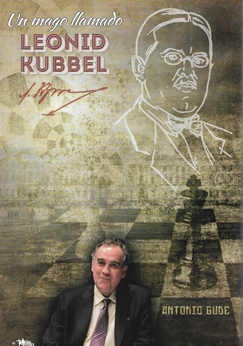
His fellow composer, who fell during the siege of Leningrad, was the great Leonid Kubel (Un mago llamado Leonid Kübel (Kúbel) and “Finales… y Temas”, N° 121 dedicado al compositor ruso Leonid Kúbel), author of almost three thousand problems, who died in his native city in 1942.
His brother, also a chess player Arvid Kubel, according to Soviet authorities died in similar circumstances; but, in reality, it seems that in this case he perished after being confined in the Soviet Gulag, either in 1938 or 1941.
The third great fallen chess composer, the prolific Aleksei Troitsky (El arcón de las joyas: Alekséi A. Troitski), with over eight hundred published works throughout his creative life, died of starvation, also during the ominous siege of Leningrad.

In the USSR, but in this case due to causes attributable to Nazism, as they besieged Leningrad for a prolonged period, cutting off supplies with devastating consequences, the great Ilya Rabinovich (Semblanza de Iliá Rabinóvich, destacado ajedrecista del periodo soviético temprano) died in a hospital in Perm, from exhaustion, suffering from dystrophy, bodily weakness associated with malnutrition generated in such a hostile context. This chess player was Soviet champion and, in the 1920s, one of the nation’s main chess figures.

For his part, Vsevolod Rauzer, a young Russian player, also died during the siege of that city, in 1941, while confined to a hospital that treated people with psychiatric problems.
He had been champion of Ukraine in 1933 and, that same year, was sixth in the Soviet national championship. Nevertheless, he will forever be recognized for the variation of the Sicilian Defense that bears his name.
He probably wasn’t a direct victim of the war, but, even so, the living conditions at the time of his death did not contribute to mitigating his ailments.

The same happened to Boris Koyalovich (a mathematician as well as a chess player) in 1941, and to Samuil Vainshtein (Weinstein), former editor of the magazine Shakmatny (Shakhmaty), who perished in 1942, always in Leningrad.
A figure who was a strong chess reality of the time, and who had the best to offer in a future that seemed more than promising, was the former Moscow champion (title achieved in 1932, 1933, and 1938) Sergei Belavenets (Serguéi Belavenets, un ajedrecista brillante a quien la guerra tronchó tempranamente su vida), third in the 1939 Soviet championship (only behind Botvinnik and Aleksandr Kotov who, incidentally, was appointed chief engineer, creating the first breech-loading mortar, for which he later received the Order of Lenin in a Kremlin ceremony for his work).
But his sports career, that of Sergei, and his life, were cut short when he fell fighting for his homeland in the Battle of Staraya Russa in 1942, as the Germans advanced on Soviet territory.

Two other USSR masters, who were part of the country’s Armed Forces, would not return from battle, and must therefore be counted as victims of Nazi fire. They are Mark Stolberg, who reached a USSR championship final, and would fall at just twenty years old, and Mikhail Makogonov.

Konstantin Vygodchikov, a central figure in Belarusian chess during the 1920s and 1930s, and a multiple national champion, died in Smolensk in 1941, due to illness and deprivation aggravated by the conditions of war during the months when that city, which was captured by the Nazis in July of that year, became one of the fiercest battlefronts on the road to Moscow with the consequent collapse of medical and food supplies.
A very special case is the death of the Chilean-German player Klaus Junge (Klaus Junge, el ajedrecista chileno-alemán, precoz en su genio y destino fatal and Entrevista a Persus Nibaes (quien hoy cumple años), autor de «El ajedrecista de Hitler») who, as a very young officer in his country’s army, was killed in action on April 17, 1945, in Welle, Germany.
Klaus, born in Concepcion, Chile, into a German family, joined the Nazi forces as a lieutenant when he moved to his definitive country. In combat, refusing to surrender while defending the city of Hamburg, it is stated that he was murdered by Allied troops, just three weeks before the end of World War II, probably being the last chess player to perish in it.
However, George Koltanowski put forth a different theory: that Junge was stabbed to death in a fight at a chess club. Although there is not much evidence for this assertion.
At the time of his death, Junge was one of the greatest promises in world chess. In 1941, he had won the Hamburg tournament and shared the lead in the German championship (though he lost the playoff to Paul Schmidt). The following year, he finished second to Alekhine in one competition, co-led another with him in Prague, and won in Dresden. In the context of this competitive growth, he even defeated the world champion in a game. Life seemed to be smiling on him, the horizon appeared limitless! And he was only twenty-one years old when his existence was cut short!

The tournaments in which Junge participated, and also those in which, among others, Alekhine and the former challenger for the crown, the Ukrainian-German Efim Bogoljubov, took part when they were held in Poland, known as the Schachmeisterschaft des Generalgouvernements, were sponsored by Hitler’s delegate in the country, from 1939 throughout the Nazi occupation, who was a great chess enthusiast.
We are referring to Hans Frank, a notorious war criminal (he would be executed after being found guilty at the Nuremberg trials) who, just as he organized such competitions of his favorite game (which he considered «the fighting sport of the Germans»), sent to their deaths so many chess players who perished in the concentration camps and ghettos under his political and military leadership.

The Allies also claimed the lives of chess players. This happened to the Dutch Arthur Wijnans and Arnold van den Hoek who, in January 1945, fatally suffered the consequences of a bombing (in the second case the information is certain, as it occurred over a German factory where he was confined to forced labor; in the other, it is presumed that the person suffered the same fate). Wijnans had won the Beverwijk tournament in 1941 (which would eventually gain great importance, played in Wijk aan Zee); van den Hoek challenged Euwe for the national title (failing in the attempt) in 1942.


The German Heinz Nowarra, who during the German occupation in Poland participated in several tournaments organized by the Nazis in this territory, within the so-called General Government, may, in the opinion of the Czechoslovak-German Ludek Pachman, have met a similar fate to that of his compatriot Junge, probably due to the effects of bombing.
But Hitler, and not only the Allies, caused the deaths of Germans, as was the situation of the Jewish Wilhelm Orbach, who died in Auschwitz in 1944. Sammi Fajarowicz, also Jewish and German, after a failed attempt to escape the country, died in 1940 of tuberculosis in a hospital in Leipzig.

Born in what is now Belarus, then the Russian Empire, and later French, Léon Monosson, Paris champion in 1934, when the country where he resided was occupied, was deported and taken to Auschwitz, where he ended his days in 1943.

It would be virtually impossible to list all cases of people who, being linked to chess, not only directly (as recognized practitioners of the game, which we tried to do previously), had a tragic fate in those years of horror.
The chess player is not an island in society; what happens around affects them, like his fellow human beings, whether they are family, friends, or simply citizens with whom they share the daily struggle for existence.
Chess players, of course, and beyond the framework of abstraction in which they operate, are always subject to the general rules of a pure and hard reality.
However, in this work, we wanted to be as exhaustive as possible, as a tribute to the most recognized chess players who fell into misfortune in such a tragic moment for humanity, as was the Second (and at times we doubt it will be the last) World War.
At the same time, the contrast has been drawn about the fact that those who could travel to the 1939 Buenos Aires Olympiad had the opportunity to survive and, in almost all cases, successfully redirect their respective lives.
Light and shadows of fate. On one side, peace; on the other, war. On one, terror; on the other, hope. An America that opened its arms; a Europe that went up in flames.
Almost clearly, we see in these epiphenomena the contrasting white and black colors of an ancient chess game, a dilemmas-filled game that, metaphorically, ends up becoming a perfect reflection of life’s contradictions.
As we said in a previous work (El agonal ajedrez siempre nos ofrece la posibilidad de redención), and with this we conclude a journey of painful implications, we are in the presence of:
«An agonal chess, of whites and blacks, able to model the contrast between darkness and light, day and night, good and evil, the profane and the sacred.
A dialectic that the game allows to represent by antonomasia with maximum fidelity.
Chess as a civilizing element, invites to reach states of joy and fullness, emotional and intellectual.
Chess that has been, and always will be, a source of solace and calm when facing the deepest sorrows and the worst living conditions.
Chess that has always offered us and will offer us the possibility of redemption…».