Chess in the 19th Century. Milestones of 1894
By Sergio Ernesto Negri

Global Context
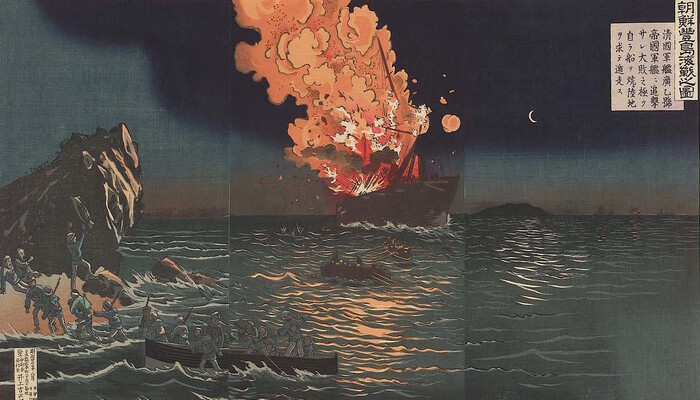
The Dreyfus Affair erupts in France, where, in a separate incident, an anarchist assassinates the president (and another anarchist in London attempts to destroy the Greenwich Observatory), following the unjust conviction of Alfred Dreyfus (1859-1935), a sign of anti-Semitism and judicial arbitrariness. The first war between China (Qing Dynasty) and Japan breaks out over control of Korea, with a swift Japanese victory that establishes Japan as a world power, marking the decline of the Chinese empire. Following the death of Alexander III (1845-1894), Nicholas II (1868-1918) ascended to the Russian throne: he will be the last Tsar, a development that was not anticipated at the time. Devastating earthquakes strike Greece and Japan; others affect Argentina and Turkey, the latter followed by a tsunami. Massacre of thousands of Armenians at the hands of the Ottomans.
Argon is discovered thanks to the work of the English scientists Lord Rayleigh (1842-1919) and William Ramsay (1852-1916), for which they would later be awarded the Nobel Prize. Swiss physician Alexandre Yersin (1863-1943) identified the bacillus responsible for the bubonic plague (Yersinia pestis) in Hong Kong, making it possible for the first time to combat the “Black Death” scientifically. Italian engineer Guglielmo Marconi (1874-1937), another future Nobel laureate, began his first experiments with radio waves in Italy in his father’s barn, successfully transmitting signals over short distances. American inventor Thomas Edison (1847-1931) unveiled the kinetoscope in New York, the first machine for viewing moving images individually. For the first time, Coca-Cola began to be sold in glass bottles (in Vicksburg, Mississippi), facilitating its mass consumption.
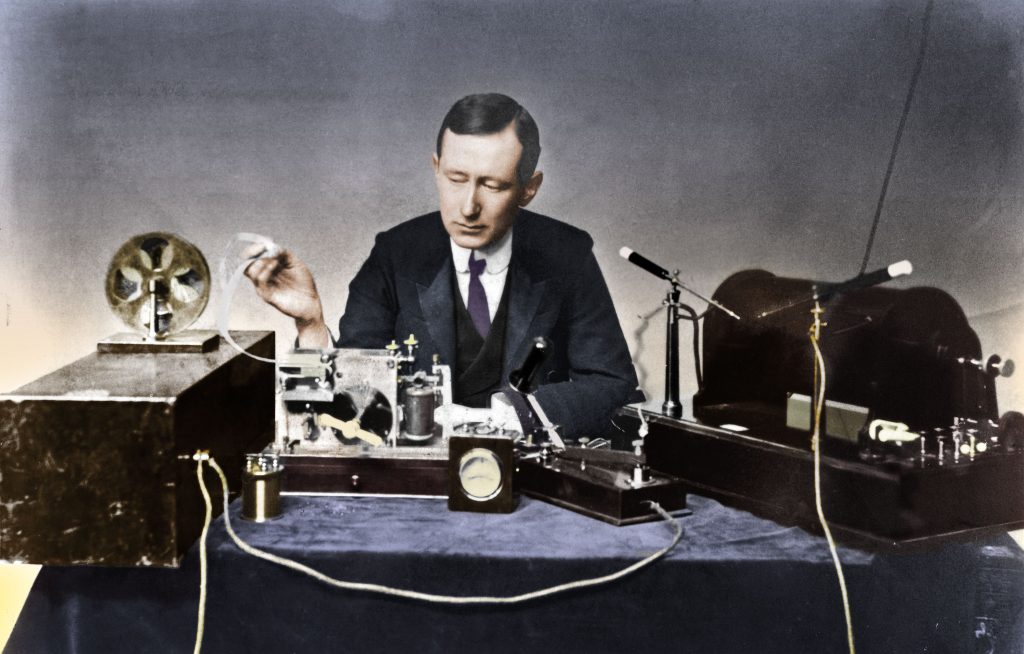
Marconi and his experiments with radio waves.
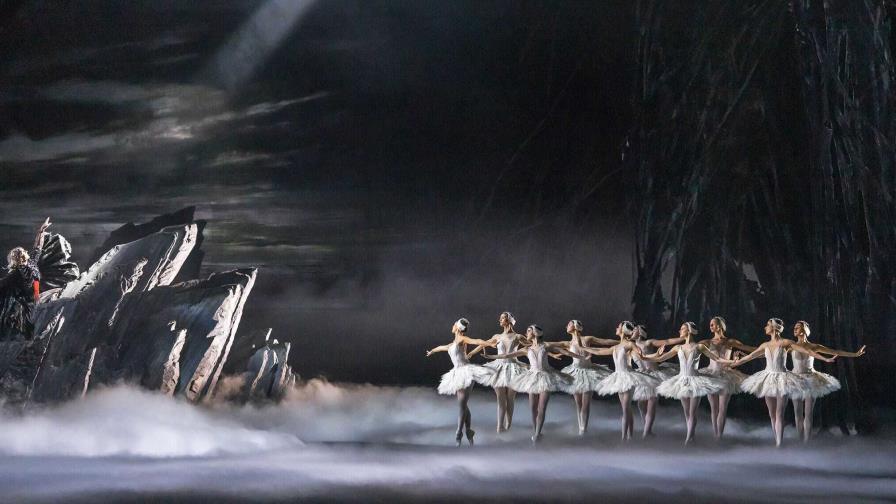
At the initiative of French Baron Pierre de Coubertin (1863-1937), the International Olympic Committee was founded in Paris, laying the groundwork for the first modern Olympic Games, which would be held in Athens in 1896. The first automobile race was held in France. The English writer (born in India) Rudyard Kipling (1865-1936) published The Jungle Book, a work that would shape the childhood and youthful imagination of future generations. In St. Petersburg, from the Russian composer Pyotr Tchaikovsky (1840-1893) was premiered Swan Lake, and in Paris, Claude Debussy (1862-1918) did the same with the symphonic poem Prélude à l’Après-midi d’un faune («Prelude to the Afternoon of a Faun«)
Chess in 1894
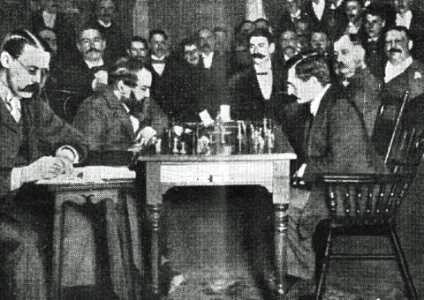
As of this year, we have a new world champion—the second in history. The Prussian Emanuel Lasker (1868–1941), in a generational showdown (he was twenty-five years old, while his opponent was fifty-eight), defeated the American (born in Prague) Wilhelm Steinitz (1836–1900) in the title match, with ten wins, five losses, and four draws (which did not count toward the outcome of the contest). It was held in three cities, two in the U.S. (New York and Philadelphia) and one in Canada (Montreal). Although the match had begun with some parity, the challenger strung together five consecutive victories, between games seven and eleven, tipping the balance in his favor, a lead that would ultimately solidify and shape the course of the contest. After losing the title, Steinitz won a tournament in New York at the end of the year, ahead of the Romanian Adolf Albin (1848–1920) and the American Jackson Showalter (1859–1935), scoring a solid 8.5 points out of ten.
The Prussian Siegbert Tarrasch (1862–1934), who had previously refused to face either Steinitz (for the title) or Lasker (in a friendly match), thereby missing the chance to reach the pinnacle of his chess career when he was at the peak of his form, emerged victorious at the 9th German Congress held in Leipzig, earning the nickname “Praeceptor Germaniae” (Teacher of Germany), with Paul Lipke (1870–1955) finishing a half-point behind him and another German, Richard Teichmann (1868–1925), coming in third.
For the month of December, the Chessmetrics rating system shows Tarrasch in the lead, ahead of Lasker, Russian Mikhail Chigorin (1850-1908), Steinitz, and German Curt von Bardeleben (1861-1924). According to EDO Historical Chess Ratings, the annual ranking places the following players in the lead: Lasker; Tarrasch; Chigorin; Steinitz; Hungarian Géza Maróczy (1870-1951).
Born: the Latvians Hermanis Matisons (1894–1932) and Fricis Apšenieks (1894–1941)—the former an amateur world champion and the latter a runner-up—at the first World Amateur Championship held in Paris in 1924, where Latvia won a silver medal as a team; Matisons would go on to achieve further successes, such as a bronze medal at the 1928 World Amateur Championship, and both would excel in tournaments in their home country and represent it at the Olympiads; the Russian Alexander Ilyin-Zheenevsky (1894–1941), who was wounded in World War I and lost his memory completely, forcing him to undergo a process of relearning that included chess; as a player, he was a three-time champion of Leningrad, but he is best known as the driving force behind the first national tournaments of the nascent USSR and the iconic 1933 match between the local star, Mikhail Botvinnik (1911–1995), and one of the prominent international figures, the Czech (later Soviet) Salomon Flohr (1908–1983); the Dutch IM (born in Austria and based in the United States) Hans Kmoch (1894–1973), who served as second to the Russian-French player Alexander Alekhine (1892–1946) in the 1935 world championship match against his compatriot Max Euwe (1901–1981); the Polish Teodor Regedziński, who adopted the surname Reger to conceal his Jewish origins and survive during the Nazi era, when he worked as an interpreter (1894–1954), a member of his country’s Olympic teams, ranked third overall at The Hague 1928, who was part of the team that won the team silver medal at the unofficial Games in Munich 1936 and in Buenos Aires 1939, and individual silver and bronze in 1937 in Stockholm and in 1939 in the Argentine capital, and Paulette Schwartzmann (1894–1953), born in a city in Ukraine (then part of the Russian Empire), who later became a French and Argentine citizen, winning multiple championships in the countries where she settled—seven times in France and four times in Argentina-.

In the U.S., the Women’s Chess Association of America was founded in New York with seventy-five members; its first president was Harriet Worrall (c. 1836–1928), and another prominent advocate was Eliza Campbell Foot (1851–1914). Women were beginning to reclaim their place in the world of chess.
In The Moth, a work published this year by the English writer H. G. Wells (1866–1946), an entomologist (Hapley) confronts a professor (Pawkins), who, cornered by the entomologist’s arguments, decides to die in order to deal a definitive blow to his rival, who is left without his nemesis. In that context, it is said: “So Hapley turned to chess, and found it a little more soothing. He soon mastered the moves and the chief gambits and commoner closing positions, and began to beat the Vicar. But then the cylindrical contours of the opposite king began to resemble Pawkins standing up and gasping ineffectually against checkmate, and Hapley decided to give up chess.”. His obsession with his former enemy had disturbingly shifted to an obsession with the game of chess.

The Greek poet Constantine Petrou Cavafy (Kavafis) (1863–1933) wrote the poem Το πιόνι («The Pawn«), in which he tells a story centered on that piece’s journey until it triumphantly reaches the eighth rank… only to die. But the poet grants us its resurrection by transforming that pawn into a queen, foreshadowing that she will save us, as he puts it:
“Because on that line the pawn will die, all his efforts were for this. He falls into the Hades of chess, and from his grave the queen who will save us rises»
(«Γιατί στη γραμμή εκείνη θα πεθάνει το πιόνι, όλοι του οι κόποι για τούτο ήσαν. Πίπτει στον Άδη του σκακιού, και από τον τάφο του ανασταίνεται η βασίλισσα που θα μας σώσει»).

Psychologie des Grands Calculateurs et Joueurs d’Échecs («The Psychology of Great Calculators and Chess Players«) by French psychologist Alfred Binet (1857–1911), creator of the first intelligence test (the Binet-Simon scale), is published. This is a pioneering study on extraordinary mental abilities, focusing on two groups: “prodigy calculators” (people who perform complex mathematical operations mentally) and chess masters, specifically those capable of playing blindfolded, for which he conducted surveys and interviews with Albin, Blackburne, Janowski, Lasker, and Tarrasch. Binet refuted the belief that chess players possessed a “photographic memory,” arguing instead that chess players perceive lines of force, geometric relationships, and functions. What matters in any case is the logic of the position.

Argentine writer Lucio Vicente López (1848–1894) passed away; in one of his writings, he captured the atmosphere of the Club del Progreso in Buenos Aires, a pioneering venue where chess was played in Argentina. And his colleague and compatriot Juan Filloy (1894–2000) was born; in addition to mentioning the game time and again in his prolific body of work, he founded a chess club, which he presided over—even though, as he himself said: “I founded a chess club and I don’t know how to play gambits…” This was the Vélez Sarsfield Club, part of the library of the same name, located in the Pueyrredón neighborhood of the city of Córdoba, which opened its doors around 1913.